| Teleconference link: | https://fnal.zoom.us/j/9082275310 |
| Domestic: | 1-646-558-8656 (US toll) |
| Domestic: | 1-408-638-0968 (US toll) |
| Access code: | 908-227-5310 |
Agenda
- Run 69 (GeHV n,gamma NR calibration) status
- Tower has cooled to around 40 mK
- Sten has returned DCRC55(1) (we've been doing OK without it though. Should ask him again in a couple weeks if he has time to look at it.)
- Data:
- HV tests: seems ok at least to +440V - at 440V there was an uptick in leakage current, so we are limiting it to 400V
- At constant HV gain falls over time as counter-bias builds up in detector
- Continuously increasing bias produces a constant gain. Using sequences to drift HV up from 300V to 400V.
- Counterbias growth rate depends on event rate (and average event energy). Event rate 99 Hz with no shield, 46 Hz with lead/poly shield (3 walls), 98 Hz with shield and PuBe source
- With PuBe can run 18-minute data series with HV drift 300V→400V. (Considering counter bias, leakage, and voltage drop across gap, detector bias is probably a little over 200V)
- 60 keV and 10 keV lines seen clearly.
- Noise width looks like ~60 eV using unbalanced PTOF and 60keV line as calibration. With balanced PsumOF and calibrating on the 10keV, noise sigma maybe as low as 26 eV. (This is still probably too high.)
- PuBe source has been returned
- Want to study calibration, threshold, noise further. Superconducting and normal noise data taken
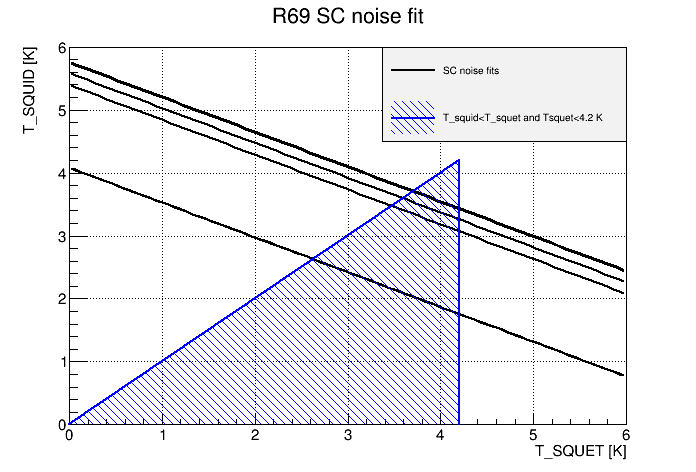
- SC noise fits hint at higher fridge temps: 07190318_1058_temp_fits.png
- Leakage issues:
- HV current leakage got worse - had been around 100 nA at HV = 400V, increased to over 200 nA
- Did some tests - in one case got much worse, to around 800 nA (HV board limit is 1 uA at 400 V)
- Nick disconnected unnecessary lines in the HV box - then leakage much better, now <10 nA
- but now phonon channel A (outer ring) is not working. Might have damaged the input coil.
- Trying to collect more stats, stable running but only with high QET biases in some channels to avoid oscillations.
- Helium recovery:
- Last run it was determined that we weren't recovering any Helium from the 4He pump because the oil mist filter was saturated
- With a new filter element, found that recovery was much worse (it must be leaking to atmosphere). Between-transfer recovery actually negative
- Removing oil mist filter makes recovery slightly better than before.
- Between transfers: boiloff 18.3 L/day, recovery with/without pump = 13.3/12.1 L/day (efficiency 73%/66%)
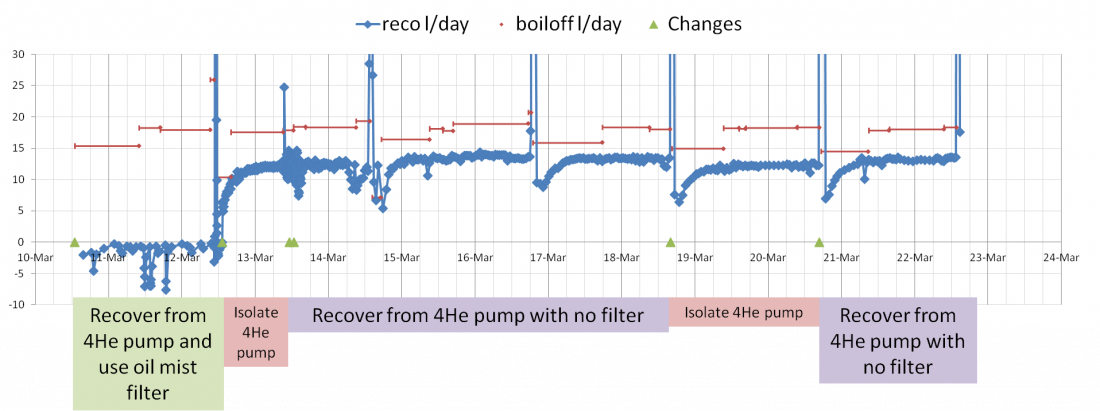
- Calculations suggest we are only collecting 17% of 4He pump exhaust. Should try some maintenance (there's an internal filter for example, maybe it's clogged)
- Run 68 (n,gamma with S101) analysis:
- Working on analysis task list
- Simulation. 1 day of livetime acquired.
- Data not yet looked at:
- Trigger study data: high priority
- Hold-time runs at different biases done, haven't looked at them yet
- Have reprocessed -80V Na data. Used -125V balancing factors, still need to check if those are optimal (if not we should redo it)
- Future 150mm runs
- 150mm w/phonons - need to design 600mK rod to accommodate 150mm cans
- Received 4/3-inch DIBs from TAMU - now we can house either detector for phonon readout (would need to machine faces on 4/3-inch housing for DIBs)
- S1501 and S1502 sent back to TAMU
- We have decided we can run 8 phonon channels
- Preferred DIB-pad layout: two DIBs separated by 120 degrees
- Himangshu's mask design: PDF download
- Will use existing vacuum-interface electrode, mounted on side opposite the phonon side
- Will connect directly to two DCRCs, with one diverter board to route one tower wire to HV connection
- We'll want LEDs - are there some mounted on the DIBs? We can mount external LEDs too - existing electrode has mounts.
- First 150mm phonon detector will be monolithic, but “donut+hole” arrangement (active veto) proposed as well.
- Aiming for May to finish fabrication and start run.
- Other future runs
- Future HVeV runs?
- Berkeley can help us with a Soudan-style housing mount (3“ or 4”?)
- then use original tower, can try different heatsinking for colder SQUID card
- would need to install optical fiber
- through top or through stripline tube? need vacuum feedthrough
- Look at Prisca's deuterium lamp/monochromator/filters, glass UV fiber
- Is PuBe NR calibration feasible?
- 1×1×0.4 cm^3 is 630× smaller than SNOLAB detector. Anthony estimates 25 events/day (over full spectrum) for Si, 250 events/day for Ge. any chance we could get multiple chips?
- Nick's idea: sandwich between two 4“ Ge detectors for gamma coincidence (large solid angle coverage)
- Other ideas:
- run SiHV with Nick's movable Am source (or with multiple Am sources)
- run SiHV with no 4K heatsinking
- re-run USD1? do we have any additional ideas to test it?
- anything else?