2019/03/12 (Tuesday)
| Setup | DIB1/3/4 → 3.2 MHz filters 2/3/1 → cable 3/1/2 → gender changer 3/?/2 → HVConn 1/3/2 → HV 1/2 → DCRCX(4)/DCRC50(3) manual kepco 1kV power supply → HV input |
|---|---|
| 0915 | Tower/MC/Coldplate = 57.2/36.2/217 mK, Still = 1.98±0.08 K / 0.170 mbar, G1/G2 = 192/179 mbar, 1K Pot = 1.79 K / 18 mbar. MB = 33.3% |
| Tower cooling at a rate of 2.3±0.1 mK/day | |
| Just after 16:55 yesterday, after filling the LN2 Cold Trap bath, Tower began rising from 55.7 mK to 58.7 mK by 17:30, then started falling steadily. Don't know why. | |
| 0930 | Fill LN2 cold trap bath |
| Nick says that the HV box wiring has DIB1 (readout side) charge channels connected, DIB4 (bias side) charge channels disconnected. | |
| 1015 | Turn on 15V power on DCRC4 (DIB1). Tower temperature increases for a few minutes to 64 mK. Turn off 15V power on DCRC4 (DIB1). Tower temperature falls again. |
| 1040 | Begin LHe transfer @ MB = 30.4% |
| during transfer Tower spikes up 1 mK, then falls to about 1 mK lower than before the transfer started. | |
| 1055 | Adjust DCRC4 Front-end Gains as high as possible before high-frequency noise rises above the white noise. pA/pB/pC = 4/2/3. (Not very high.) |
| 1100 | Turn on 15V power on DCRC3 (DIB4). No Tower temperature increase, as expected. Turn it off again. |
| 1115 | End LHe transfer @ MB = 92.1% |
| 1200 | Realized that between transfers, reco meter has been running backward |
| 1205 | Open the He recovery system ball valve, which prevents overpressure outside the lab from being pushed in, and look at it. Looks fine (though maybe the hard plastic washer was on upside-down? definitely on correctly now.) Put it back in the recovery line. |
| 1305 | He recovery meter is still running backwards. |
| 1315 | Try isolating 4He pump from recovery. Close valve on recovery system for 4He, and switch valve on 4He exhaust line from RECOVERY to EXHAUST. |
| 1350 | Today none of the channels had pulses. Started IbIs measurements. Looked like everything was stuck in normal state (though calculated Rnormal much higher than before, as if Rshunt was lower than presumed 6.67 mΩ). As I went through the channels I got to DCRC3pC, and found that it was railed - after unrailing it, it shifted, and started showing pulses. Now other channels show pulses too. Maybe DCRC3pC was in a strong oscillatory state (saw some of those yesterday) and was warming all the channels up. |
| 1350 | Tower temperature starts falling, apparently because DCRC3pC was heating things up before, now it's fixed. |
| 1425 | Adjust QET biases on all channels, dropping in steps by 10 uA until something goes bad (usually oscillations). Settling on lowest good-looking value. |
| 1433 | Start dialing up HV, targeting 200 V. Dial it up pretty quickly - see jagged breakdown noise. Dial back down below 100V, noise goes away. Dial back up more slowly to 190V, some noise returns but gets better with time. |
| 1443 | Vbias = 190.8 V, Vtest = 25 mV (so Velectrode = 180.8 V), Tower = 52.7 mK |
| 1443 | Start background series at HV = 190.8 V CDMS detector: Driver Gains = 1x, QET biases = (405/350/420)/(390/470/400) uA, Front-End Gains = (4/2/3)/(10/15/10) 1000 BOR randoms, trigger on DCRC3pB threshold = 7 |
| Looks like LazyLogger is off again. So we'll have to restart the DAQ again after we stop data, to get the files copied to /byseries. | |
| 1450 | Vtest = 21.0 mV, Tower = 52.4 mK |
| 1515 | Vtest = 19.6 mV, Tower = 52.5 mK |
| 1540 | He recovery is now running forward again! So isolating the 4He exhaust from recovery made the recovery start working again. (Hmm…) |
| 1545 | Start dialing HV back down to 0 V. Finish after about 5 minutes. Note - switched the big knob down one first, then waited a while as Vtest settled, then dialed the little knob down to zero. |
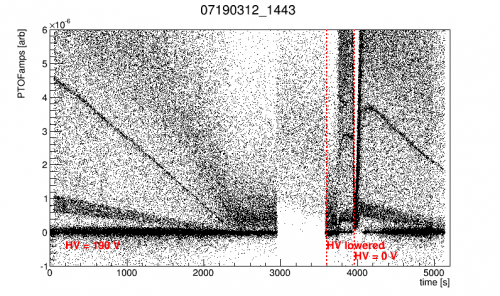
Quick analysis of this data. Have OF working now with PT built using even balancing. Can again see the 60 and 10keV lines decreasing linearly over time. Can also see the signal return after the HV is removed and the residual counter bias takes over.
 |
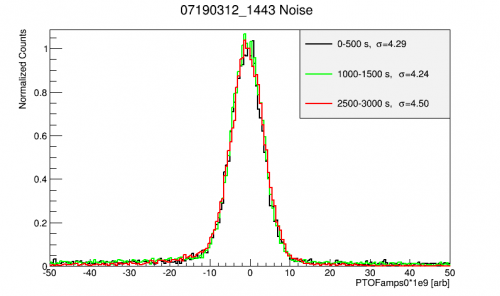
Here is the noise width for several periods of the biased data. As crystal bias goes to 0, this noise is relatively stable, actually increasing by ~5%. Since this is occurring as the NTL gain decreases, it indicates there is no significant HV noise present.
 |
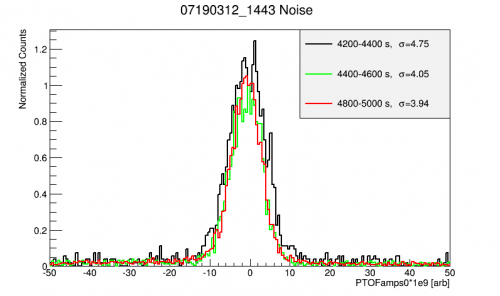
Here is the noise after the bias is removed. Here, the counter bias (opposite to applied bias direction) is present and provides NTL gain. Here there may be a decrease in noise by ~20% as the counter bias goes away. This may be evidence for HV-noise in the opposite polarity (negative bias).
 |
| 1605 | Fill LN2 cold trap bath |
|---|---|
| 1605 | MB = 88.4% |
| 1608 | Stop data |
| 1610 | Using DCRC Control tool, flash DCRC3&4 LEDs for 30 seconds. Tower spikes but only from 52.6→54.7 mK. Seems awfully low. |
| 1610 | Turn off DAQ programs, then turn off and restart MIDAS. LazyLogger starts copying data to /byseries. |