2019/03/20 (Wednesday)
| Setup | DIB1/3/4 → 3.2 MHz filters 2/3/1 → cable 3/1/2 → gender changer 3/?/2 → HVConn 1/3/2 → HV 1/2 → DCRCX(4)/DCRC50(3) DCRC33(2) → 1kV power supply → HV input Lead poly shield is erected, N/E/W walls complete, no poly or lead on S wall. |
|---|---|
| 0930 | Tower/MC/Coldplate = 47.4/33.6/196 mK, Still = 1.90±0.10 K / 0.170 mbar, G1/G2 = 249/236 mbar, 1K Pot = 1.79 K / 16 mbar. MB = 38.2% |
| Tower temperature falling at 0.3 mK/day. It appears to be elevated from yesterday's base, probably can be reduced by adjusting the QET biases again. | |
| 0935 | Fill LN2 cold trap bath |
| 0945 | Set all QET biases to 0 uA. |
| 1005 | Restore all QET biases to yesterday's settings, all look OK. Tower temperature is falling a bit. |
| 1015 | Estimate event rate from looking at 30 52.488 ms traces in DCRC3pB, count a total of 71 pulses, so rate is 45±5 Hz. Consistent with yesterday's measurement. Combining the two, rate is 46±4 Hz |
| 1015 | Tower = 44.9 mK, temperature has fallen significantly, and continues to fall. |
| 1050 | Move PuBe source in its paraffin barrel from PAN 443 storage into the lab, behind the middle of the lead stack, up against the stack. |
| 1050 | Tower has settled at 43.1 mK, significantly lower than it has been recently. |
| 1055 | Estimate event rate with PuBe present from looking at 30 52.488 ms traces in DCRC3pB, count a total of 154 pulses, so rate is 98±8 Hz. |
| Looks like about the same rate as before the shield was up, so let's just try a series with HV increase rate of 4 V/min as before. Create a sequence to do 300 to 400 V bias with 4V/min drift with following command: |
python HVscan.py -iDCRC 2 -HVs 300 -HVcalFile HV_calibrations/HV_DCRC2_control_cals_440V_190315.txt -HVdriftRate 0.067 -HVpreBias 15/2 -tSeries 25 -DCRCs2Flash 3,4 > ../../sequencer/HVdrift_300V_4VPM_prebias_15_2_dur_25min.msl
| 1122 | Start PuBe series at HV = 300→400V @ 4 V/min (25 min duration) with 2 minute 15% prebias CDMS detector: Driver Gains = 1x, DCRC4/3 QET biases = (410/370/450)/(400/370/420) uA, Front-End Gains = (4/2/3)/(10/15/10) 1000 BOR randoms, trigger on DCRC3pB/C threshold = 7/15 use sequence HVdrift_300V_4VPM_prebias_15_2_dur_25min.msl |
|---|---|
| 1134 | Initial HV rampup finished. HV = 343.9 V, Vtest = 74 mV and falling. Start the 2 minute prebias wait. |
| 1136 | HV = 343.9 V, Vtest = 53 mV. Sequence begins stepping voltage down to initial value. |
| HV [V] | Vtest [mV] | notes | |
|---|---|---|---|
| 11:37 | 299.7 | 22 | Start data. HV upward drift is working. |
| 11:39 | 306.4 | 46 | Channels all look good. |
| 11:42 | 317.1 | 46 | |
| 11:44 | 324.5 | 51 | |
| 11:47 | 335.1 | 53 | |
| 11:50 | 347.1 | 56 | |
| 11:53 | 358.5 | 58 | DCRC3pB baseline is near or below minimum. Adjust driver offset. |
| 11:56 | 368.7 | 60 | Tower flat at 43.0 mK |
| 12:00 | 378.1 | 63 | DCRC4pC has a lot of ringing. Other channels all look pretty good. |
| 12:05 | 399.4 | 68 | Data stops, HV ramping down. |
| Note that the actual HV rate 0.059 V/s, about 12% lower than the target 0.067 V/s |
| 1210 | At 11:55 Tower temperature began rising slowly, looks like maybe a channel is in a bad state again. |
|---|---|
| 1220 | HV = 0.199 V, Vtest = -24 mV. So Velectrode = 9.8 V. Looks like sequence has finished stepping down, may need to adjust DCRC2 QI bias to set HV closer to 0. |
| 1225 | Changed Qinner bias to 11.565, HV = .041. Vtest = -2.4 mv, so Velectrode = 1 V and seems pretty constant |
| 1230 | Just noticed flash has happened, temperature spiked to Tower = 46 mK, and is returning to Tower = 44 mK (same as it was pre-flash) |
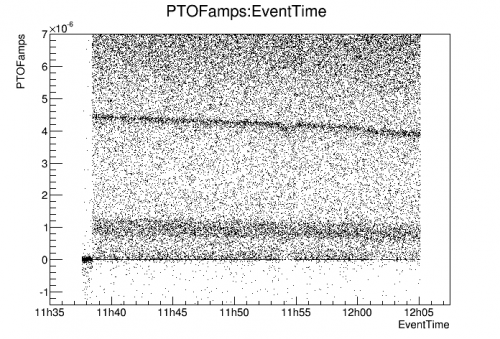
As can be seen we probably need to increase the HV drift rate somewhat to get a flatter calibration.
Tried to calculate how much higher we need to set the drift rate. Rough calculation suggests setting it to 5.6 V/min.
Noise width seems to be about 62 eV (from PTOFamps0. PTOFamps gives smaller width, around 46 eV.)
| 1335 | Tower temperature is increasing again, so let's bring QET biases back to 0, then back up to say 800 uA. |
|---|---|
| 1345 | Messing around with QET biases, temperature started to fall but then started increasing more sharply. Peaked at 46.2 mK. Bring all to 0 uA again and see if it will settle. |
| 1430 | Get all channels back in transition. Tower temperature is settling back down. 44.3 mK and falling. |
| 1433 | Start PuBe series at HV = 300→400V @ 5.6 V/min (18 min duration) with 2 minute 15% prebias CDMS detector: Driver Gains = 1x, DCRC4/3 QET biases = (410/370/450)/(400/370/420) uA, Front-End Gains = (4/2/3)/(10/15/10) 1000 BOR randoms, trigger on DCRC3pB/C threshold = 7/15 use sequence HVdrift_300V_5p6VPM_prebias_15_2_dur_18min.msl Unfortunately DCRC3pB was railed for the entire series. |
| 1540 | Series has ended, HV = -0.045 V, Vtest = -.64 mv. So Velectrode = 0.2 V. Tower = 42.5 mK and stabilizing. |
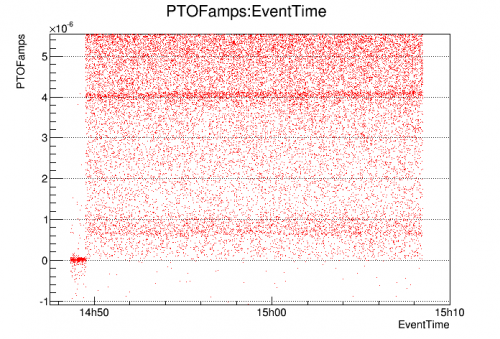
This time the calibration looks nice and flat. Estimated noise width = 63 eV. Attempted a balanced PSUM, noise width appears to be around 50 eV.
| 1645 | Begin LHe transfer @ MB = 27.7% |
|---|---|
| 1645 | Switch back to recovering from 4He pump exhaust (no oil mist filter) |
| LHe Recovery analysis: for the two boiloff periods before this one, with the 4He pump connected to recovery, recovery rate (averaging over 12 hours after transfer to just before the next transfer) averaged 13.3 L/day. With the pump isolated from recovery, it averaged 12.1 L/day. So there is a significant increase when we recover from the pump. But bath boiloff generally averages around 18.3 L/day in the same period, so recovery efficiency is pretty poor in either case: 73% with the pump, 66% without. |
|
| 1722 | End LHe transfer @ MB = 91.0% |
| HPGe tests | |
|---|---|
| 1800 | Fill HPGe Dewar with LN2 |