2019/03/29 (Friday)
| Setup | DIB1/3/4 → 3.2 MHz filters 2/3/1 → cable 3/1/2 → gender changer 3/?/2 → HVConn 1/3/2 → HV 1/2 → DCRCX(4)/DCRC50(3) DCRC33(2) → 1kV power supply → HV input Lead poly shield is erected, N/E/W walls complete, no poly or lead on S wall. |
|---|---|
| 0930 | Tower/MC/Coldplate = 39.8/29.6/187 mK, Still = 1.70±0.15 K / 0.150 mbar, G1/G2 = 282/254 mbar, 1K Pot = 1.78 K / 13 mbar. MB = 70.5% |
| 0940 | Fill LN2 cold trap bath |
| 1045 | DCRC3 pB is still not working. Stop DCRC programs and power cycle DCRC3. |
| 1050 | DCRC3 pB still unresponsive, Zap DCRC3 SQUIDs. It took ~5 times for the Zap sequence to start without getting the “problem in toolstimeout” error. |
| 1100 | DCRC3 pB is still not working. A change of QET bias by 1000 uA results in a baseline shift of only 2 mV with Gd=1. This is linear from 0 to 1000 uA. Compare to a healthy channel, DCRC3pC - from 800 to 1000 uA, baseline drops by 357 mV (1785 mV per mA). Also unusual about pB: the baseline rises with QET bias. This should only happen in transition, not at normal or s/c. |
| 1111 | Take a look at DCRC3 pB's SQUID. With test signal connected to DCRC3 pB's feedback line we can watch the SQUID response at the preamp. The modulation and lockpoint look good. SQUID responds to changes in SQUID bias and lockpoint as expected. So it seems like the problem is with the Rshunt/TES/input-coil branch. Could be that somehow the TES part is now open. Maybe for example the input coil was blown open. |
| 1140 | It's also possible that the DCRC is doing something dumb. Let's swap out DCRC3 for DCRC1. Stop programs, power down DCRC3 and put DCRC1 in it's place on the HV board. Copy DCRC3 phonon settings over to DCRC1 in the ODB. |
| 1152 | Can see pulses on DCRC3 pC,pD. DCRC3 pB shows the same behaviour as above with this DCRC. So it must be something wrong with the TES branch of the circuit. |
| 1155 | Stop programs, put DCRC3 back in place, zap DCRC3 SQUIDs. |
| 1210 | Tower has been slowly warming since 1145, now at 42.4 mK |
| 1256 | Tower is flattening out at 45 mK. The 5 working channels look okay and show pulses and DCRC3 pB has QET bias = 0. Maybe one of them is somehow in a bad state still though. Set all QET biases to 0. |
| 1350 | Tower rose to 48 mK and flattened again. Channels aren't responding normally. Let's power-cycle the DCRCs. |
| 1350 | Stop DAQ programs and unplug DCRC4. Not much change in Tower temperature. |
| 1355 | Unplug DCRC3. Still no immediate change in temperature. |
| 1400 | Seems to have started cooling. |
| 1405 | MB = 64.1% |
| 1415 | Tower = 41.8 mK and falling. |
| 1415 | Plug in DCRCs and start DAQ programs. Zap SQUIDs. |
| 1420 | Tower peaked at 44.8 mK, now 43 mK and falling |
| 1425 | All channels are at 500 uA, all except DCRC3pB show pulses. |
| 1430 | Get all 5 channels in OK shape. Lowered some DCRC3 front-end gains. |
| 1441 | Start a background series at HV = 300→400V @ 3.9 V/min (26 min duration) with 1 minute 15% prebias CDMS detector: Driver Gains = 1x, DCRC4/3 QET biases = (430/410/450)/(500/400/420) uA, Front-End Gains = (2/2/3)/(5/5/5) 1000 BOR randoms, trigger on DCRC4pA/B/C threshold = 7/6/6 use sequence looptest_HVdrift_fast_300V_3p9VPM_prebias_15_1_dur_26min.msl |
| 1445 | Vtest = 23 mV during prebias |
| 1450 | Data has started, all 5 channels working. DCRC3pC however has terrible pulse shapes. |
| 1450 | Tower = 40.6 mK and falling. |
| 1452 | HV = 310.2 V, Vtest = 6 mV |
| 1515 | HV = 394.5 V, Vtest = 10 mV |
| 1515 | Check pulses. Seeing a lot of jagged noise, some have strong oscillations. Temperature nice and low, 40.0 mK. |
| 1521 | MIDAS crash during HV downramp. |
15:21:42.142 2019/03/29 [dcrc_driver01,ERROR] [midas.c:11495:recv_tcp_server,ERROR] rpc connection from 'mhttpd' on 'cdms2.spa.umn.edu' unexpectedly closed

15:21:42.140 2019/03/29 [triggerfe2,ERROR] [midas.c:11495:recv_tcp_server,ERROR] rpc connection from 'mhttpd' on 'cdms2.spa.umn.edu' unexpectedly closed

15:21:42.139 2019/03/29 [towerfe3_01,ERROR] [midas.c:11495:recv_tcp_server,ERROR] rpc connection from 'mhttpd' on 'cdms2.spa.umn.edu' unexpectedly closed

15:21:42.135 2019/03/29 [Logger,ERROR] [midas.c:11495:recv_tcp_server,ERROR] rpc connection from 'mhttpd' on 'cdms2.spa.umn.edu' unexpectedly closed
| 1525 | As before only mhttpd is not running. As before do ./start command without killing anything. Sequence starts where it left off. |
|---|---|
| 1545 | Now that HV = 0V and the flash is over, check channels. They don't look nearly as bad as they did at bias. |
| 1555 | Start dialing HV from 0 to 350V (using a sequence created for this purpose). |
| 1610 | Have been watching and adjusting channels during rampup. Saw some jagged breakdown noise. At one point saw strong oscillations in multiple channels - it seemed that DCRC3pC was responsible, and was causing oscillations in DCRC4pA and pB too. Raising DCRC3pC's QET bias fixed all of them. |
| 1620 | Adjust all channels so they look good at HV = 350 V. Major change to QET bias on DCRC4pC, raised to 500 uA. |
| 1620 | Start a sequence to dial HV down from 350V to 0V. |
| 1624 | MIDAS mhttpd crashed again. Restart it. |
| 1640 | At 0V all channels still look pretty good. |
| 1647 | Start a background series at HV = 300→400V @ 3.9 V/min (26 min duration) with 1 minute 15% prebias CDMS detector: Driver Gains = 1x, DCRC4/3 QET biases = (430/410/500)/(500/460/420) uA, Front-End Gains = (2/2/3)/(5/5/5) 1000 BOR randoms, trigger on DCRC4pA/B/C threshold = 7/6/6 use sequence looptest_HVdrift_fast_300V_3p9VPM_prebias_15_1_dur_26min.msl |
| 1652 | Fill LN2 cold trap full. |
| 1655 | All channels look OK, although DCRC3pC seems like it's in a pretty low gain point in its transition. |
| 1710 | Tower = 39.7 mK |
| 1715 | MB = 59.6% |
| 1730 | Flash happened, according to temperature record |
| 1815 | Looks like MIDAS crashed again |
| 1820 | Run ./start script, get mhttpd up again. Apparently the sequence was already finished before the crash. |
| 1825 | Start a background series at HV = 300→400V @ 3.9 V/min (26 min duration) with 1 minute 15% prebias CDMS detector: Driver Gains = 1x, DCRC4/3 QET biases = (430/410/500)/(500/460/420) uA, Front-End Gains = (2/2/3)/(5/5/5) 1000 BOR randoms, trigger on DCRC4pA/B/C threshold = 7/6/6 use sequence looptest_HVdrift_fast_300V_3p9VPM_prebias_15_1_dur_26min.msl |
| 1850 | data failed to start apparently because triggerfe2 crashed. |
| 1855 | Start sequence to dial HV down from 300V to 0V |
| 0910 | Flash DCRCs 3,4 for 30 seconds |
| 0915 | Set mhttpd to auto restart with ODB (after clicking link on Programs tab). Who knows whether this will work, or whether it will screw other things up. |
| 1933 | Start a background series at HV = 300→400V @ 3.9 V/min (26 min duration) with 1 minute 15% prebias CDMS detector: Driver Gains = 1x, DCRC4/3 QET biases = (430/410/500)/(500/460/420) uA, Front-End Gains = (2/2/3)/(5/5/5) 1000 BOR randoms, trigger on DCRC4pA/B/C threshold = 7/6/6 use sequence looptest_HVdrift_fast_300V_3p9VPM_prebias_15_1_dur_26min.msl |
| 2055 | Start a background series at HV = 300→400V @ 3.9 V/min (26 min duration) with 1 minute 15% prebias CDMS detector: Driver Gains = 1x, DCRC4/3 QET biases = (430/410/500)/(500/460/420) uA, Front-End Gains = (2/2/3)/(5/5/5) 1000 BOR randoms, trigger on DCRC4pA/B/C threshold = 7/6/6 use sequence looptest_HVdrift_fast_300V_3p9VPM_prebias_15_1_dur_26min.msl |
| Note: with this sequence, data (randoms) starts almost exactly 8 minutes after bias is first applied. | |
| 2140 | MIDAS mhttpd crashed again. Looks like it happened after the data series ended, during HV rampdown, before flash. Run ./start command, sequence starts up again. |
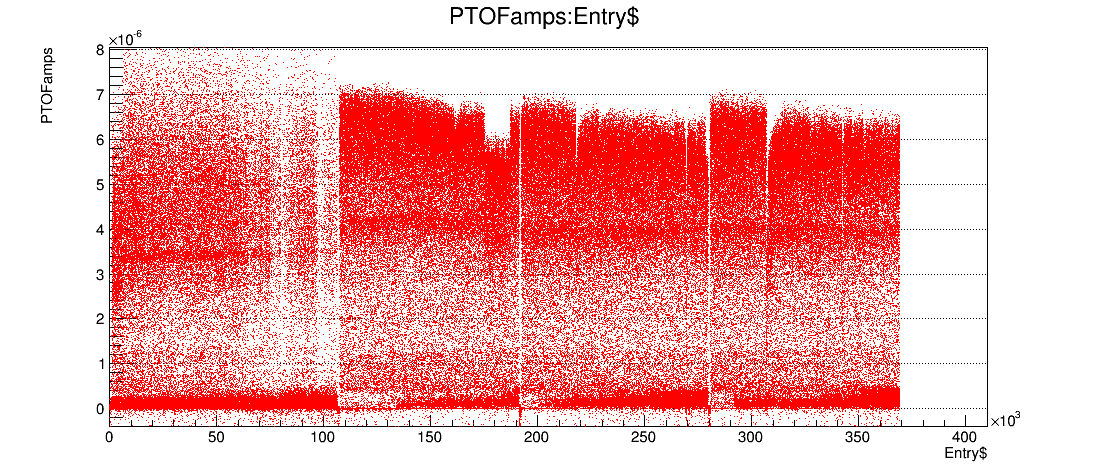
Some plots from today's data:
 |
|---|
| Note the first series is significantly different because of the shifted QET biases |
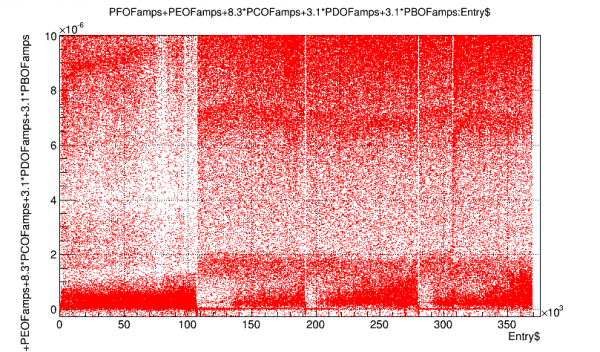 |
|---|
| The channels are severely imbalanced: above is an attempt to balance them Don't know why a band appears at low energy after a few minutes |
 |
|---|
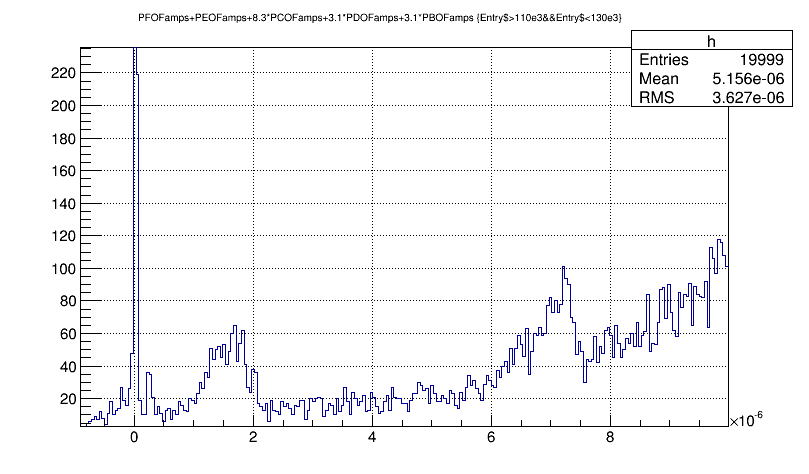
| For a short period of time before the low-energy band appears we can see a relatively clean balanced-psum spectrum including the 1 keV line |