The Simulations for Run 68
There are several goals for the simulations summarized in this table:
| Simulations | |||
|---|---|---|---|
| Purpose | Notes | Sim-run path | Status |
| direct gamma and neutron | livetime problems | (text) /data/chocula/villaa/k100Sim_Data/captureCal/Run68_gdirect_bknd_R68_PuBe_0x0004_* or (hdf5) /data/chocula/villaa/k100Sim_Data/captureCalhdf5/Run68_gdirect_bknd_R68_PuBe_0x0004* | investigating re-throw |
| captures | can use same sim as “direct” | not started | |
| coherent gammas | not started | ||
Livetime and Re-throw
The livetime for the standard “direct gamma and neutron” simulation is not favorable. To do the simulation on 100 available cores, we get only 0.27 hours of livetime per day of processing time. This means it would take 393 days to simulate our -125V dataset (with the same livetime). This produces about 2.6 Gb of simulated data per day of processing time or about 1Tb for our whole dataset, that part's not as bad.
We have to find a way around the livetime problem, I can see two possible solutions. a) get more cores, and b) try to increase the efficiency of the simulation.
Get More Computing
Do we have more cores available on the UMN cluster? Did we ever get some cores from CMS? If we got 1000 cores instead of 100 then we could do 2.7 hours of livetime per day of compute time. This is still not great, it would still take 39 days to simulate our entire -125V dataset (with the same livetime).
Increase Simulation Efficiency
The most obvious way to increase efficiency is throwing away some volume that is tracked and doesn't need to be, or to decrease the total number of particles per primary. I've tried these things and doing things like removing the barrel from the sim or removing the gamma's associated with the primary source and they didn't change the computation time much.
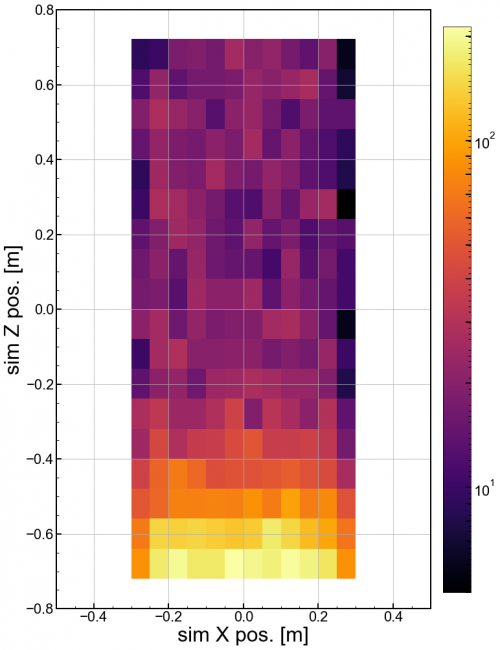
One possibility is re-throwing the primaries from a surface with less flux (more time per primary). I've tried this from the west poly wall that's just outside of the cryostat. See the figure below of the number of particles going toward the cryostat exiting out of the poly. The problem with this simulation was that of the events that created energy in the HV detector, not many of the particles seemed to emerge from the poly really (2 out of 10 was a very rough estimate). So that means we probably shouldn't re-throw from the poly surface.
 |
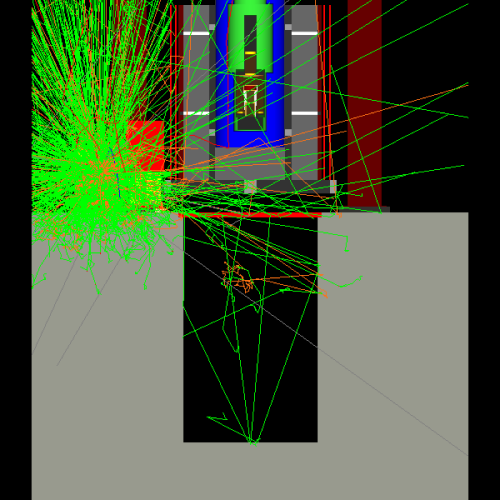
To try to move forward I'm looking at what other surfaces exist for re-throwing:
 |