2016/10/12 (Wednesday)
| Status: Tower installed, SQUETs attached, striplines plugged in and repaired, all DIBs pass electrical checks. (At least I assume this is the status, there were no updates to the run diary after a certain point.) All mixture in dump. MB vacuum jacket has been pumped out. | |
| 0810 | Remove Cf source from the IVC and return source to safe |
| 0845 | Put bottom IVC piece on loosely, then quick electrical check of all three DIBs - all look OK |
| 0915 | Finish first go-round of tightening bottom IVC and begin pumping IVC with scroll pump |
| 0955 | Open pumping valve completely (until now was pumping gently with valve partially closed). Scroll pump = 0.25 mbar, IVC (with pumping valve closed) = 0.86 mbar |
|---|---|
| 1030 | Scroll pump = 86 μbar, IVC = 250 μbar |
| 1110 | Turn on He-3 pump and open V9 to see what is in the dump. |
| 1125 | 778 mbar mixture in the dump. Isolate dump (close V9) and turn off He-3 pump. Opened both cold traps to P2, which started at <1 mbar. |
| 1135 | P2 reads 55mbar. Turn on He4 pump and begin pumping out both cold traps. |
| 1135 | Scroll pump = 40 μbar, IVC = 100 μbar |
| 1140 | Begin pumping IVC with turbo pump. |
| 1200 | Turbo pump = 0.46 μbar, IVC = 63 μbar |
| 1205 | Stop pumping on cold traps. |
| 1300 | Turbo pump = 0.46 μbar, IVC = 34 μbar |
| 1345 | In order to deal with the Taconis oscillations in the bath, we are attempting one of the remedies mentioned in this note on Thermoacoustic Oscillations. As described in the note, oscillations can occur in tubes that are closed at the top (on the room temperature end) and open at the bottom above the bath at a little above 4 K. There are four such tubes in our fridge: the level meter port, the 4He cold trap port, the fill port, and the unused port next to the fill port. As suggested in the note we are drilling small holes near the top of these tubes in the hopes of killing the resonance. With help and advice from Bill Voje we got rods that just fit inside the tubes (about 0.19“ for the level meter port and 0.38” for the other three). These are meant to prevent the tubes from buckling while being drilled. The rods were sized to be a little larger than the transfer tube and the 4He trap. Bill made split ring for us to fit on the outside of the tubes with guide holes to drill through. We drilled 3/32“ holes in each of the four tubes. |
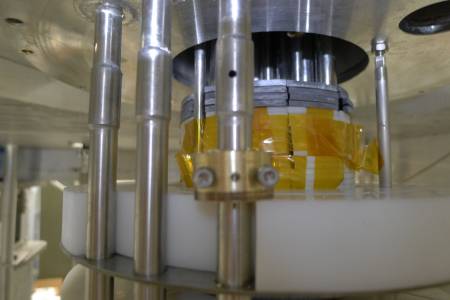 | 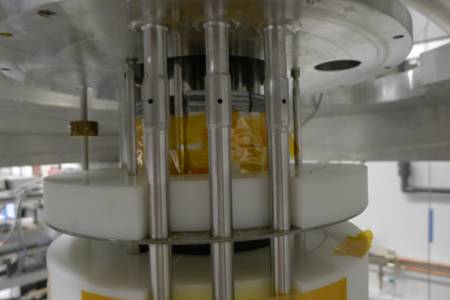 |
| First hole drilled in the spare port. Also visible is the split ring drill guide | Holes drilled in the three large ports. To the left the smaller port for the level meter is visible. We drilled a hole in it too. |
|---|
| 1420 | Turbo pump = 0.25 μbar, IVC = 22 μbar |
|---|---|
| 1425 | Begin pumping on IVC with leak detector. Leak falls to 40 pbarL/s, continues to drop. |
| 1435 | Leak detector flat at 8.5 pbarL/s. This is much better than Run 60, a little better than Run 59, both of which were after overnight turbo pumping, so this is pretty good. |
| 1450 | Squirt He gas around IVC joints, no leaks detected. At the end the leak signal slowly rose to 12 pbarL/s but it didn't appear to have anything to do with the squirting. |
| 1500 | Switch back to pumping IVC with turbo pump. Attach fill port to IVC and vacuum out bath Dewar. Clean o-ring groove on Dewar, it was pretty dusty. |
| 1530 | Main bath Dewar is raised and attached |
| 1550 | The standard breakout box checkout with only phonons is not sensitive to whether channel bonds to the detector are intact, because the QET bias-to-return check is shorted by the shunt resistor. So cross-channel checks are necessary to check continuity through the crystal. The DIB map is as follows: |
| DIB | Stripline | Cable | Channels connected |
|---|---|---|---|
| 1 | 19 | 1 | pA, pB, pC, pD |
| 3 | 27 | 2 | pB, pC |
| 4 | 20 | 3 | pB, pC, pD |
Checking cross-channel QET biases shows continuity between the connected channels (around 300 Ω) and open circuits to the unconnected channels, as expected.
| 1615 | Turbo pump = 0.19 μbar, IVC = 46 μbar. this is higher than last time, but until now we were only waiting about 2 minutes after closing the pump valve, this time we waited longer. |
|---|---|
| 1621 | Commence LN2 transfer. Add 4.6 mbar He exchange gas to IVC. |
| 1730 | Cernox = 170 K, IVC = 1.9 mbar. Sorb still at max, >249 K |
| 1800 | Cease LN2 transfer. Install ping pong ball. |
| 1805 | Place Cf source onto dewar at detector height. |