| Teleconference link: | https://umn.zoom.us/j/8797896096 or https://umn.zoom.us/my/fritts |
| Access code: | 879-789-6096 |
Agenda
- Starting Run 72
- Payload:
- Housing in Position 1 with Source mover, LEDs, thermometer and maybe a test screw-terminal for NbTi
- G101D with Side 2 etched, Position 2. Source pointed at readout side.
- External electrode in Position 3
- Based on CUTE experience, trying copper wires from detector to tower for one phonon channel, instead of side coax
- Electrode-detector gap is about 0.5 mm. Three clamps were removed from the detector so that there are no adjacent clamps, so that housings completely mesh.
- PuBe storage shielding
- Howitzer is good neutron shielding but not as good as red box for gamma shielding. Is it insufficient? Initial look at NaI spectra suggests it's comparable to leaving one of our strong sources out of the safe. Need to complete this analysis.
- Budget overage: we have something like $20,000 we could spend on lab stuff before April 1
- Buy equipment/supplies:
- Replacement forepump for leak detector
- Send out spare circulation pump for leakcheck/repair
- Two lab computers replaced
- NbTi cables for tower-free detector&cold electronics mounting
- could get 2@25-wire for 4K-CP, 2@25-wire for CP-MC. And maybe 2@25-wire, longer, to try 4K-MC (colder SQUETs)
- SQUIDs for new cold electronics
- Copper-clad NbTi bell wire for a new source mover motor - quote at $930 for one motor
- Analysis status:
- Run 71
- paper on Arxiv and submitted to NIMA
- possible followup studies. 100mm iZIP position reconstruction
- Run 68 (n,gamma with S101)
- Migdal analysis pending
- New (n,γ) simulations, modified signal shape
- NaI studies
- tried to see Si n-capture gammas with a bag of sand - nothing seen
- assessing the howitzer for PuBe storage - definitely doesn't shield gamma as well as paraffin drum and lead box
- Run 70
- analysis team includes Pramod, Matt, Zach - should coordinate, have meetings
- Need to look at the recent PuBe data, work on a low-threshold energy quantity, see if we can see a hint of (n,γ) signal. Also develop cuts and look for low-energy junk
- Will study the activation peak background
- Run 67 (USD detector with novel time-dependent gain)
- Dongming has characterized lots of microscopic processes, wants us to write a paper
- Matt working on rough model of detector behavior
- SiHV event reconstruction
- Derek working on this
- Hongguang developing connection to DMC
- Future runs?
- Re-run USD1?
- use Co source
- experiment with varying the amount of shield, distance of Ba source, see how background rate affects time variations in gain
- maybe use source mover
- Position reconstruction with source mover
- improve motor heatsinking?
- run with GeHV prototype - would probably want to rebond it for standard direct contact biasing
- some day get a SiHV prototype again, run with that
- Improved neutron calibration runs
- under discussion with Anthony - working on grant proposal for new measurements with more NaI and whatever other improvements
- more NaI coincidence detectors
- can we improve Ge?
- try again with standard bias, maybe no-tower setup?? Would this improve it?
- try polishing bias side for “true” vacuum interface?
- or - use a HVeV detector? can we get a high enough signal rate?
- or should we re-do SiHV? with one of the new “pathfinder” detectors, whichever they give to us
- Future 150mm runs
- 150mm w/phonons - we considered designing new 600mK rod to accommodate 150mm cans. Could rethink this in terms of no-tower setup maybe…
- We have 4/3-inch DIBs from TAMU - now we can house either detector for phonon readout (would need to machine faces on 4/3-inch housing for DIBs)
- S1501 and S1502 sent back to TAMU
- We have decided we can run 8 phonon channels
- Preferred DIB-pad layout: two DIBs separated by 120 degrees
- Himangshu's mask design: PDF download
- Will use existing vacuum-interface electrode, mounted on side opposite the phonon side
- Will connect directly to two DCRCs, with one diverter board to route one tower wire to HV connection
- We'll want LEDs - are there some mounted on the DIBs? We can mount external LEDs too - existing electrode has mounts.
- First 150mm phonon detector will be monolithic, but “donut+hole” arrangement (active veto) proposed as well.
- Last discussion of this was a year ago, we were aiming for May 2019 to fab a detector
- Future HVeV runs?
- Berkeley can help us with a Soudan-style housing mount (3“ or 4”?)
- then use original tower, can try different heatsinking for colder SQUID card
- would need to install optical fiber
- through top or through stripline tube?
- Should we design and build new cold hardware?
- Soudan towers didn’t perform thermally as well as they should have (graphite tubes too conductive)
- Soudan towers had requirements we can relax
- FET heat not a consideration for phonon-only devices
- Materials don’t need to be as radiopure
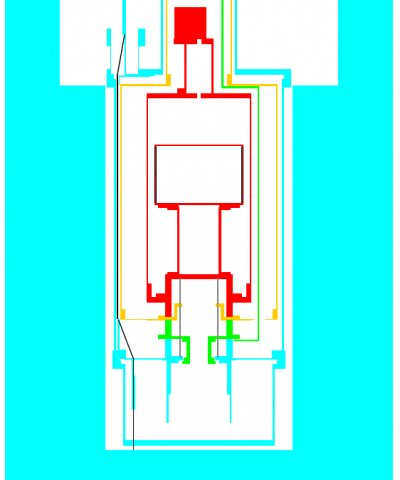
- Soudan tower concept
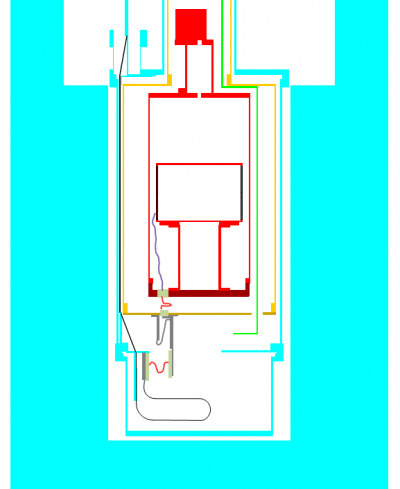
- NEXUS setup
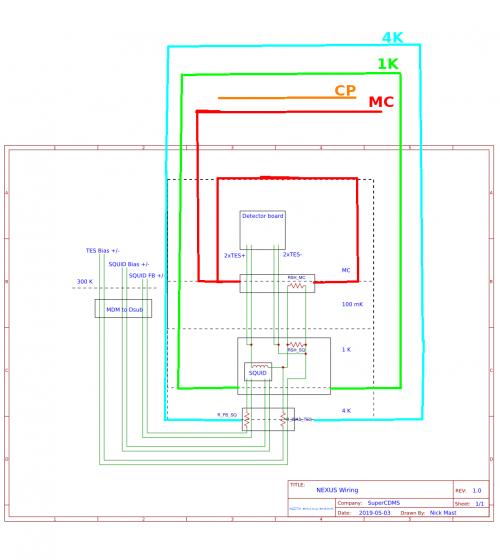
- NbTi cable thermal conductance: G=3.11e-8*T^1.19 W/mK (for 1m, 40 wires, base = 100 mK)
- Tekdata NbTi, MDM-25 quote: ~$715 each
- Cheap ($10/inch^2) SC flex PCB inside MC can Photo
- SQUET recall
- Martin wants 5 of our 9 SQUETs sent back to Colorado. He wants good SQUIDs.
- A lot of issues to deal with:
- there are bad SQUID chips
- we need to change shunt resistances for iZIPv6 versus HV, but don't want to wirebond too many times
- some SQUETs have problems at the pins
- can we get spare SQUETs with the SQUID chips removed? Could theoretically glue good SQUID chips onto good SQUET.
- Anthony says we may be able to get alternative SQUID chips
- We have 1.5-ish months to deal with this
- Lab and infrastructure
- Leak detector: After pump rebuild, pump no longer turned. Jake and Derek fixed this problem. However, it still doesn't seem to be able to pull a good vacuum. Using scroll pump assist in order to use leak detector.