| Teleconference link: | https://fnal.zoom.us/j/9082275310 |
| Domestic: | 1-646-558-8656 (US toll) |
| Domestic: | 1-408-638-0968 (US toll) |
| Access code: | 908-227-5310 |
Agenda
- Run 70 (GeHV n,gamma NR calibration)
- Setup:
- Replaced standard 4K heat-sinking.
- Changed how we wire HV to the electrode to bypass SQUET
- Modified one unused SQUET channel by shorting the TES leads. The purpose is to study noise, IbIs etc during cooling to get a better handle on the SQUID card temperature.
- Status: Fridge is working, Tower @ 44 mK, slowly cooling (like last time, aluminum electrode seems to cool very slowly)
- HV leakage: last week we thought it was extremely low, but we must have had the meter set wrong. It's closer to what we are used to:
- e.g. at HV = 200 V, Ileak = 5 nA. 99% of applied HV reaches the electrode.
- We reduced the leakage by purging the Ebox with N2 boiloff
- Noise and threshold:
- Noise width at 0 Volts ≈ 700 eV. Better than 1500-2000 eV of last run, worse than 250 eV in Run 66
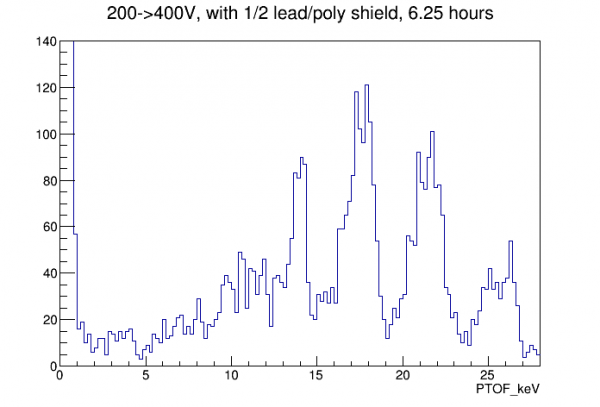
- Have had difficulty calibrating because 14keV&18keV lines are weak, hard to identify….
- at one point thought noise width as low as 17 eVee, but I think this was a bad calibration…
- best width seen so far is 27.2 eVee (better than the best Run 66 result, ~ 40 eVee)
- probably need around 15 eVee or lower to do the n-capture measurement
- Does noise still increase with bias?
- earlier we said no, because in constant-HV runs, effective bias falls over time, but noise stays constant
- however, if we hold the detector bias constant (by drifting HV upward), noise seems to be higher with higher biases:
- uncalibrated noise widths: 1.7 nA @ 0V, 3.6 nA @ 200V, 8.5 nA @ 300V (biases here are raw HV)
- 2.0 nA @ HV = constant 125 V, even after effective bias falls to zero
- it looks sorta like the noise depends on electrode bias, not on effective crystal bias

- Lab
- Leak detector: ordered maintenance kits to repair rough pump
- Pfeiffer vacuum gauge: was reading strangely, broke the igniter while trying to clean it. Ordered replacement parts.
- Sten has returned DCRC55(1) (we've been doing OK without it though. Should ask him again in a couple weeks if he has time to look at it.)
- PuBe source: plan is to take over the source on our permit, house it in PAN443b, the right cleanroom. We've been storing it in the steel box there with lead, now we will use the “howitzer”.
- Run 68 (n,gamma with S101) analysis:
- Working on analysis task list
- Simulation. 1 day of livetime acquired.
- Data not yet looked at:
- Trigger study data
- Hold-time runs at different biases done, haven't looked at them yet
- Have reprocessed -80V Na data. Used -125V balancing factors, still need to check if those are optimal (if not we should redo it)
- Future 150mm runs
- 150mm w/phonons - need to design 600mK rod to accommodate 150mm cans
- Received 4/3-inch DIBs from TAMU - now we can house either detector for phonon readout (would need to machine faces on 4/3-inch housing for DIBs)
- S1501 and S1502 sent back to TAMU
- We have decided we can run 8 phonon channels
- Preferred DIB-pad layout: two DIBs separated by 120 degrees
- Himangshu's mask design: PDF download
- Will use existing vacuum-interface electrode, mounted on side opposite the phonon side
- Will connect directly to two DCRCs, with one diverter board to route one tower wire to HV connection
- We'll want LEDs - are there some mounted on the DIBs? We can mount external LEDs too - existing electrode has mounts.
- First 150mm phonon detector will be monolithic, but “donut+hole” arrangement (active veto) proposed as well.
- Aiming for May to finish fabrication and start run.
- Other future runs
- Future HVeV runs?
- Berkeley can help us with a Soudan-style housing mount (3“ or 4”?)
- then use original tower, can try different heatsinking for colder SQUID card
- would need to install optical fiber
- through top or through stripline tube? need vacuum feedthrough
- Look at Prisca's deuterium lamp/monochromator/filters, glass UV fiber
- Is PuBe NR calibration feasible?
- 1×1×0.4 cm^3 is 630× smaller than SNOLAB detector. Anthony estimates 25 events/day (over full spectrum) for Si, 250 events/day for Ge. any chance we could get multiple chips?
- Nick's idea: sandwich between two 4“ Ge detectors for gamma coincidence (large solid angle coverage)
- Other ideas:
- run SiHV with Nick's movable Am source (or with multiple Am sources)
- run SiHV with no 4K heatsinking
- re-run USD1? do we have any additional ideas to test it?
- anything else?