Fiducialization
It is important to understand where events are occurring in the detector. In particular, there are known effects near detector surfaces which can distort the measured energy quantities. In addition, certain types of events may be more likely to occur near the surfaces.
Near-Threshold
After applying quality cuts, it was found that there was an excess of events in the Na data below 150 eVee as can be seen in Fig. 1. This is troublesome as it also casts doubt on the ~100eV structure observed in PuBe data. Perusing the first dozen event traces doesn't throw any obvious red flags. Many have sloped baselines, but all events at these energies do in the high rate data. Additionally, such effects are not expected to distort the amplitude by more than ~10% (See study here).
| Figure 1: Spectra with current quality cuts |
|---|
 |
It was then realized that these events are concentrated at high partitions of channels PA and PC. This can be seen in Fig. 2 as the slight excesses at PTOFamps=0.1e-6, P*part=0.3 in the Na and PuBe data. As it happens, the triggering channels were PA, PC, and PF. However, this same excess is not observed in PF.
| Figure 2: Partitions below 500 eVee | |
|---|---|
| Bkg |  |
| Na |  |
| PuBe |  |
A selection of events with high channel partitions was made with cuts of the form P*part>0.22 where P*part is the individual phonon partition including balancing factor. Fig. 3 shows the fraction of good events passing this selection (i.e. being concentrated in a given channel) for each channel and each data type. The PuBe data has the cleanest behavior. There, it appears that the fraction of events primarily in channels A and C does indeed increase below ~150eVee. Interestingly, the same is true of PB to a lesser extent.
By contrast, the other inner ring channels (PC,PD) both show a marked decrease in fraction below 200eVee, though above that PC,PD,PE all have roughly the same share. This may indicate that events under, say PD, below 200eVee start to have too few phonons absorbed in other channels to trigger. This should be compared to trigger simulation work.
The fraction of high PF (low radius) events is quite flat down to the noise wall. This channel was triggering along with PA and PC, so it is not understood why it does not see the same increase in fraction at low energy.
| Figure 3: High partition fractions below 500 eVee | |
|---|---|
| Bkg |  |
| Na |  |
| PuBe |  |
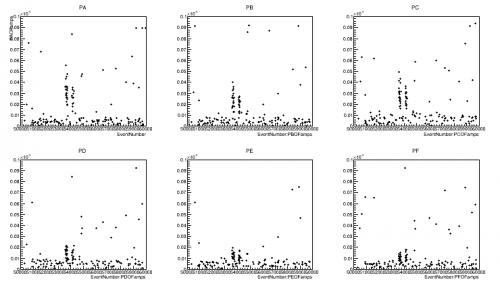
These events seem to occur in bursts. The bursts are present even without quality cuts, indicating that they are trigger related and not a cut artifact. The right figure shows that these bursts can be seen in all channel OF amplitudes, not just PC. They can also be seen with the WKmax RQ, indicating they are not an OF artifact. They are interspersed with otherwise seeming good events. Groupings of these events can span 1-2 seconds, though we only have 1s absolute timing resolution with the EventTime RQ.
| Figure 4: Trigger bursts | |
|---|---|
 |  |
Here are some examples of PuBe events in this energy range. The examples do show some pileup events in this region, though there are also seeming good single events there. This also doesn't explain the groupings of such events in time.
Work to identify these events based on their OFamplitudes and high trigger rate is described here.