Table of Contents
Run 59 Summary
Setup
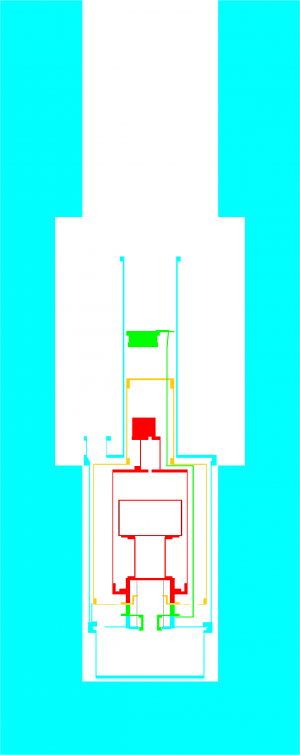
Notes here on source positions, two Am sources pointing at Side 2.
Mu-metal shield and Phonon Collection Efficiency
Plan
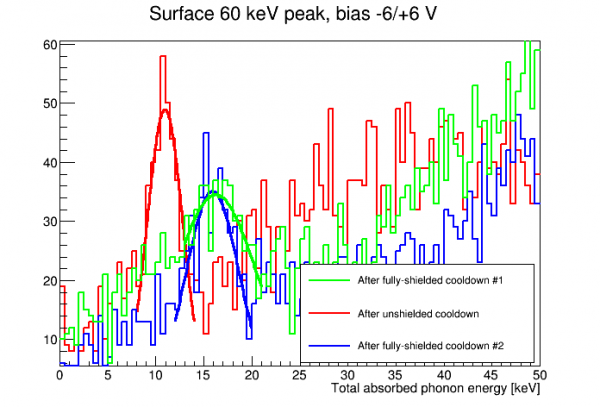
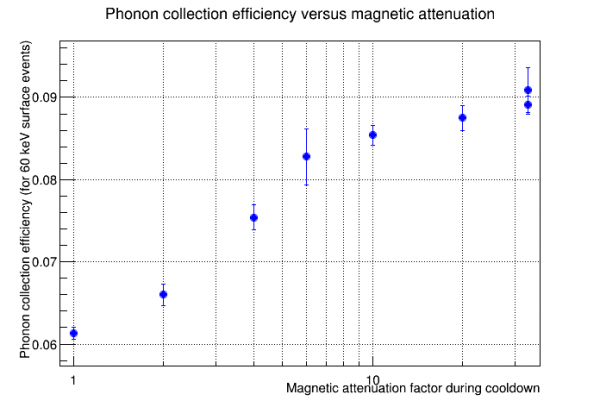
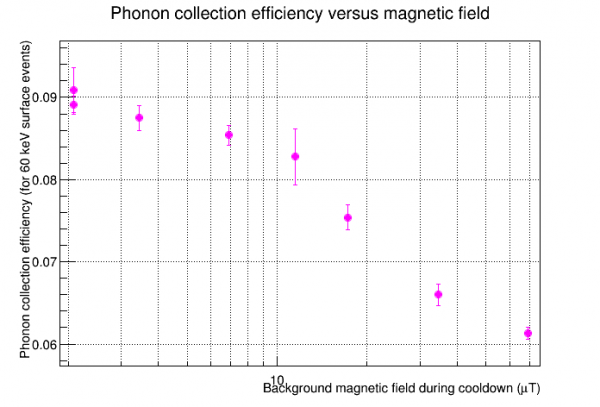
The intent of this study is to assess what degree of magnetic attenuation is required to prevent significant degradation of phonon collection efficiency. Measurements will be taken similar to what was done in Run 56 but at a variety of shield heights.
Measurements taken on 2016 May 17 provide magnetic field as a function of height in the shield. The results can be summarized as follows:
| h(cm) | attenuation factor |
|---|---|
| 7 | 1.621 |
| 17 | 3.329 |
| 27 | 7.128 |
| 37 | 14.65 |
| 47 | 24.666 |
| 57 | 33.488 |
| 67 | 35.336 |
| 77 | 27.449 |
| 87 | 14.907 |
| 97 | 6.975 |
| 107 | 3.100 |
| 117 | 1.526 |
| 127 | 1.004 |
The shield is 124.5 cm tall with an inner diameter of 53.3 cm and a thickness of 1/16 in. The table above gives the amount by which the external magnetic field is attenuated as a function of height from the bottom of the shield along its axis. The strength of the Earth's magnetic field in the lab is 69 μT.
The data above can be fit well to a Gaussian plus constant:
Attenuation factor = 34.63 * EXP(-0.5*((h[cm]-62.70)/18.60)^2) + 1
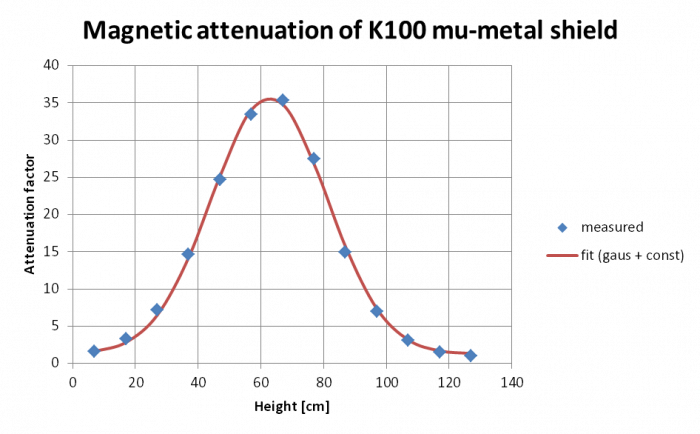
With the shield at its normal position, detector position 2 is at a h = 59 cm and detector position 1 (which is the setup in this run) is at h = 55.4 cm. We can use the formula above to find the distance that the shield should be lowered from its standard position in order to produce a particular attenuation:
| Δh (cm) | h (cm) | attenuation factor |
|---|---|---|
| 0 | 55.4 | 33.1 |
| 23.2 | 78.6 | 25.0 |
| 27.7 | 83.1 | 20.0 |
| 32.3 | 87.7 | 15.0 |
| 37.8 | 93.2 | 10.0 |
| 43.9 | 99.3 | 6.0 |
| 45.9 | 101.3 | 5.0 |
| 48.4 | 103.8 | 4.0 |
| 51.7 | 107.1 | 3.0 |
| 56.8 | 112.2 | 2.0 |
| 61.4 | 116.8 | 1.5 |
| 67 | 122.4 | 1.2 |
| 180 | 235.4 | 1.0 |
Results
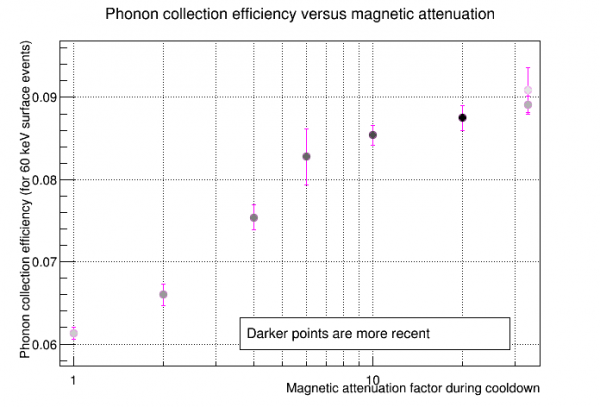
Cryogenics
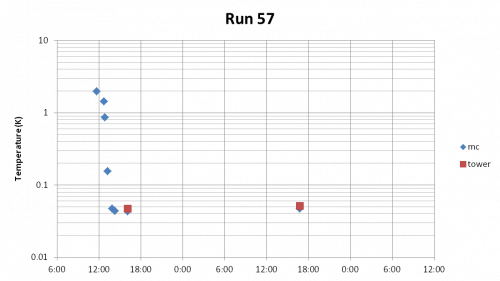
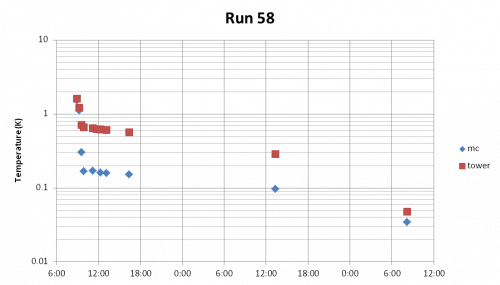
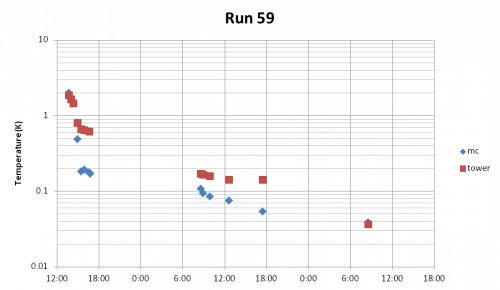
As in Run 58, cooling to base is very slow this run.
| Runs 53-57 | Tower reaches base (<50 mK) the day we start circulation, typically ~5 hours after starting |
|---|---|
| Run 58 | Tower takes 3 days to cool to base (600/300/180/45 mK by end of day 1/2/3/4) |
| Run 59 | Tower takes 2 days to cool to base (610/170/38 mK by end of day 1/2/3) |
It looks like we are doing a little better this run than last but it is still dramatically slower than Run 57 and earlier, by a factor of 10 or so.
The most obvious difference between Runs 58-9 and the older ones is that we started using Soudan iT4 instead of our old tower. It's not at all obvious to me yet why a different tower would change the cooldown rate.
- One obvious guess to explain slow cooling but reasonably good base is poor thermal connectivity between tower and MC. But why would this vary between towers?
- Another proposed theory is that there is some high thermal leak between the tower stages but that it disappears at temperatures below ~100 mK.
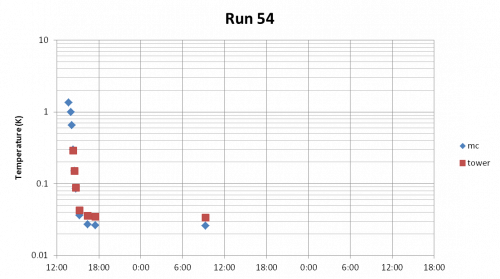 | 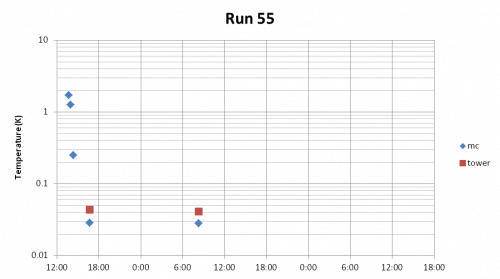 | 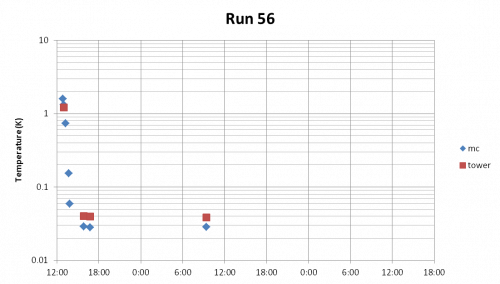 |
 |  |  |
 |
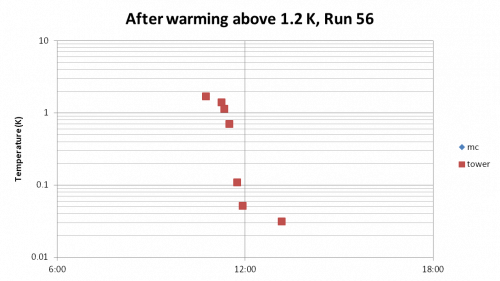
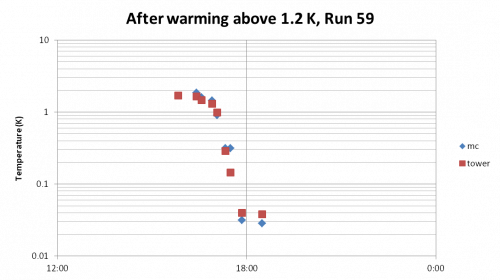
Since we need to warm above 1.2 K then recool many times this run, there was concern that the cooldown would be very slow. This turned out not to be the case. Below compares recooling from Run 56 mu-metal studies to one from this run:
 |  |
He leak from bath to IVC
15-Jul	warm to 1.7 K
18-Jul	warm to 2.0 K
19-Jul	while warming Tower jumps to 2.8 K, but then falls again to 2 K. Recooling commences normally
	the jump occurred some time after Tower >= 1.23 K
20-Jul	while warming Tower jumps from 1.4 K to 3.2 K. Pot affected too, here and previous.
	Recooling commences normally
21-Jul	After fridge failure, have difficulty cooling. Notice pressure in IVC
	IVC = 220 nbar, with tower&mc at 3.4 K, still at 4.0 K
	recool after pumping out IVC
22-Jul	while warming Tower jumps from 1.44 K to 3.1 K (MC&CP 2.3 K, Still 2.8 K)
	have trouble cooling, again look at IVC pressure
	IVC = 160 nbar, with tower&mc ~ 3.5 K, still at 3.2 K
	recool after pumping out IVC
24-Jul	while warming Tower jumps 3.5 K
	IVC = 340 nbar, with Tower = 3.5 K
	recool after pumping out IVC
28-Jul	base goes up a couple of mK, problems with pulses dissappearing or weak/noisy
29-Jul	worsening problems with base temperature
1-Aug	Tower/MC = 57/30 mK, pretty bad
2-Aug	Tower above 80 mK
	while warming Tower jumps to 3.3 K very quickly
	IVC = 8600 nbar, with Tower = 3.5 K
	recool after pumping out IVC, difficult cooling
	warm again, this time turn off pot
	IVC < 10 nbar
	pump IVC overnight at around 4 K
3-Aug	cool to base without problems
4-Aug	some temperature spikes seen but base is good
5-Aug	begin continuously pumping on IVC (except during warmup/cooldown cycles)
9-Aug	while warming Tower jumps from 0.9 to 3.3 K
	IVC = 630 nbar, with Tower = 3.3 K
	recool after pumping out IVC
10-Aug	while warming Tower jumps from 1.27 to 3.05 K
	IVC = 160 nbar, with Tower = 3ish K
	recool after pumping out IVC
15-Aug	while warming Tower jumps from 0.78 to 3.2 K
	IVC = 1600 nbar, with Tower = 3.5 K
	recool after pumping out IVC
16-Aug	while warming Tower jumps from 1.3 to 3 K
	IVC = 250 nbar, with Tower = 3.3 K
	recool after pumping out IVC
17-Aug	while warming Tower jumps from 1.36 to 3 K
	IVC = 220 nbar, with Tower = 3.1 K
	recool after pumping out IVC
18-Aug	while warming Tower jumps from 1.29 to 3 K
	IVC = 250 nbar, with Tower = 3.36 K
	recool after pumping out IVC
19-Aug	while warming Tower jumps from ? to 3 K
	IVC = 220 nbar, with Tower = 3.3 K
	recool after pumping out IVC
18-Aug	while warming Tower jumps from 1.29 to 3 K
	IVC = 220 nbar, with Tower = 3.36 K
	recool after pumping out IVC
20-Aug	while warming Tower jumps from 1.1 to 3.3 K
	IVC = 250 nbar, with Tower = 3.5 K
	recool after pumping out IVC
21-Aug	while warming Tower jumps from 1.1 to 3.3 K
	IVC = 250 nbar, with Tower = 3.5 K
	recool after pumping out IVC
22-Aug	while warming Tower jumps from 1.25 to 3.25 K
	IVC = 300 nbar, with Tower = 3.4 K
	recool after pumping out IVC
23-Aug	while warming Tower jumps from 1.3 to 3 K
	IVC = 300 nbar, with Tower = 3.3 K
	recool after pumping out IVC
25-Aug	while warming Tower jumps from 1.1 to 3.1 K
	IVC = 300 nbar, with Tower = 3.4 K
	recool after pumping out IVC
26-Aug	stop pumping on IVC to allow buildup
29-Aug	circulation and 1K Pot left off overnight
	IVC = 2200 nbar, with Tower = 4.9 K
Looking at the patterns above it appears that the He in the IVC (measured at something around 4 K) built up to 160 nbar over 1 day, then up to 340 nbar over 2 days (so close to the same rate), then up to 8600 nbar over 9 days (a much higher rate per day, apparently). If the temperature problems occurring toward the end of July are attributed to the He, then it looks like 4 days after a pumpout some early signs of problems appeared (small increase in base, plus maybe an effect on pulses) and got worse and worse over days 5-9.
So it may be that we need to warm and pump out every 3 days, or maybe the leak is getting worse and it will need to be more frequent.
Update: On August 5 we began continuously pumping on the IVC at base temperature. This probably improved the situation but did not completely prevent He buildup. A 630 nbar boiloff was seen 7 days after the preceding (thorough) pumpout and 4 days after we started pumping continuously. Then after a one day pause we saw a 160 nbar boiloff - this is exactly the same one-day buildup that we saw before we started pumping continuously. So maybe the continuous pumping is only helping prevent really large accumulations of He.
LHe boiloff rates
This is the first run since the recovery system one-way valve was reinstalled correctly. Previously the lab recovery tubing was open to the exterior recovery system; now the valve prevents overpressure in the exterior system from pushing gas back into the lab system.
We found in previous runs that high bath pressures can lead to Taconis oscillations and cause the bath to boil off at a faster rate. A procedure was developed to release pressure from the main bath five minutes after a fill - this also released pressure from the exterior system since the one-way valve was installed wrong. Releasing pressure once at this point prevented the development of Taconis oscillations and made the boiloff rate slower. (In the slow state, the 90%-to-20% main bath hold time is about 49 hours; in the fast state it's only about 38 hours.)
In this run, with the corrected one-way valve, we experimented with not releasing the pressure. We found that the boiloff was fast. We then tried releasing pressure using the old procedure - not surprisingly, less gas blows out now that we are only opening the main bath, not the exterior recovery system. But we still had a fast boiloff. Likely what happens is that the pressure in the bath builds up again, and since the exterior system is still at high pressure and the one-way valve is present, the pressure is not released - previously it would have blown off into the exterior system, whose pressure was low. Essentially there was more low-pressure volume for the gas to blow off into prior to the fix.
We were able to achieve slow boiloff rates again by releasing pressure multiple times: the current working procedure is to release pressure at the 5 minute, 30 minute, and 60 minute points after a transfer. We will experiment with fewer pressure releases in the hope that we won't have to wait as long after a transfer (particularly convenient for weekend transfers).