2016/12/30 (Friday)
| Status: IVC open, tower removed. Main bath vacuum jacket is evacuated. 1K Pot needle valve closed. LN2 traps clean. Mixture is in dump, fridge evacuated. | |
| 1140 | Finish drilling hole through back of small fridge bath port, the one used for the level meter. |
| 1145 | Finish all four holes through the fridge bath ports with a somewhat larger 3/32“ drill bit |
| 1215 | Remove tower with G101C from purge cabinet for disassembly |
|---|---|
| 1240 | Finish removing MC can adapter and side coaxes. Desolder wires leading to external LEDs from side coax extenders (see October 10). |
Found that a piece of kapton tape had fallen on each side of the detector:
| Kapton tape on bottom (upper in our arrangement) side of G101c |
|---|
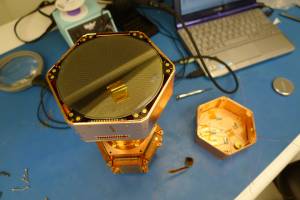 |
| Tape fell off of the plate holding the LED boards and the thermometer. Hard to say when, could have happened during warmup or later |
| Kapton tape on top (lower in our arrangement) side of G101c |
|---|
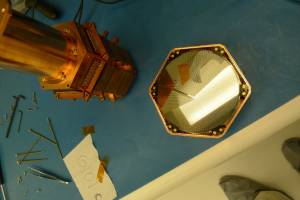 |
| This probably didn't happen until disassembly when the detector was flipped over. These pieces of tape were to protect the detector from debris during transport. They should have been removed because they are unnecessary during operation, the holes are blocked by screws. |
| 1300 | Finish tower disassembly, return G101c to purge cabinet |
|---|
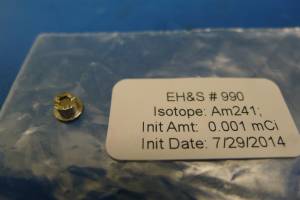
Measuring the new smoke-detector 241Am source and the source holders:
| 241Am source UCB#990 | |
|---|---|
 |
|
| column diam | 0.170” |
| base diam | 0.235“ |
| total height | 0.129” |
| base thickness | 0.021“ |
| column height | 0.108” |
| active AmO2 diameter | 0.09“ |
| Large source holder | |
|---|---|
| ID | 1.000” |
| depth | 0.375“ |
| plate diam | 0.998” |
| plate thick | 0.066“ |
| aperture | <0.006” |
| Source holders | Aperture disk for large source holder |
|---|---|
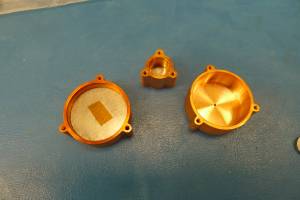 | 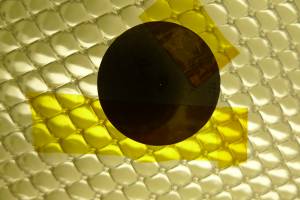 |
| Large and small source holders, aperture disk shown | Zooming on this photo suggests that the aperture is about 6 mil, although a 6 mil wire did not fit in the hole, so probably it's a little smaller |
The source holders are designed for our old Am sources. They consist of a cup and two steel (I think) plates, one on each side of the source - the one on the detector side has an aperture hole. The aperture hole is covered over with Kapton tape, which should be sufficient to block the alphas while being transparent to x-rays. UPDATE: Allison, referring to a talk by Hassan, says the plates are lead, and that the aperture hole diameters are supposed to be 0.008“. (Lead collimator.)
To adapt the large holder for the new UCB#990 source, we can make two pieces: a disk with a hole in the center that the cylindrical column of the source fits into, and another disk as an additional spacer to fill the cup depth.
Since the new source is the same activity as our old sources, I'm guessing the aperture will produce about the same event rate (for 60keV gammas). But this isn't necessarily so - it depends on the geometry of the 241Am. If the Am int the new source is spread out over a wider area (it should be pretty thin to operate as an alpha emitter for a smoke detector) then the rate through the aperture will be smaller.
The kapton tape appears to be 4 mil = 100 μm thick. Online I found the Kapton formula C22H10N2O5, density 1.43 g/cm^3, and using the CXRO LBL calculator gives an attenuation length for 10 keV x-rays of 2348 μm, implying a transmission coefficient of 95.8%.
| Prominent 241Am lines according to something found online: |
|---|
| 59.5409 keV (36%) |
| 13.9 keV (13%) |
| 17.8 keV (18%) |
| 26.4 keV |
| %s are fraction of alpha decays for which this gamma is also emitted. |
| 1800 | Finish making adapters for source holder out of aluminum. |
|---|
| Source holder adapter to fit UCB#990 source into large source holder |
|
|---|---|
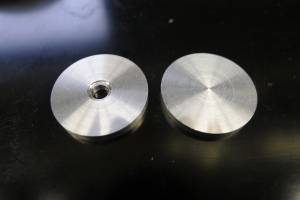 |
|
| OD | 0.996” |
| Solid plate thickness | 0.114“ |
| Holder plate thickness | 0.127” |
| Hole diameter | 3/16“ = 0.1875” |
| Depression diameter | 0.250“ |
| Depression depth | 0.023” |
 |
|
0.066+0.114+0.129+0.066 = 0.375