| Teleconference link: | https://fnal.zoom.us/j/9082275310 |
| Domestic: | 1-646-558-8656 (US toll) |
| Domestic: | 1-408-638-0968 (US toll) |
| Access code: | 908-227-5310 |
Agenda
- Run 69 (GeHV n,gamma NR calibration) is finished.
- Ready to disassemble shield, drop main bath, open IVC
- should do electrical checks first
- Oscillations in QETs made it difficult to find good settings and stable behavior. Tried running at higher temperature, not sure how much it helps.
- HV leakage issues:
- On March 26 had severe leakage (and tower warming) during a HV test.
- Disconnecting bias from all but the one necessary channel improved leakage greatly (for a while)
- After the March 26 incident, pA became inoperable. Evidence suggests input loop in SQUET was damaged (can check when warm)
- HV leakage came back: severe leakage again on April 5
- Magnitude of heating during severe leakage suggests the leakage is at the SQUETs (50 μW power from leakage, 3 mK Tower rise)
- SQUID and Feedback read open on two of the six SQUID channels that were biased (not readout channels)
- Want to study calibration, threshold, noise further. Superconducting and normal noise data taken
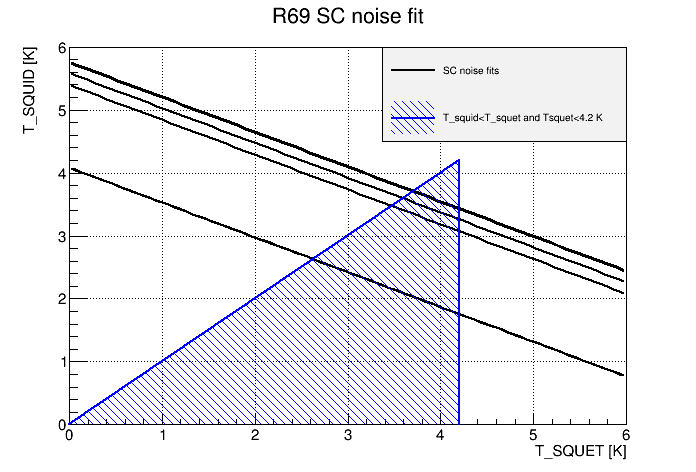
- SC noise fits hint at higher fridge temps: 07190318_1058_temp_fits.png
- Run 70 plan - modification of Run 69
- Replace standard 4K heat-sinking. Removing it seems to have increased temperatures at SQUET which would make the noise worse.
- Change how we wire HV to the electrode:
- Running HV through SQUETs seemed ok before, when we kept it below 200V.
- In Run 69 with HV up to 400V, we seem to have damaged some SQUET components.
- Run 69 HV wiring: HV connected to unused phonon channel (all components), at side coax connection to tower solder wires from QET&Return leading to electrode
- Run 70 modification: bypass SQUET. Diverter board at stripline-SQUET connection, disconnect wires from SQUET, solder wires to diverter board to plug into unused tower face. At tower face side coax connection (unused), plug pins in and solder wire to electrode. (Also bypasses side coax)
- Lab
- Sten has returned DCRC55(1) (we've been doing OK without it though. Should ask him again in a couple weeks if he has time to look at it.)
- PuBe source availability: P Crowell says source is too a big liability (plutonium could be stolen by terrorists…)
- Paul talked to Vuk - apparently it would be OK for us to keep the source, and keep it locked up
- need to figure out where/how. Apparently we'd get the big “howitzer” too, well shielded, has a lock, easy to move source in and out.
- Helium recovery:
- Last run it was determined that we weren't recovering any Helium from the 4He pump because the oil mist filter was saturated
- With a new filter element, found that recovery was much worse (it must be leaking to atmosphere). Between-transfer recovery actually negative
- Removing oil mist filter makes recovery slightly better than before.
- Between transfers: boiloff 18.3 L/day, recovery with/without pump = 13.3/12.1 L/day (efficiency 73%/66%)
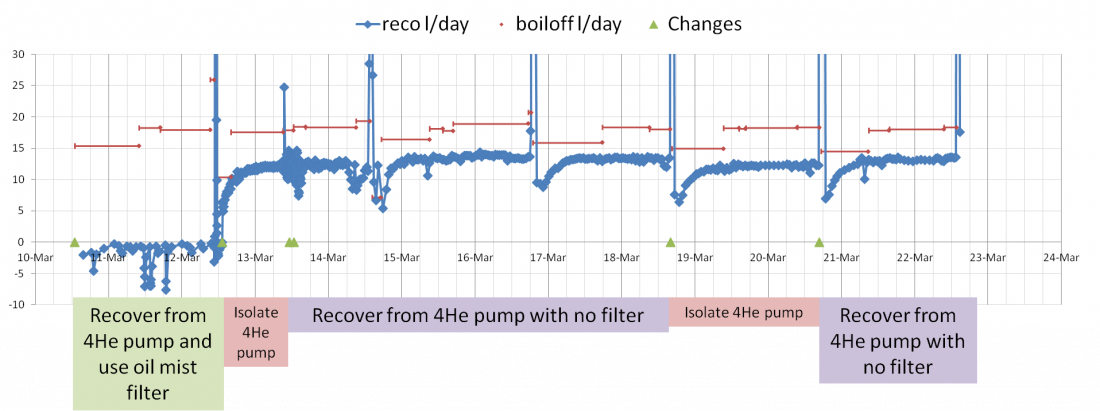
- Calculations suggest we are only collecting 17% of 4He pump exhaust.
- After stopping 1K Pot before warmup, recovery rose to 90% or better (saw this during last run too)
- Purchased pump rebuild kit, beginning pump rebuild. Found severely damaged o-ring on exhaust manifold.
- Run 68 (n,gamma with S101) analysis:
- Working on analysis task list
- First pass trigger efficiency:
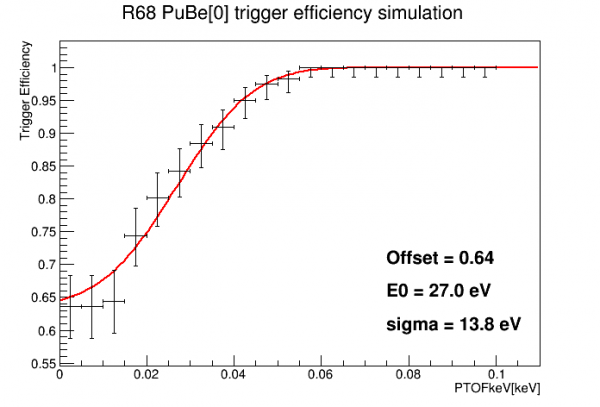
- Simulation. 1 day of livetime acquired.
- Data not yet looked at:
- Trigger study data: high priority
- Hold-time runs at different biases done, haven't looked at them yet
- Have reprocessed -80V Na data. Used -125V balancing factors, still need to check if those are optimal (if not we should redo it)
- Future 150mm runs
- 150mm w/phonons - need to design 600mK rod to accommodate 150mm cans
- Received 4/3-inch DIBs from TAMU - now we can house either detector for phonon readout (would need to machine faces on 4/3-inch housing for DIBs)
- S1501 and S1502 sent back to TAMU
- We have decided we can run 8 phonon channels
- Preferred DIB-pad layout: two DIBs separated by 120 degrees
- Himangshu's mask design: PDF download
- Will use existing vacuum-interface electrode, mounted on side opposite the phonon side
- Will connect directly to two DCRCs, with one diverter board to route one tower wire to HV connection
- We'll want LEDs - are there some mounted on the DIBs? We can mount external LEDs too - existing electrode has mounts.
- First 150mm phonon detector will be monolithic, but “donut+hole” arrangement (active veto) proposed as well.
- Aiming for May to finish fabrication and start run.
- Other future runs
- Future HVeV runs?
- Berkeley can help us with a Soudan-style housing mount (3“ or 4”?)
- then use original tower, can try different heatsinking for colder SQUID card
- would need to install optical fiber
- through top or through stripline tube? need vacuum feedthrough
- Look at Prisca's deuterium lamp/monochromator/filters, glass UV fiber
- Is PuBe NR calibration feasible?
- 1×1×0.4 cm^3 is 630× smaller than SNOLAB detector. Anthony estimates 25 events/day (over full spectrum) for Si, 250 events/day for Ge. any chance we could get multiple chips?
- Nick's idea: sandwich between two 4“ Ge detectors for gamma coincidence (large solid angle coverage)
- Other ideas:
- run SiHV with Nick's movable Am source (or with multiple Am sources)
- run SiHV with no 4K heatsinking
- re-run USD1? do we have any additional ideas to test it?
- anything else?