Phi-based Am-241 source cut
A cut to remove the region of the detector near the source is useful because we see events related to the source at low energy, that produce extra background for our signal search. (Note: this cut would probably not be necessary if we had put a layer of tape on the collimator, to block both alphas and any low-energy electrons.)
Example
This example begins after loading sample data and developing an integral/OF agreement cut as shown in the data quality cut example page.
// Am cut
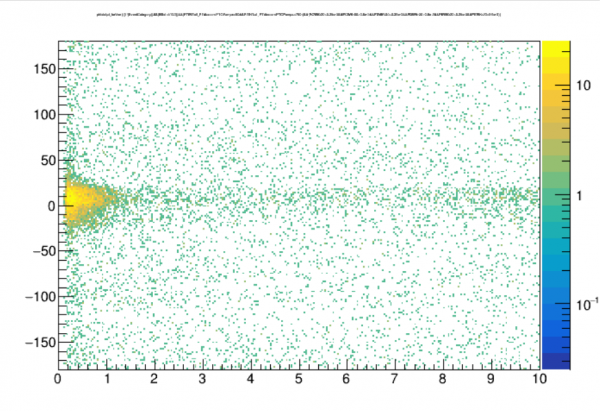
z[1]->Draw("phidel:pt_keVee>>h1phie(300,0,10,200,-180,180)",!crand+cbs+cofintl+cgoodwalk,"colz")
z[1]->Draw("phidel>>h1phile(200,-180,180)",!crand+cbs+cofintl+cgoodwalk+"pt_keVee<1")
z[2]->Draw("phidel>>h2phile(200,-180,180)",!crand+cbs+cofintl+cgoodwalk+"pt_keVee<1")
z[3]->Draw("phidel>>h3phile(200,-180,180)",!crand+cbs+cofintl+cgoodwalk+"pt_keVee<1")
h1phile->Draw();h2phile->SetLineColor(kRed);h2phile->Draw("same");h3phile->SetLineColor("kGreen");h3phile->Draw("same");
The first drawing shows phi versus energy for 0-10 keVee for the first calibration series:
The main purpose of the cut is to remove Am-events in the signal region. The plot below shows phi for 0-1 keVee for each of the three series.
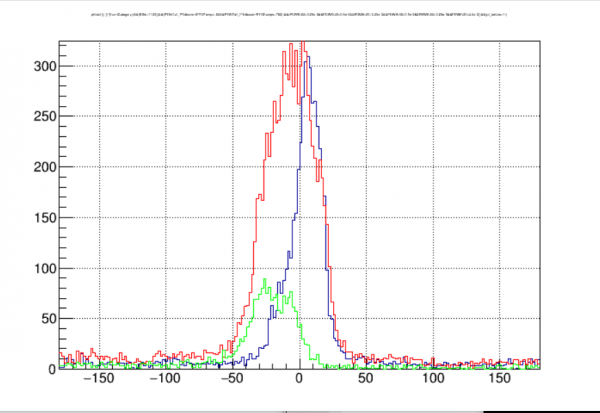
The phi reconstruction seems to be time dependent. To be thorough for this dataset, we set a wide phi cut to cover the full time period.
// There's some time dependence in phi. This cut covers all of them.
TCut cam = "phidel>-70&&phidel<50"
//
// Approximate efficiency is 66.7%