Table of Contents
Run 74
Run 74 planning slideshow
Source position
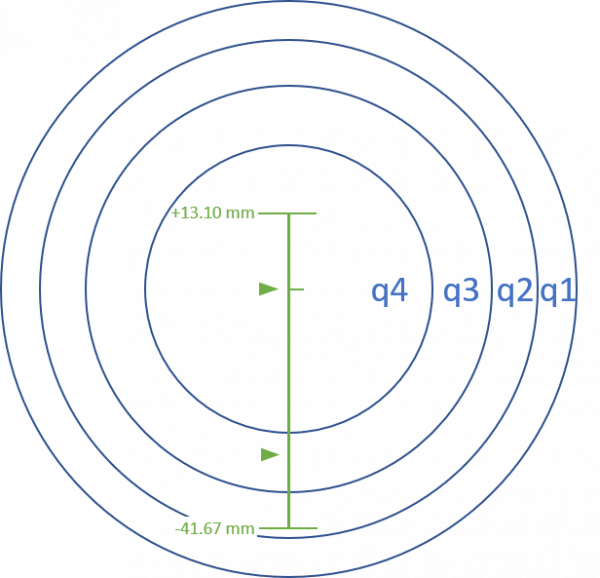
Run plan
Run 74 is a followup to run_67, in which we tested USD1. That detector (a crystal grown by Dongming Mei's group and patterned with four charge channels) showed strange time-dependent impact ionization in holes. This followup will study that phenomenon further by doing a few new things:
- Use source mover instead of 4 fixed Am-241 sources. This will allow us to further explore the radial dependence of the phenomenon. We may also be able to move the source while taking data, rather than between data series, to see how that affects the observed behavior.
- Set up for HV biasing. Previously we grounded the bottom of the detector and applied bias to the ionization channels using the DCRCs, limiting the bias to 12 V. We can instead divert the bottom electrode wiring to connect to our HV power supply, allowing bias up to 300 V. (We need to work out the wiring details.)
- Comment from Dongming: “The detector could break down at ~15 volts when run at 40 mK. It may hold voltage higher when runs at higher temperature. If this is the case, it may indicate phonon dominated excitation at low temperature.” So we should look for breakdown at various temperature.
- Rejected idea: set up to read out Side 2. This would likely require a 3rd DIB and a 3rd side coax, which would be difficult to manage. Possibly in another followup this could be done if we were willing to sacrifice two other readouts. Note: in principle the info from this channel would be redundant with the Side 1 readouts.
- Do further studies on how the overall event rate affects the observed phenomenon. We can do this in two ways:
- Erect the lead fridge shield to reduce the lab background
- Vary the distance of the external Ba-133 source (and/or other external sources)
- Try other external sources and try to resolve a line from them, e.g. Co-57. Co-57 setup from Run60
- Take data at a range of temperatures. Some notes:
- in Run67, R versus T measurements suggest that the detector won't hold a bias above 5 K
- in Run67 we took some data at 4 K - the resolution was terrible
- so: exploring the range 0.1 - 4 K will probably be of the most interest
| USD1 pinout map | ||||
|---|---|---|---|---|
| DIB1qO | DIB1qI | DIB2qO | DIB2qI | DIB1pin7 |
| q1 | q3 | q2 | q4 | g |
| Charge channels are numbered outer-to-inner | ||||
60 keV line and bias
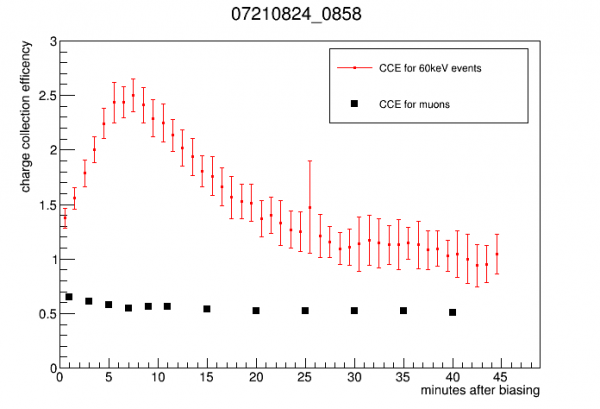
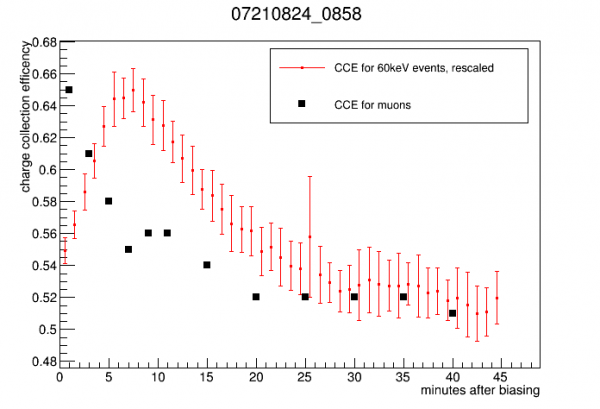
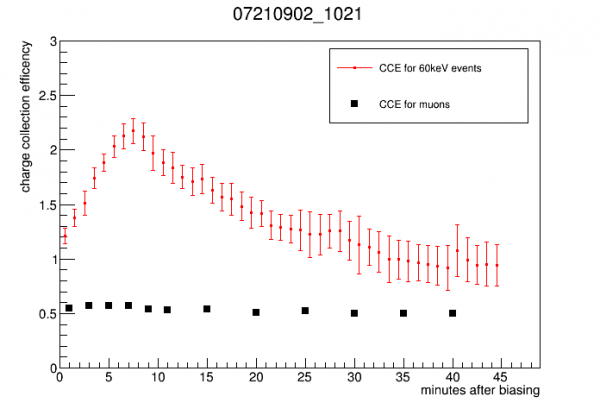
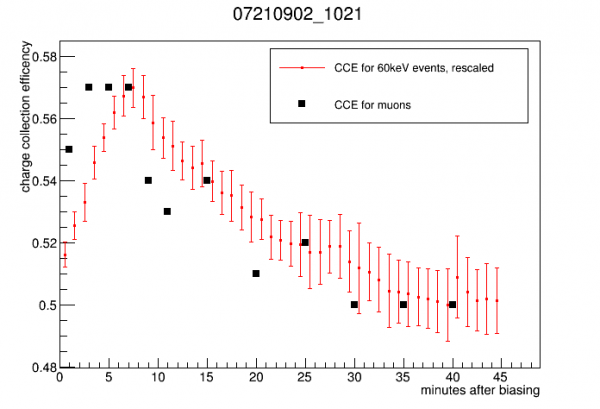
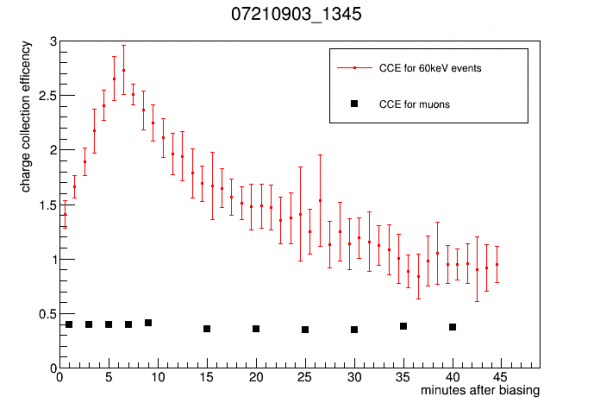
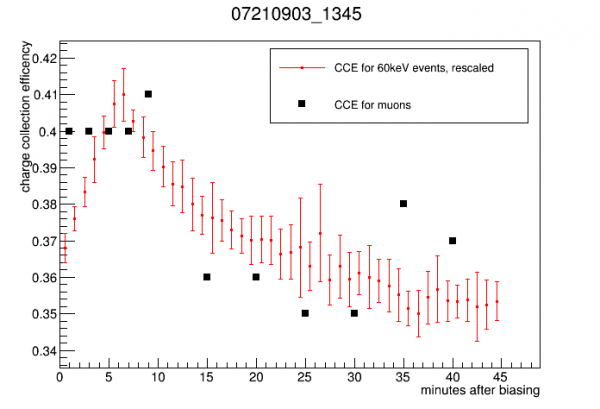
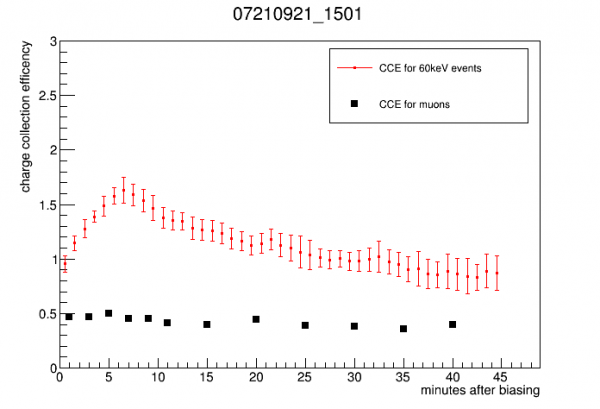
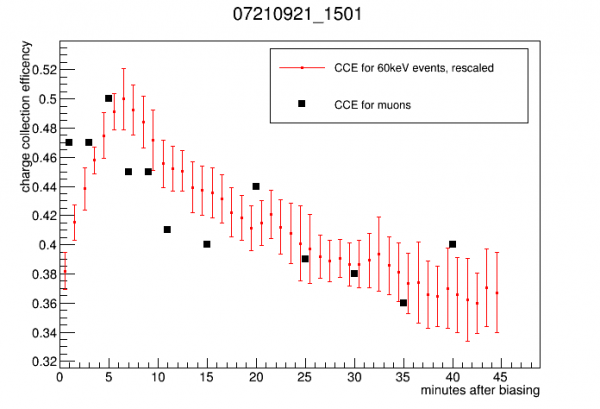
Early in the run we found that much higher biases were needed to see the 60 keV line than in Run 67. At first we suspected Side2 was not connected, but we confirmed that it was. The link below shows that we can see the 60keV line and time-dependent impact ionization at high enough biases, applied either to Side1 (via DCRC), Side2 (via external HV supply), or both. Also shown is a charge collection efficiency curve based on the observed muon bulge.
Fitting impact ionization trend
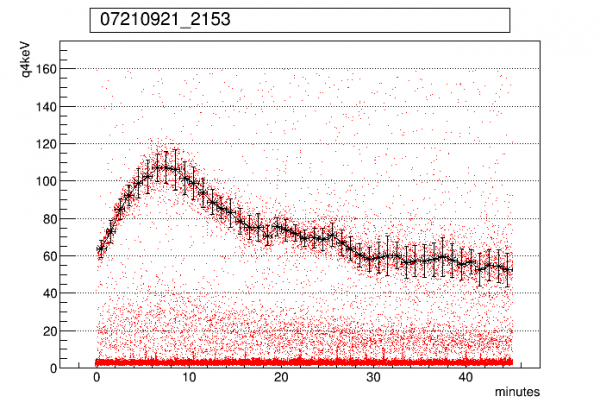
Muon charge collection efficiency and 60keV impact ionization
 |  |
 |  |
 |  |
 |  |
aps_2022.pdf