Table of Contents
Run 70 First Quality Cuts
180V drifted background data taken on June 12 was studied for data quality issues.
DCRC glitch: Start-time shifts
During the two 90-minute series, the start times of the traces with respect to the trigger time shifts occasionally by 8 samples, as was seen in Run 68.
| Figure 1 |
|---|
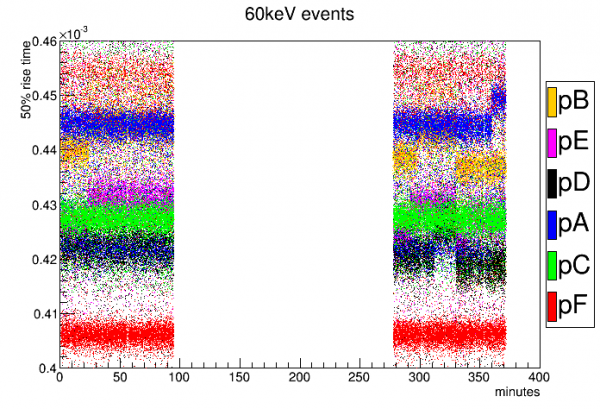 |
| Time at which pulses reach 50% height for 60keV events |
This will have a deleterious effect on pT quantities (though it probably won't affect pSum quantities). It looks like the start times “reset” at the beginning of a series - this was observed in Run 68 and we decided to switch to 10-minute subseries to “reset” the DCRCs more often.
This probably explains why pSum quantities seem to produce narrower noise than pT quantities (mainly because the gain in pT is suppressed due to shifting and mismatched timing when the pulses are combined into pT).
Note that in Figure 1 the differences from channel to channel make sense - since these are 60keV events, the central channel pF rises first, followed by the inner ring channels pC/D/E, followed by second ring pB, followed lastly by outer ring pA.
Basic cuts, and time-dependent noise
Some first-pass cuts used are
- a baseline cut, to remove most retriggers and tail events
- a OF-integral agreement cut, to remove most pileup
| Figure 2 |
|---|
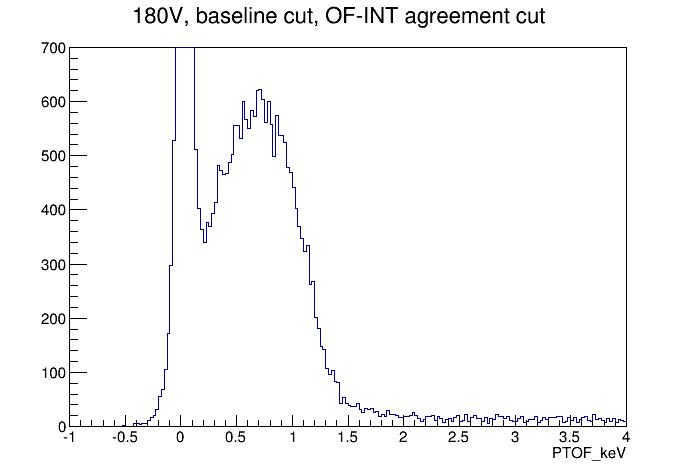 |
With the basic cuts applied, Fig 2 above shows a big, anomalous hump at the low end of the spectrum. These events turn out to be time-dependent:
| Figure 3 |
|---|
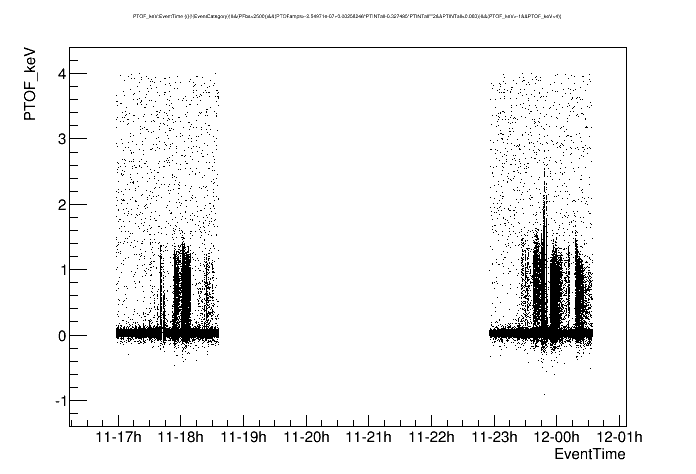 |
The early parts of the two series seem to be free of noise. Perhaps it is related to the surface charge buildup, or the increasing bias on the electrode.
We may want to take shorter series. If we apply a cut selecting early times in the series the spectrum is much cleaner:
| Figure 4 |
|---|
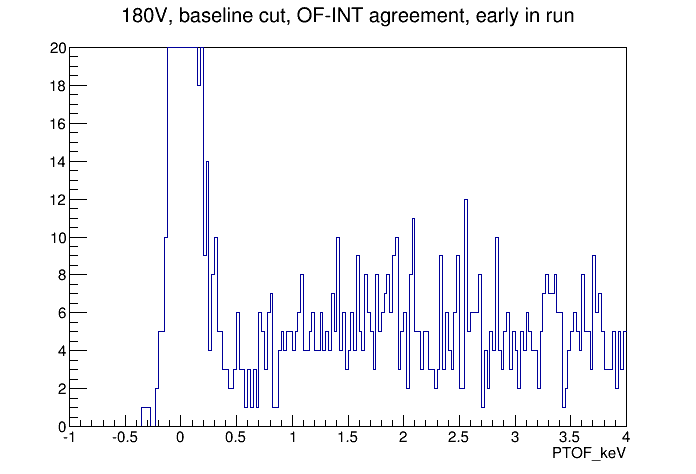 |
The spectrum above is base on PTOF with a measure noise width of 20.6 eVee. One would hope the effective threshold would be around 103 eVee but it's clearly higher. I looked at some event traces between 180 and 200 eVee and found that most of the events had pathologies such as the first 8 bins being too high, or a pulse at the very end of the trace, or in some cases unusually high low-frequency (“wavy”) noise. Presumably more cuts similar to Nick's from Run 68 will clean this up further.