Run69 Fridge Thermal State
This run was done without 4K shielding or heatsinking in hopes of reducing the SQUET and SQUID temperatures to reduce thermal Johnson noise on shunt and parasitic resistances.
Phonon noise
Using the fitted SC noise along with a model of parasitic resistances as was done in Run 66 can give hints as to the temperatures of various stages. This time, however, we don't have a variety of shunt resistances, so there is some degeneracy in the model.
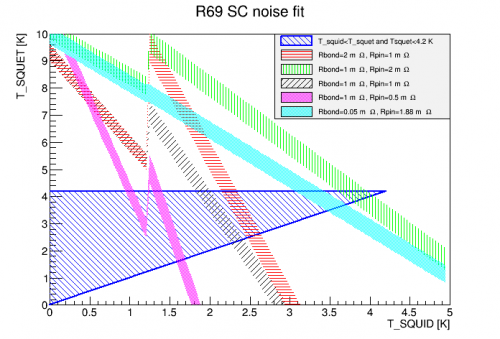
The figure below shows the relationship between the SQUID card temperature (where Rsh and a wirebond live) and the SQUET card/tower base temperature (where there are 2 milmax pins). The curves depend on the average fitted SC noise of channels A-E as measured in 07190318_1058 (F was ignored as an outlier in this study). Each curve makes different assumptions about the resistances of wirebonds and milmax pin connections in order to show the sensitivity to those parameters. The kink at 1.2K is due to the SQUID wirebond going normal. The blue shaded region denotes the likely range of teperatures such that the SQUID is colder than the SQUET and the SQUET is below LHe temperature. The cyan curve (Rbond/Rpin=0.05/1.88 mΩ) uses the resistances estimated in the Run 66 analysis. Note that Rpin is the main driver of these curves, and as long as it is greater than ~ 1 mΩ, both temperatures are likely above 2.5 K.
| Thermal relationships based on SC noise fits |
|---|
 |