Glitches
An interesting population of events was found in the PuBe data when developing the OF/WKmax cut. They have higher peak height/OF ratios and have lower rise times (i.e they're peakier) This is a common property of near-surface events, but why should they appear just in PuBe data? Maybe they're low energy florescence, but why not in Na? Can they be something neutron-induced? Some sort of glitch or crosstalk (NaI event related?) Should check their position distribution, compare raw pulses.
| Bkg |  |  |
|---|---|---|
| Na |  |  |
| PuBe |  |  |
The ~5us PTRT events are clear glitches (checked the first ~10) and appear in all data types at all times. Some cut on the fastest channel RT or consistency of channel start times might pull them out even better. We have seen this type of thing early on in this run and previous runs. This is why we chose to run with very short series to give frequent DCRC “resets”.
 |  |
Of the other events, some don't look unusual, but about 5/6 do. Below are a few examples.
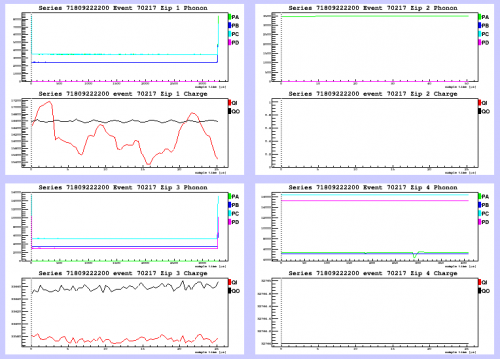
07180922_2200, 70217: small triggered events followed by a large pulse in the last few bins of the trace. Passes OF/INT, WK latches onto final few bins(WKr100==3.2768us).
 |
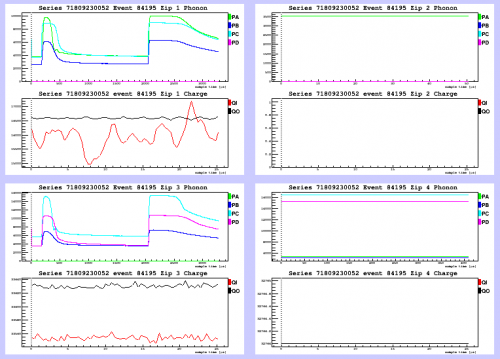
07180923_0052, 84195: was 2 large pulses, one before the trigger which upset bs and let it pass OF/INT. Would be fixed w/ a bs cut.
 |
(07180923_0122, 33701-33705), (07180925_0132, 20139-20143): Trains of spikey pulses on 2 channels (PB,PC, to a lesser extent in others). This happens a few times with these same 2 channels.
 |
The P*/PT partition distribution of these events roughly follows these observations, they have slightly higher than average PB, PC partitions, but this is subtle. They don't seem correlated with NaI pulses, though these did stop after we changed the setup.
These events appear mostly in the first 3 n125_PuBe datasets. They also become more frequent over time within a set of series taken back to back.
 |  |
Whatever they are, they are unphysical as their fall times are far lower than those of real phonon signals. They simply fall faster than the TES fall time would allow. Because of this, they must be some source of external noise coupling into the phonon readout circuit somewhere between the SQUID input coil and the DCRC digitizer. We can use this anomalously low fall time to construct a cut which removes these events with minimal impact on good physics pulses.
These events seem to be most separated from the band of good events when using a fall time calculated from the PT 100% and 20% fall points as measured by the RTFTwalk algorithm. The figure below left shows this fall time as a function of PTOFamps for the first 2 PuBe datasets. The spikey events and the glitches each form a band of low fall time. On the right, the same quantities are plotted, but the spikey events are absent. Lines have been drawn at fall times of 35 and 12 us to remove the spikey and glitch events respectively. The small number of (non-noise) events removed by the cuts in datasets 3 and4 indicate that this cut will have very high efficiency for good signal events above threshold.
| PuBe, datasets 1,2 |  |  |
|---|---|---|
| PuBe, datasets 3,4 |  |  |
Interestingly, the bulk of noise triggers also fall below these cut lines. This means that the largest excursion found by RTFTWK in the noise trace had a fall time inconsistent with that of a phonon signal. However, these events still exhibit relatively low PTOFchisq, which means they aren't that different (in frequency space) from the pulse template. This is something that should probably be thought about more carefully. Given our noise PSD and the RTDTWK's 50kHz filtering, can we come up with an expected fall time for a max noise excursion?