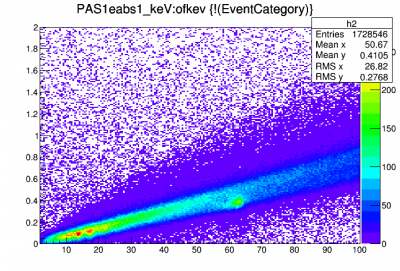
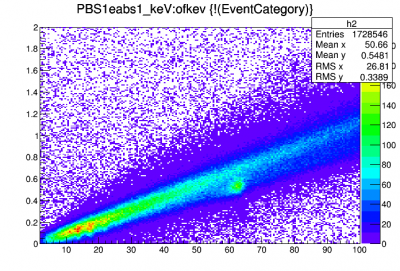
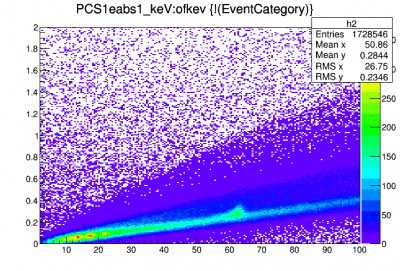
On April 17-18 we had three DCRCs working: DCRC1[55](RevC.1), DCRC2[33](RevC), and DCRC4[x](RevC.1). We took 2-sided data for all 9 working channels. All QET biases were set with a target QETbias*prefactor value of 20 μA. This is relatively low in transition. From the dP/dI study this seems like a better place to run to avoid the partially-normal regime. But it's an area where the prefactor is very sensitive to bias, so there are likely large statistical errors.
| pTotal OF spectrum |
|---|
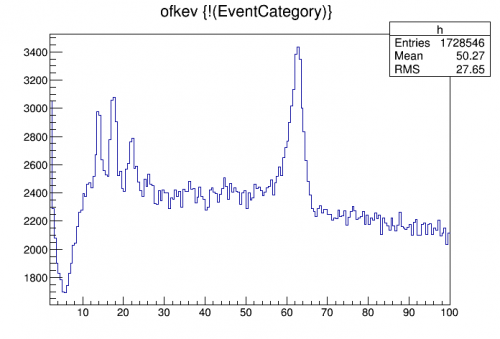 |
| With this data the Am peaks are quite clear even with no quality cuts. The only cut applied is to remove randoms. The spectrum above is a simple linear calibration of the pTotal OF amplitude to keVee using the 13.942 keV line. With this calibration the 60 keV peak appears somewhat too high. This is the opposite of what would be expected if saturation were dampening the higher energies. |
 |  | |
 | 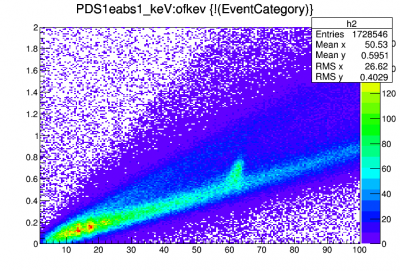 | 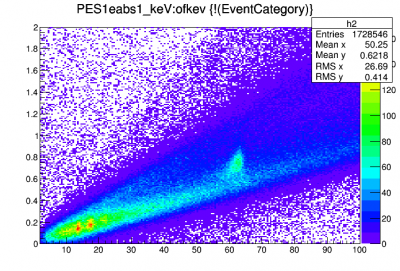 |
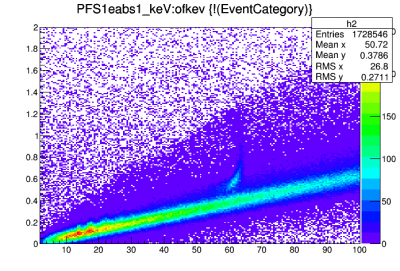 | ||
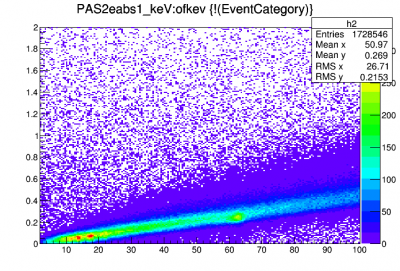 |  | |
 |  |  |
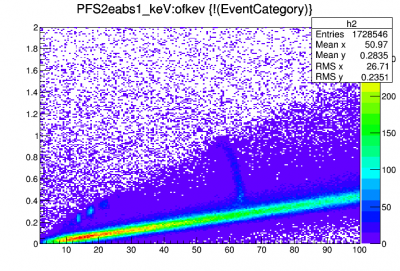 |
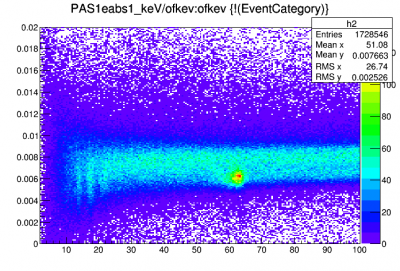 | 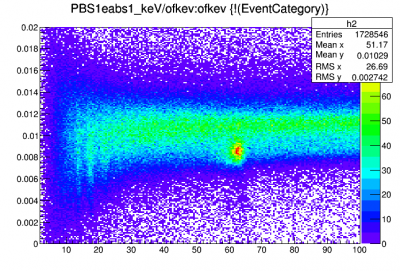 | |
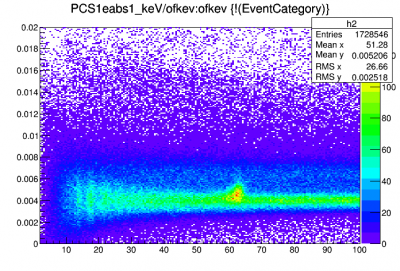 | 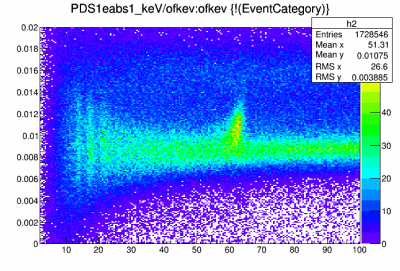 | 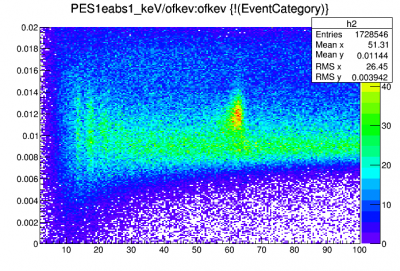 |
| note this channel is anomalously low, but this was also the case with the HV setup, different DCRC, different rev, different QET bias | ||
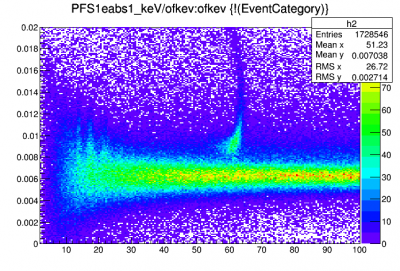 | ||
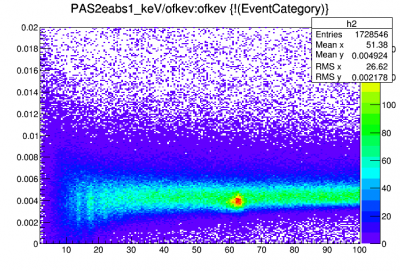 |  | |
 |  | 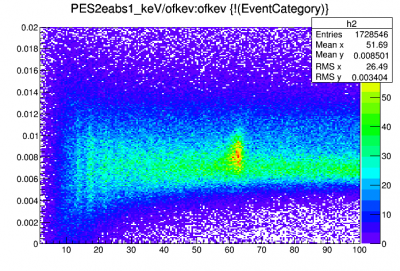 |
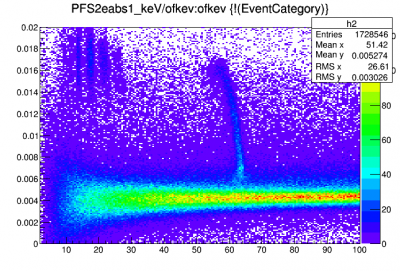 |
| Z-partition based on inner F-channels versus energy |
|---|
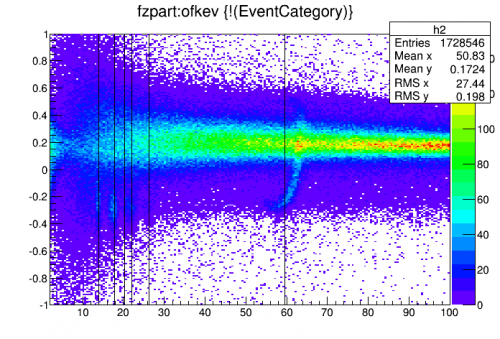 |
| Z-partition versus absorbed energy |
|---|
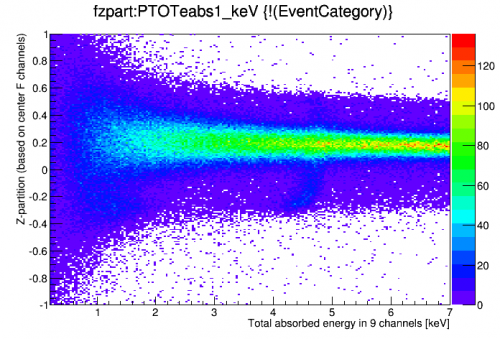 |
| The x-axis shows the total calculated absorbed energy in the 9 working channels. The events at 4.6 keV are 60keV Am events. Those at low z have reduced phonon collection efficiency, possibly due to local saturation for near-surface events. There's some evidence that high-z events also have reduced efficiency. |
| pTotal OF spectrum with low-z cut |
|---|
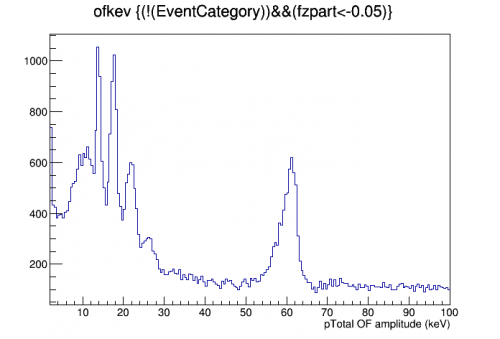 |
| Am spectrum (in OF amplitude) is very well-resolved for events near Side 2 |
If we instead choose the middle of the z-band we can avoid saturation and from that calculate phonon collection efficiency. For this purpose I extrapolated the missing channels' energies by assuming z-symmetry, i.e. inner-ring channels on Side 1 and 2 have similar energies and B-ring channels on Side 1 and 2 have similar energies. Using this extrapolation and a mid-z cut I calculated the phonon collection efficiency for 60 keV events. Since the lower peaks don't show up in the mid-z range, the 60keV peak is the only benchmark for this measurement.
| Phonon collection efficiency for mid-z events at 60 keV, extrapolated to 12 channels: | 11.16% |
|---|
If we neglect Side1pC, the anomalously low efficiency channel, then extrapolate based on the other inner-ring channels, this increases to PCE = 12.06%.
Note that it's possible that if we could measure PCE at lower energies we'd find higher efficiencies - maybe at 60keV you are already getting significant saturation. Hard to know for sure.
| Absorbed energy versus recoil energy |
|---|
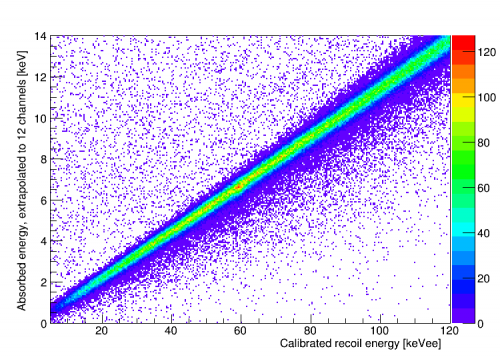 |
| Mid-z cut has been applied to remove near-surfaced events Recoil energy is OF calibrated to the 60keV line Absorbed energy is extrapolated to 12 channels |
We can also try to calculate PCE for events in the lower peaks. These events are close to Side 2. For these I use a different extrapolation to the non-functioning channels. I assume there is no z-symmetry; instead I use z ratios to extrapolate. I assume the energy ratio of the B-rings is the same as for the A-rings. We can also assume azimuthal symmetry, so the Side2 inner-ring channels have the same energy.
| Phonon collection efficiency for near-surface events at 13.94 keV, extrapolated to 12 channels: | 9.09% |
|---|---|
| Phonon collection efficiency for near-surface events at 17.75 keV, extrapolated to 12 channels: | 9.24% |
| Phonon collection efficiency for near-surface events at 26.35 keV, extrapolated to 12 channels: | 9.06% |
The lower efficiency in this case may be a consequence of local saturation for events so near to Side2 pF.