Table of Contents
Run 55 Summary
First look at data
Phonon Microphonic Noise from Taconis Oscillations
Some time after filling the main bath with LHe we often notice that the fridge rack is humming with apparent Taconis oscillations. These are often accompanied by sinusoidal low-frequency (~200Hz) noise in the phonon channels. Pressing one's ear against the rack you can discern a specific pitch; on one occasion we determined this pitch and compared to the frequency of the noise, and found that the noise was very close to twice the frequency of the Taconis oscillation.
Releasing the pressure from the main bath generally causes the oscillations to disappear, but it's likely that they return after the pressure builds up again. It's of course undesirable to run with the bath open because we want the exhaust to go to the recovery system, so we never leave it open for long.
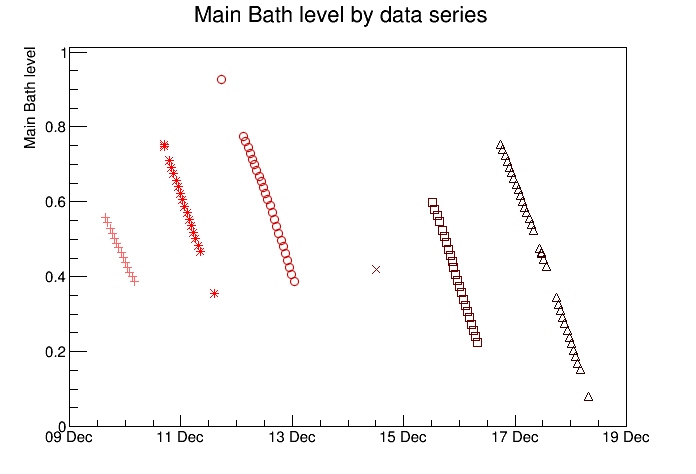
The plot below shows the main bath level for each good data series of this run (marker color and style are coded by each bath fill period):
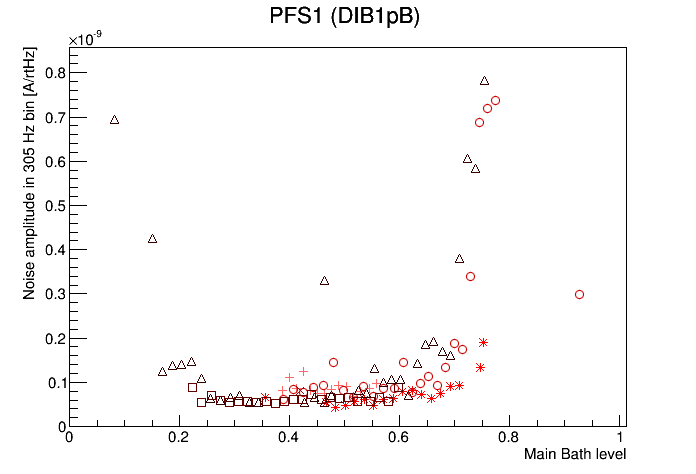
The plot below is one example of how the noise in the first PSD bin (centered at 305 Hz) varies as a function of bath level:
This link shows plots for all phonon channels: Low-frequency Noise as a function of Main Bath Level
It's clear that when the bath is above 70% the low-frequency noise is much worse. It also seems that the noise is elevated when the bath is below 25%, although the evidence is mostly from one fill period at the end of the run.
Main Bath Boiloff Rates
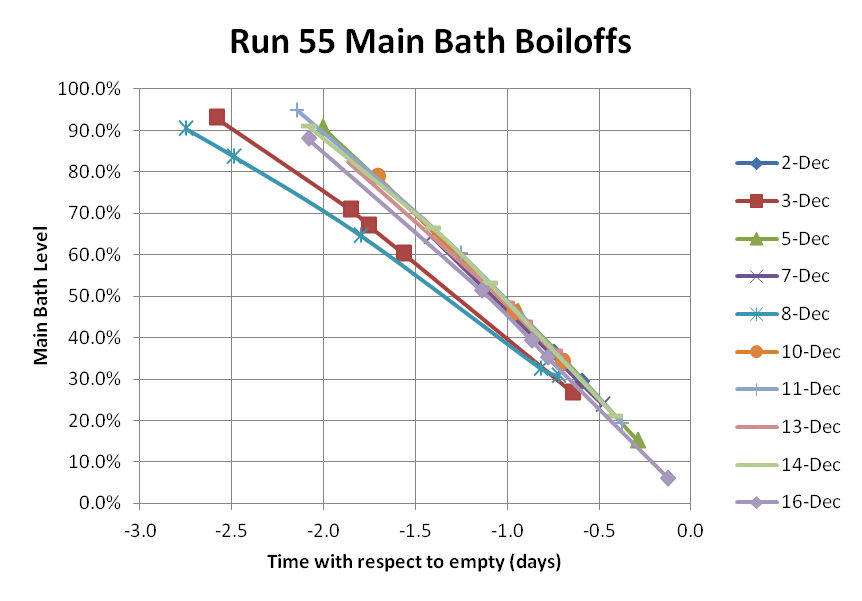
Between runs we pumped out the cryostat vacuum jacket. It was hoped that the main bath boiloff rate would be slower, but it seems about the same as before. The plot below shows the boiloffs for the various fills this run, shifted so that in each case the approximate time that the bath reaches 0% is at t=0 on the horizontal axis. There are two outliers in which the rate was slower than the other fills, but it is difficult to find any conditions that were significantly different for these fills. One guess is that variations in the pressure of the recovery system, which is of course out of our control, have some effect on our boiloff rates.