Table of Contents
Further Cryogenic Problems- 2012/07/29-present
At the beginning of Run 31 we had a poor initial base temperature. At that time we conducted a 1-shot mode test then, the results of which can be found on the main run summary page: Run 31 Initial Cryogenic Problems , and we cleaned the helium and nitrogen cold traps, which helped us lower the base temperature significantly. The lowest, stable base temperature we've reached this run has been 62 mK, which we maintained for at least a week. However, our base temperature has risen to 82 mK and several tests have indicated to us that our cooling power is very ineffective. Below is a summary of the progression of our attempts to lower the base temperature and figure out what is preventing us from doing so. In general, we've found that we are getting a very low cooling power while having a high circulation rate in our lines.
2012/07/29
After a long period of flashing the detector, the base temeperature settled down to 81.9 mK
2012/07/30
After taking some charge only data, the base temperature was at 78.2 mK. To go back down to the lower base temperature, we cleaned the helium and nitrogen cold traps. However, after cleaning them and re-commencing circulation, the temperature only got down to 89.5 mK. It was still decreasing at that point, but very slowly.
2012/07/31
The temperature at the beginning of this day was ~ 81 mK. Believing that the cold traps might still be at fault, they were cleaned again. This didn't improve things, however, for the base temperature by the next day was still 81 mK.
2012/08/01
Today a couple of tests were done to see how the temperature changed due to changes we input.
Removing Mixture
The first test was to see what the effect of removing mixture from the circulation lines would have on the temperature. We opened V9 to the dump for 3-5 seconds to pull in some mixture (2012/12/05 – Note: we also should have closed V13A, but that was probably not mentioned due to accident), and then closed V9. We recorded the pressure in the dump right away, and then when the temperature stabilized, we recorded the temperature for different stages and the pressures in P1, P2, G1, and G2. There aren't an extensive amount of data points for this test, but there wasn't a significant change in the temperature or pressures in pulling out the mixture.
| Time | G2 (immediate) | P1 (mbar) | P2 (mbar) | G1 (mbar) | G2 (mbar) | Mixing Chamber (mK) | Still (kOhms) | Cold Plate (kOhms) | 1 K Pot (K) |
|---|---|---|---|---|---|---|---|---|---|
| 1101 | 36→40 | 0.06 | 3.8 | 31.1 | 45.2 | 81.05 | - | - | 1.48 |
| 1131 | 35→41 | 0.06 | 2.8 | 30.8 | 44.8 | 81.08 | - | - | 1.43 |
| 1200 | 35.5→42 | 0.06 | 4 | 30.8 | 45.4 | 80.7 | - | - | 1.46 |
| 2307 | 42.8 | 0.06 | 3.4 | 37.3 | 50.7 | 81 | 4.63 | 15.38 | 1.45 |
| 2322 | (extra reading for previous test) | 0.055 | 4 | 36.4 | 49.6 | 79 | 4.64 | 15.44 | 1.46 |
| 2340 | missed it | 0.055 | 4 | 36.1 | 49.4 | 77 | 4.64 | 15.48 | 1.47 |
Applying Heat to the Mixing Chamber
In this test we applied heat to the mixing chamber and then recorded the temperatures of different stages and the pressures of P1, P2, G1, and G2. We started off in small increments when applying power of ~ 1 uW. Note that after 1551 we conducted a LHe transfer because the fridge was almost empty of LHe.
| Time | Power (uW) | Mixing Chamber (mK) | Still (kOhms) | P1 (mbar) | P2 (mbar) | G1 (mbar) | G2 (mbar) | 1 K Pot (K) | Cold Plate (kOhms) |
|---|---|---|---|---|---|---|---|---|---|
| 1504 | 1 | 100 | 4.65 | 0.06 | 4.5 | 31.7 | 47.1 | 1.48 | - |
| 1512 | 2 | 120 | 4.67 | 0.06 | 4 | 32.5 | 47.6 | 1.46 | 15.03 |
| 1517 | 3 | 122 | 4.69 | 0.06 | 4.5 | 32.6 | 48 | 1.48 | 14.77 |
| 1525 | 4 | 135 | 4.67 | 0.06 | 4 | 32.8 | 48 | 1.47 | 14.06 |
| 1532 | 4 | 123 | - | 0.065 | 4 | 34 | 49 | 1.47 | - |
| 1538 | 5 | 123 | 4.59 | 0.065 | 3.4 | 38.2 | 52 | 1.45 | 14.06 |
| 1546 | 5 | 119 | - | 0.065 | 3.6 | 40.7 | 55 | 1.45 | - |
| 1551 | 9 | 116 | 1.86 | 0.07 | 4 | 40.7 | 55.1 | 1.47 | 14.11 |
| 1710 | 30 | 133 | 4.63 | 0.065 | 3.8 | 37.8 | 53.6 | 1.46 | 13.94 |
| 1724 | 40 | 178 | 4.65 | 0.065 | 4 | 40.2 | 55.7 | 1.46 | 12.71 |
| 1734 | 50 | 206 | 4.68 | 0.07 | 4 | 44.6 | 60 | 1.47 | 11.97 |
| 2049 | 60 | 176 | 4.66 | 0.075 | 4 | 55.6 | 67.5 | 1.47 | 11.56 |
| 2114 | 70 | 205 | 4.64 | 0.08 | 3.8 | 57.4 | 69.2 | 1.48 | 10.8 |
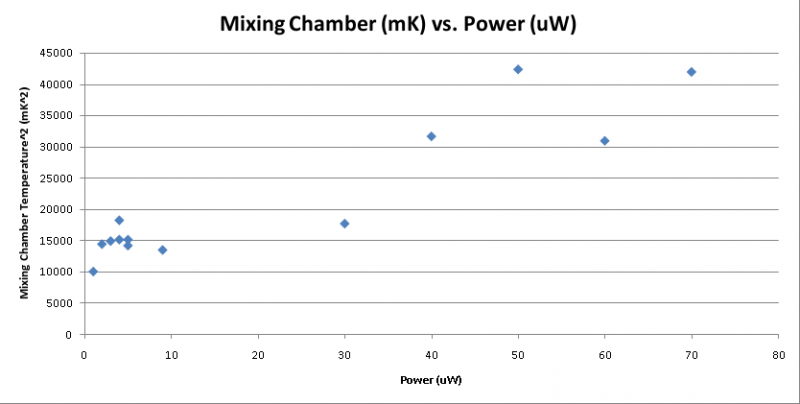 |
| Plot of Temp. Squared vs. Power, based on data points in table above |
The still's resistance stayed constant (except for one point the value changed distinctly- perhaps due to the transfer), and the temperature didn't change dramatically until increasing the power in increments of 10 uW.
2012/08/02
At 0005, we began a 1-shot mode test. The fridge was at the time circulating mixture, so we closed V13A and opened V9, which initiated the flow of mixture into the dump. The results of this test can be seen on the corresponding run diary page: 2012/08/02 According to the pressure and temperature plots, the mixing chamber temperature started to rise when the pressure in G2 ~ 240 mbar. Assuming this is mostly He3, the amount of He3 in the mixture is ~ 40%. The original He3 pressure was 200 mbar. Perhaps we are losing He4 from somewhere?
Heat was also added to the still (2mW, 5mW) but there was little effect on the base temperature.
We performed another cooling power test where we fixed an amount of mixture in the dump (say 60 mbar) and monitored changes in temperature and pressure with the goal of finding the ideal amount of mixture circulating and/or in the dump to reach a low base temperature. To set this amount of mixture, the fridge would start off in circulation mode, and we would close V13A. Then we would open V9 and monitor the pressure rise in G2 until it increased by 5 mbar. At that point, we would close V9 and open V13A to re-commence circulation. Once the temperature stabilized, temperature and pressure values were recorded. Afterwards, we applied 1 uW to the mixing chamber for 1-2 minutes (at most) to see if there was any cooling power effect. We would then turn off the heater and record the values for the temperature and pressures at that point. We would repeat the test by increasing the pressure in the dump by 5 mbar, wait for the temperature to stabilize, and conduct the steps above.
Except for the first line of values, every other line of entry has two times recorded which reflect the time when the dump had an increase of 5 mbar, and then the time when the temperature stabilized and values were recorded.
| Time | G2 put into dump (mbar) | Mixing Chamber (mK) | G1 (mbar) | G2 (mbar) | P1 (mbar) | P2 (mbar) | 1 K Pot (K) | Cooling Power? |
|---|---|---|---|---|---|---|---|---|
| 2016 | 65 | 74 | 39.7 | 52 | 0.06 | 5.5 | 1.53 | - |
| 2032 | - | 71.4 | 42.4 | 54.5 | 0.06 | 6 | 1.52 | no |
| 2039/2053 | 70 | 65.9 | 41.5 | 53.4 | 0.055 | 6.5 | 1.56 | - |
| 2056 | - | ~77 | 41.7 | 53.5 | 0.055 | 7.5 | 1.565 | no |
| 2101/2116 | 75 | 65 | 41.5 | 53.1 | 0.06 | 6 | 1.525 | - |
| 2117 | - | 94 | 41.9 | 53.4 | 0.055 | 5 | 1.510 | no |
| 2126/2140 | 80 | 65.1 | 42.3 | 53.9 | 0.06 | 5.5 | 1.52 | - |
| 2142 | - | 102 | 42.5 | 53.9 | 0.06 | 5.5 | 1.53 | no |
| 2153/2205 | 85 | 65.4 | 42.2 | 53.6 | 0.06 | 5.5 | 1.53 | - |
| 2206 | - | 95 | 42.6 | 53.7 | 0.06 | 6 | 1.53 | no |
It seems that the temperature CAN reach 65 mK. We adjusted the amount of mixture in the dump to 75 mbar since that seemed to give us the lowest temperature, but the temperature leveled out at 76.5 mK. Overnight we left 85 mbar in the dump and in the morning the temperature was at 74.1 mK.
2012/08/03 - 2012/08/04
After having 85 mbar in the dump overnight, 1 uW of power was applied to the mixture chamber, which spiked the temperature up. There was more variation of mixture in the dump, but nothing that produced promising results.
The cold traps were checked again to see whether they were still contaminated. They were pulled out and the pressure in G1 read ~ 1 mbar. This means that they're were relatively clean, still, and weren't the problem here. There was still a gradient across the cold traps, though, because there was consistently a pressure difference of at least 10 mbar betwee G1 and G2.
2012/08/05
A test done was to restrict the flow of mixture back into the fridge by closing V12A little by little. This has little effect on the mixing chamber temperature. We could have perhaps turned out the still heater to increase the circulation rate and see if that had an effect on the temperature, but the circulation rate is already high. Though we seem to have a high circulation rate, the cooling power is low. When we've done tests to see what the appropriate amount of mixture should be to get the lowest temperature, we've been able to reach 65 mK. However this isn't stable for very long. The base temperature returns to 81-82 mK.
Where to go from here?
At this point we can say that we're not getting proper cooling power and our circulation rate is high. All of the cold traps appear clean. Thus, this rise in base temperature could be due to contact in the fridge or we don't have the right amount of He3-He4 mixture. At this point, more suggestions for tests are welcome. We can continue to take more charge data, or warm up and try to correct the problem from there.