2020/10/28 (Wednesday)
- Lab in-person: Ruiren, then Matt
- Virtual partner: Matt, then Pramod/Derek/Nick
| Setup | Run 73. DIB 1/3/4 → Stripline 43/48/41 → pi-filters 1/2/3 → Cable 3/1/2 → nothing/nothing/accessory_interposer → HV_Conn 1/3/2 → HV 1/2 → DCRCX(4)/DCRC55(1)-master; DCRC33(2) → HV control. DCRCs on. Lead/poly shield erected (4 lead walls, 2 poly walls). |
|---|---|
| 1030 | There was a DAQ crash during the +300V data series last night. HV still stuck at high this morning. Flash never happened. |
| 1035 | Try restarting DAQ programs but they crash, probably need to restart MIDAS from scratch |
| 1045 | Restart MIDAS, then try restarting programs. To get them to all start I need to disable some DCRCs at first, this is familiar behavior. But - starting with DCRC2 enabled, I expect the ODB settings to applied, so I expect the HV to fall to zero. But it's still high (>300V). Try modifying DCRC2 qI… there's still no change in HV, and modifying the ODB seems to cause dcrc_driver and tower_fe to crash. I don't remember this sort of behavior. |
| 1055 | Managed to start programs with DCRC1&4 enabled, and the Pulse Viewer is working. Also confirm that changing ODB settings (a phonon offset) works, it responds. |
| 1100 | Can't seem to get programs to start with DCRC2 enabled. So we are still stuck at high bias. |
| 1411 | Ruiren enters lab |
| 1411 | transfer lN2 into cold trap dewar |
| 1412 | Tower/MC/Coldplate = 58.8/30.9/194 mK, Still = 1.46 K / 0.120 mbar / 0 mW, G1/G2= 238/225 mbar, 1K Pot = 1.62 K / 18±2 mbar. |
| 1417 | Ruiren leaves lab |
| 1425 | Matt enters lab |
| 1430 | HV is stuck at 330V |
| 1430 | Try turning on DAQ programs with only DCRC2&4 enabled. At first they go on, but they seem to crash after a minute or so. |
| 1435 | With DAQ programs off, we'll unplug DCRC2. This will probably cause the HV supply to switch off and the bias to fall to 0V. |
| 1435 | Unplug DCRC2. HV supply turns off, HV falls to 0V. Now - should I plug in DCRC2 with the HV still switched on? That's not the safest. I think I'll start by turning off the power switch on the HV supply, then plug in DCRC2. |
| 1440 | With HV supply switch off, plug in DCRC2. Can hear it switch the relay back on. Try turning on the DAQ programs and adjusting DCRC2 qI. It seems to be OK, DAQ programs have not crashed. |
| 1440 | Turn HV back on. It stays at 0V - good. Adjust qI: HV changes, good. Set it back to 0V. It actually reads a little negative at first, perhaps from the leftover charge on the detector. |
| 1455 | Measure resistance from Far Endstop to ground with multimeter - it's bouncing around 100-200 Ω. Something caused Tower temperature to spike to 0.65 K, then cool - was it the multimeter? |
| 1540 | Connect oscilloscope to measure across the capacitors on one motor coil (CH1) and across the trim pot of the same coil (CH2). This is the setup of the second photo from Run 71 on 2019 Nov 14. |
| We'll try a +4 step move. This should move the source away from the endstop (maybe). | |
| 1543 | Move source with “mv +4” at Arduino Editor page. Looks like I didn't have the scope set properly for single-trigger acquisition. Temperature spikes as expected. |
| 1555 | Check resistance of far endstop to ground: <1 nS. So it looks like we broke contact as expected, good. |
| 1555 | Press the Single Sequence button on the scope. I think this will do what we want: trigger once and save the output on the screen. |
| 1547 | Move source with “mv +4” at Arduino Editor page. Scope output doesn't change at all. Maybe something is wrong with the connection? Next time we'll try triggering on CH1 instead of CH2. |
| 1601 | Move source with “mv +4” at Arduino Editor page. Scope output doesn't change at all, even though I'm triggering on CH1 (the ones attached to the probes on the breadboard). What's the problem? |
| I had the scope set to Peak Detect, previously it was set to Sample. Try setting it back to Sample. | |
| 1613 | Move source with “mv +4” at Arduino Editor page. This time the scope catches an image! But I had the time division set wrong - 100us, should be 100 ms. So just seeing some weird spiky thing. OK, we'll try again. |
| 1618 | Move source with “mv +4” at Arduino Editor page. Scope time setting looks ok, although I should reset the trigger time. But amplitude is off scale. Surprising because the scale is +8/-8 V, like before. Maybe I have it set to 10x or something. Change “attenuation” to 1x on both channels, it was at 10x. And the scope shows me the full waveform after that, I can change the scale after the fact. |
| I'm pretty sure the scope was saturating in this case, so we'll ignore this one. | |
| 1630 | Move source with “mv +4” at Arduino Editor page. This time scope was set with 1x attenuation in each channel. Now we're seeing plausible waveforms. |
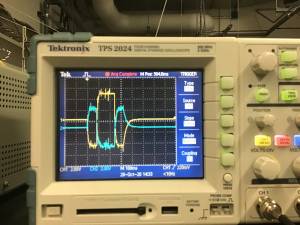
| OK, now we're interested in seeing what happens if we issue moves in more rapid succession. Something much less than the 4-minute pause. | |
| 1640 | Move source with “mvNwait +4 30 2”, and reset scope trigger after first move so we can see the second. |
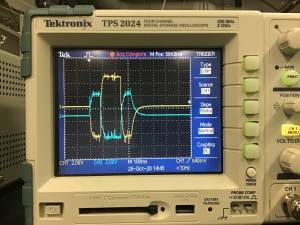 |
| Waveform looks just as good as last time! |
| We've done 8 +4step moves today. Let's try moving back to the endstop. We'll start with 7 -4step moves, and we'll try with the 30-second pause between. | |
| 1657 | Move source with “mvNwait -4 30 7” |
| OK, not sure if the waveforms look good, because the shape for -4step moves seems to be different than for +4step moves, so I don't have a “good” basis of comparison. Tower temperature continued to rise during this sequence, up to 1.7 K by the end. The cooling after the sequence looks slower than with the single- or double-moves we were doing earlier. |
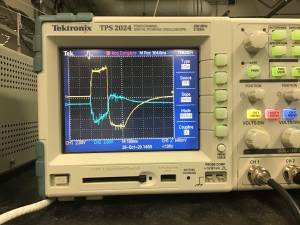 | 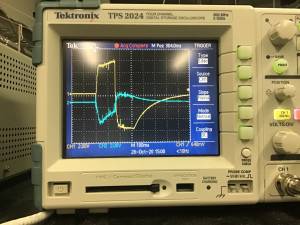 |
| 2nd move | 3rd move |
| Far endstop resistance is still open. We should be able to reach it with one more -4step move. I'll wait for it to cool more before trying, currently Tower = 1.1 K. | |
| 1710 | Tower = 0.8 K. Let's try a single -4step move, see if it hits the endstop again. |
| 1712 | Move source with “mv -4”. Waveform looks similar to Moves 2&3 from the 7-move sequence. However we don't quite seem to be in contact with the endstop. |
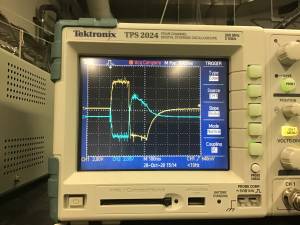
| 1717 | Move source with “mv -4”. Still not in contact with endstop. |
|---|
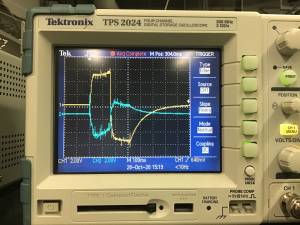
| 1724 | Move source with “mv -4”. Now we are in contact with the endstop, reading 19 Ohm. (Not entirely sure that we weren't in contact with the last move, I'm not sure I had the range set correctly.) |
|---|---|
| Let's try to move away from the endstop again | |
| 1729 | Move source with “mv +4”. This breaks contact with the endstop. |
| 1736 | Move source with “mv -4”. Resistance of endstop is unstable but it seems to be in contact. In nS mode it reads OL. |
| Let's try a slow-ish sequence of moves away from the endstop, then a faster sequence back to the endstop, see if we lose any steps on the way back. | |
| 1740 | Move source with “mvNwait +4 180 4”. A little faster than the standard 4-minute wait, this is 3-minute. But it's getting late. |
| Ok let's move the other direction now but faster. | |
| 1753 | Move source with “mvNwait -4 30 4”. Notice that the amplitude of the second part of the current is smaller after Move2 than it was after Move1. Tower rises to 1.35 K during sequence. And: we're in contact with the far endstop! So at least with 4 -4step moves, you can move perfectly OK with 30 second wait between. But not sure about more moves (from earlier today it looks like 7 moves may not have worked). |
| 1800 | Matt leaves lab |
| 2050 | OK, let's try another slow move in the +y direction, equal fast move in the -y direction. This time 8 moves. From the 7 move sequence earlier, with 30 second waits, it looks like this probably won't work - we'll lose some steps. Like an efficiency of 5/7 = 71%. |
| 2058 | Move source with “mvNwait +4 240 8”. Should finish at 21:30. |
| Looks like moves in the + direction don't warm as much as in the - direction. Tower peaks at 1.1 K, about the same as in the -direction, but cools as low as 0.3 K between, in contrast to 0.8 K for -direction move sequences. | |
| 2142 | Move source with “mvNwait -4 30 8”. This will only take 4 minutes. |
| Tower thermometer rose to 1.6 K during the series, then started cooling. We'll check tomorrow to see if it hit the endstop, and if not how many more moves it takes. | |
| These hot move sequences are more likely to cause trapped flux in the QET fins. So we should take more data and see whether phonon collection efficiency is low. | |
| 1015 | Definitely takes longer to cool after this fast sequence: 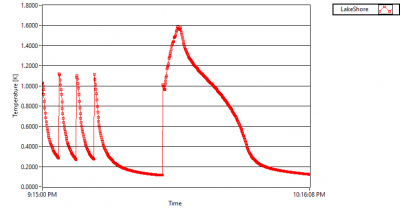 |
| 1030 | Tower = 96 mK and cooling. Had to work a little to get Pulse Viewer working, but now it is - seeing pulses in the channels already. |
| Sorta looks like phonon fall times are faster. Is that a symptom of trapped flux? | |
| 1035 | Ugly pulses in DCRC1pB, we should zap. |
| 1035 | Zap DCRC1&4 SQUIDs |
| 2320 | Tower thermometer has fallen to around 70 mK. Take a few IbIs on DCRC1pD, detector temperature is around 58.4 mK. |
|---|---|
| 2326 | Start a 60 min series at HV = 0V, CDMS detector: Driver Gains = 1x, DCRC4/1 QET biases = automatically updated to track temperature, Front-End Gains = (3/3/3)/(5/5/5) 1000 BOR & 5 Hz in-run randoms, trigger on DCRC1pB/D threshold = 8/8 Use sequence SimpleDataLoopNoFlash.msl Use QETbias_update.c, function sequence_update_QETbiases(60,30,0,0.0295,56.33) |
| Tower thermometer fell from 69.0 to 58.7 mK during series. |