2020/10/29 (Thursday)
- Lab in-person: Matt
- Virtual partner: Ruiren, Derek
| Setup | Run 73. DIB 1/3/4 → Stripline 43/48/41 → pi-filters 1/2/3 → Cable 3/1/2 → nothing/nothing/accessory_interposer → HV_Conn 1/3/2 → HV 1/2 → DCRCX(4)/DCRC55(1)-master; DCRC33(2) → HV control. DCRCs on. Lead/poly shield erected (4 lead walls, 2 poly walls). |
|---|---|
| 0817 | MB = 34.4% |
| 0905 | Tower thermometer = 53.4 mK and unusually flat this morning. DCRC1pD IbIs suggests detector temperature = 57.4 mK |
| 0925 | Start a 60 min series at HV = 0V, CDMS detector: Driver Gains = 1x, DCRC4/1 QET biases = automatically updated to track temperature, Front-End Gains = (3/3/3)/(5/5/5) 1000 BOR & 5 Hz in-run randoms, trigger on DCRC1pB/D threshold = 8/8 Use sequence SimpleDataLoopNoFlash.msl Use QETbias_update.c, function sequence_update_QETbiases(60,30,0,0.035,55.60) |
| Tower thermometer stayed between 53.4 and 53.5 mK during series. |
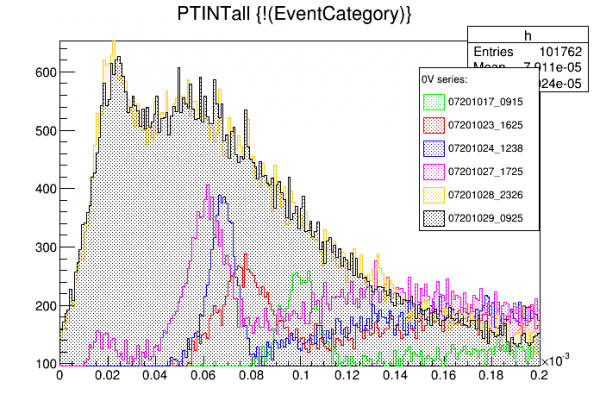
The recent 0V data, after doing the fast source mover moves, differs from older 0V data. As seen below, fall times are faster for some reason, and it looks like amplitudes are low (presumably reduced phonon collection efficiency).
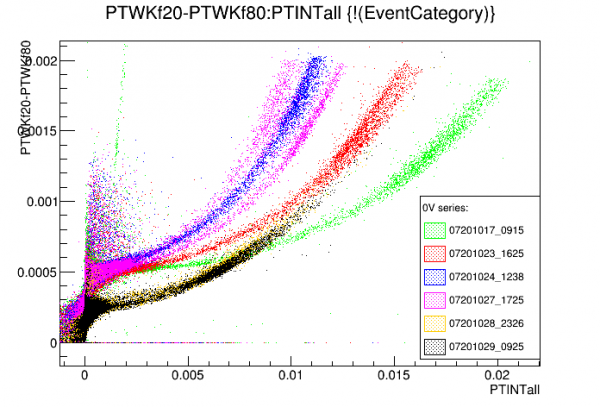
Here's a comparison of PTINTall spectra (since pulse shapes are changed, this seems a more fair comparison than PTOFamps)
| 1150 | Matt arrives in lab |
|---|---|
| 1155 | Matt Fritts body temperature = 97.4 F |
| 1155 | Tower/MC/Coldplate = 53.5/30.8/183 mK, Still = 1.30 K / 0.120 mbar / 0 mW, G1/G2= 247/224 mbar, 1K Pot = 1.62 K / 19±2 mbar. |
| 1205 | Check resistance to far endstop (Pin1-ground) - it's open. Last night I did a slow +4×8 step move away from the endstop, and a fast -4×8 step move back. Looks like it didn't quite get all the way back to the endstop. |
| 1205 | Move source with “mv -4”. Still no contact with endstop. |
| 1212 | Move source with “mv -4”. Still no contact with endstop. |
| 1225 | Move source with “mv -4”. Now there's contact with the endstop, ~ 1 kΩ. |
| It took 11 4step moves to get back to the endstop when it should have taken 8. Or put another way, the fast 8 moves amounted to only 5 moves. So that's a 5/8 = 63% step efficiency. | |
| 1226 | Begin LHe transfer @ MB = 28.6% |
| Let's try another fast-move test, do a slow +4×8 sequence of moves, then a fast -4×8 move, but not as fast. We'll increase the wait from 30 seconds to 60 seconds. | |
| 1234 | Move source with “mvNwait +4 180 8”. Should finish at 12:58. |
| 1305 | Move source with “mvNwait -4 60 8”. The temperature pattern looks a little better than in the 30-second-wait case, at least there is some cooling between peaks. But each peak was warmer than the last, up to the last two which look pretty similar, so they may represent the steady state. The last two peaks were 1.42 K with a 1.33 K minimum between. At end of sequence, source mover carriage is not in contact with endstop. |
| 1333 | Move source with “mv -4”. Now there is contact with the endstop. This suggests a 7/8=88% step efficiency. But it could have been 100% - I noticed after we made contact before that a little later it looked like there was no contact again. So a 1-move error should probably be assumed. |
| 1345 | Move source with “mvNwait +4 180 8”. Should finish at 14:09. |
| 1413 | Move source with “mvNwait -4 90 8”. Temperature pattern is similar to the 60-second case. The last peak is 1.35 K, and the minimum before the last peak is 1.21 K. So a little less than the 60-second case. At end of sequence, source mover is in contact with the endstop. So apparently this is 100% step efficiency. |
| 1446 | Move source with “mv +4”. A single move - I just wanted to see it break contact with the endstop. It did, indeed, break contact. |
| 1515 | Set up Keithley meter to read endstop resistance. This requires disabling the LabVIEW readout for that meter, so no Vtest. Set up a camera so we can see the meter remotely, updating every 60 sec |
| 1533 | Move source with “mv -4”. A single move - now I can see on the Keithley that it's reading around 80 Ohm, indicating contact. |
| 1545 | Fill LN2 cold trap bath. Note: had to use 5L Dewar because big was empty. It turns out it took about 5L exactly to fill it, so I guess that's around what our daily usage is. |
| 1545 | Move source with “mvNwait +4 180 16”. Should finish at 16:33. Unusual pattern this time. The first four moves were normal, with minimum around 0.3-0.4 K, but the minima were higher after that: 0.6 for a few, then as high as 0.9 for the last several. |
| 1550 | Matt leaves lab |
| Now we'll try moving back to the endstop with 90-second waits between moves, like last time (except twice as many moves this time). | |
| 1651 | Move source with “mvNwait -4 90 16”. Last max = 1.39 K, last min = 1.29 K. Endstop resistance still off-scale, no contact. |
| 1730 | Move source with “mv -4”. Still no contact with endstop. |
| 1736 | Move source with “mv -4”. Still no contact with endstop. Hmm. Did a wire from the meter come lose? Seems unlikely. |
| 1750 | Move source with “mv -4”. Still no contact with endstop. |
| 1803 | Move source with “mv -4”. OK, now there's contact with endstop. 20.9Ω |
| This suggests that the -4×16 move sequence with 90sec waits missed 4 moves, so 12/16 = 75% step efficiency. | |
| 1817 | Move source with “mvNwait +4 240 16”. Should finish at 19:21. Kinda weird temperature pattern again, after moves 7-13 the minima were kind of elevated, around 0.8 K, but the first and last were lower, more like 0.5 K. |
| 1934 | Move source with “mvNwait -4 120 16”. Last max = 1.35 K, last min = 1.20 K. Strangely, there was endstop contact after the 15th move - but then contact was lost after the 16th! |
| 2025 | Move source with “mv +4”. No contact with endstop. |
| 2045 | Move source with “mv +4”. No contact with endstop. |
| 2057 | Move source with “mv -4”. Contact with endstop, 225Ω |
| 2235 | Tower has cooled to 177 mK and is stuck there. It could be that the resistance measurement is heating the tower. Let's move 4steps away from the endstop to break contact. |
| 2238 | Move source with “mv +4”. |
| 2255 | Yeah the Tower is cooling further after that move, 134 mK and falling |