2020/08/13 (Thursday)
- Lab in-person: Matt
- Virtual partner: Nick, Michael, Derek
| Setup | Run 73. DIB 1/3/4 → Stripline 43/48/41 → pi-filters 1/2/3 → Cable 3/1/2 → nothing/nothing/accessory_interposer → HV_Conn 1/3/2 → HV 1/2 → DCRCX(4)/DCRC55(1)-master; DCRC33(2) → HV control. DCRCs on overnight. Lead/poly shield erected (4 lead walls, 2 poly walls). |
|---|---|
| 0800 | Perform IbIs on DCRC1pD at 55.1 mK |
| Using this and also IbIs at 51.9 mK and 58.3 mK, try to refine the table of QET biases. The intent is to have dP/dI in all cases roughly match what it was at 51.9 mK for the standard QET biases chosen after that IbIs. The technique is to calculate prefactor*QETbias, which is proportional to dP/dI (in the linear approximation). I only did this for the one phonon channel; for the others we use the observation that it seems that the same shift in QET bias seems to apply, with the exception of the oddball DCRC1pB. |
| QET bias table | |||
|---|---|---|---|
| Temperature range | |||
| 50.9 to 54.1 | 54.2 to 57.4 | 57.5 to 60.7 | |
| DCRC4pB | 320 | 310 | 300 |
| DCRC4pC | 370 | 360 | 350 |
| DCRC1pB | 360 | 360 | 350 |
| DCRC1pC | 420 | 410 | 400 |
| DCRC1pD | 420 | 410 | 400 |
| 0925 | Tower = 54.7 mK. Set QET biases to Column2 values. |
|---|---|
| 0930 | Write sequence for -75V at 48.7 mV/s, 1min pause after rampup. HVdrift_neg75V_1min_48p7mVps_multiloop10_60min.msl |
| 0946 | Start a 60 min series at HV = -75V, drifting 0.0487 V/s, 1min pause after rampup, CDMS detector: Driver Gains = 1x, DCRC4/1 QET biases = (0,310,360,0)/(0,360,410,410) uA, Front-End Gains = (3/3/3)/(5/5/5) 1000 BOR & 5 Hz in-run randoms, trigger on DCRC1pD threshold = 8 Use sequence HVdrift_neg75V_1min_48p7mVps_multiloop10_60min.msl |
| 0944 | Tower = 54.5 mK |
| 0947 | Vtest = -4.5 mV shortly after drift begins. Drift appears to start at -77.2 V. |
| 1052 | Vtest = -14.0 mV, HV = -251.8 V, drift ends. Lag ratio = 1.10. |
| 1054 | Tower = 54.1 mK. This fell slightly into the Column 1 range of the QET Bias table |
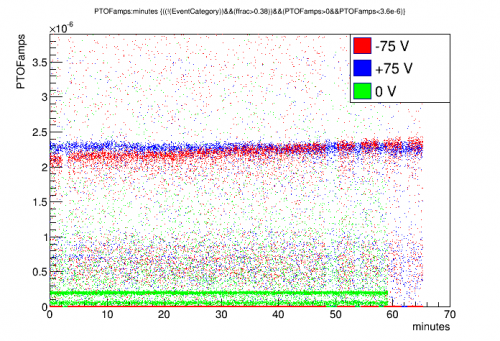 |
| Drift rate still too high. Guess maybe 45.7 mV/s |
| Let's try the source mover today if we can. There are some connection notes from 2019 Nov 8 Notes on hot LED flash 2019 Nov 11 |
|
| 1200 | Matt Fritts body temperature 98.6 F |
| 1200 | Matt enters lab |
| 1200 | Tower/MC/Coldplate = 55.1/37.4/190 mK, Still = 1.41 K / 0.12 mbar / 0 mW, G1/G2= 405/370 mbar, 1K Pot = 1.65 K / 28±2 mbar. |
| note: still cooling after flash | |
| 1210 | Follow this link for arduino control: https://create.arduino.cc/editor/flyingfeet213/083dfa23-4f45-4eaa-87c7-e62b2ff1883e/preview. This is Nick's shared code. From there create my own login. Select WEB EDITOR from menu. Then click MONITOR to get communication interface. |
| 1230 | Original motor wiring to Arduino board: Motor A/B = wires brown,orange/red,yellow. Later in Run 71 we added a breadboard with capacitors for filtering… brown,orange/red,yellow into board corresponds to violet,gray/white,black out of board. So we'll plug in in that order to the arduino. |
| 1235 | Switch off GwINSTEK power supply power to Arduino first, using Output button. Then plug in the wires from the source mover to the arduino. Turn power back on. |
| take a look at phonon channels, a couple of them have railed, others seem ok | |
| 1243 | OK let's try a move. Do mv +4. Tower temperature spikes to 0.7 K, then starts cooling. Takes 7 minutes to cool below 0.1 K. |
| Power supply for motor set to 7.1 V. Dwell on arduino = 15 ms. | |
| Looks like in Run 71 we settled at +/-4 moves, 4 minute pauses, power set to 8.0 V, dwell set to 40 ms. Tower would heat to around 0.4 K so it seems worse this run. | |
| 1257 | Tower =72 mK. Do mv -4. Tower spikes to 760 mK. |
| Note: dwell should probably be 40 ms with the capacitors present. These first two moves were done at 15 ms dwell - Nick thinks that maybe it only the first of four steps will work that way. | |
| Set source mover power to 8.0 V, dwell to 40 ms. | |
| 1310 | Swap HV power leads to positive polarity |
| 1310 | Turn off motor power (GwINSTEK) and Arduino power (USB at fridge computer) |
| 1315 | Fill LN2 cold trap bath |
| 1340 | Remove LN2 Dewar so that Mike can fill it. So Ebox purge is paused. Put a stopper in the purge line to help keep moist air out. |
| 1345 | Matt leaves lab. |
| 1635 | Tower = 59.6 mK |
| We want to take data to compare to some previous data, see if the phonon collection efficiency has fallen as we expect it to. Let's try to repeat the +40V data taken late on Aug 9. Those aren't the same QET biases as the updated table I made, but we'll use those old ones anyway for a apples-to-apples comparison. That data was taken at 57 mK, which is relatively warm although we're a chunk warmer now. | |
| 1640 | Apply QET biases = (0,290,340,0)/(0,350,390,390) and check phonon channels, had to unrail a couple. DCRC1pB is troublesome, had to set its offset abnormally high. |
| 1652 | Start a 60 min series at HV = +40V, drifting 0.0269 V/s, no prebias, CDMS detector: Driver Gains = 1x, DCRC4/1 QET biases = (0,290,340,0)/(0,350,390,390) uA, Front-End Gains = (3/3/3)/(5/5/5) 1000 BOR & 5 Hz in-run randoms, trigger on DCRC1pD threshold = 8 (later raised to 12) Use sequence HVdrift_pos40V_26p9mVps_multiloop10_nopre_60min.msl |
| 1651 | Tower = 59.3 mK |
| 1653 | Vtest = 5.2 mV shortly after drift begins. Drift appears to start at +39.4 V. |
| Leakage current is higher than usual, reducing HV by about 5% (it had been mostly around 2%). Maybe because the Ebox purge is off. | |
| 1658 | BatViewer suggests that we are triggering too much. Try raising threshold 8→12. |
| 1758 | Vtest = 23.5 mV, HV = 136.0 V, drift ends. Lag ratio = 1.10. |
| Leakage current shows 7% loss in HV | |
| 1800 | Tower = 58.5 mK. |
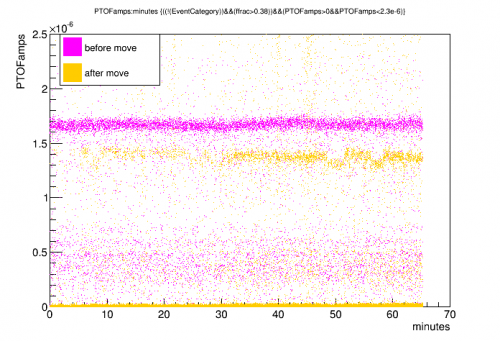 |
| Gain seems to have fallen after move, but not as severely as in the iZIP in R71 |
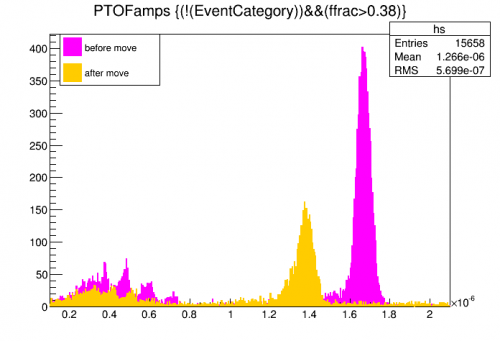 | 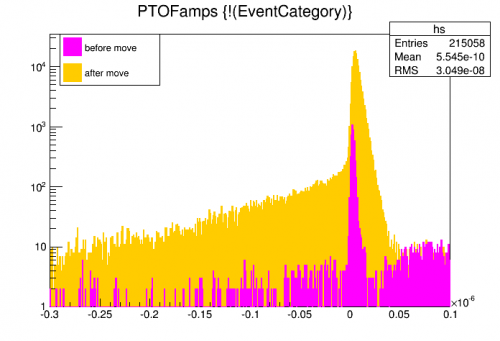 |
| Gain is down 17% for the 60keV peak, ~14% for lower peaks. Only about 4% of this can be attributed to the higher HV leakage current | After the move there's dramatically more low-energy junk. |
Overall observations of the effects of the source mover on the phonon channels:
- Phonon Collection Efficiency is reduced by >10%
- Noise width from randoms is a little higher, but a stronger effect seems to be a lot of low-energy junk, had to increase the trigger threshold. This is a sort of noise too, but I guess sporadic enough to not show up in the OF window in randoms very often.
| 1725 | Matt Fritts body temperature 98.6 F |
|---|---|
| 1900 | Try adjusting LED settings for a Hot Al Flash to restore Phonon Collection Efficiency. Start with the current standard: LEDPulseWidth/LEDRepRate/LED1Current = 100/10000/0.6. Tower→0.8 K after about a minute. Meant to reduce RepRate to 5000, but typed in 500 instead - Tower→2.3 K. Go back to RepRate 10000, Tower-0.9 K. At RepRate 2000, Tower→1.55 K, that's probably good. Leave it there for 2 minutes then turn off LEDs. |
| 1910 | Turn off flash at this time |
| 1915 | Write sequence for hot Al flashing, LEDPulseWidth/LEDRepRate/LED1Current = 100/2000/0.6, for 90 seconds. Al_flash_DCRC1.msl |
| 1940 | Tower = 100 mK, 30 minutes after Al flash |
| 2010 | Tower = 72 mK, 60 minutes after the flash. Pulses look strong though, kind of surprising - is the detector cooler than the tower thermometer? |
| 2110 | Tower = 63 mK, 120 minutes after the flash. |
| 2310 | Tower = 58.3 mK, 4 hours after the flash. |