2020/08/14 (Friday)
- Lab in-person: Zach
- Virtual partner: Matt
| Setup | Run 73. DIB 1/3/4 → Stripline 43/48/41 → pi-filters 1/2/3 → Cable 3/1/2 → nothing/nothing/accessory_interposer → HV_Conn 1/3/2 → HV 1/2 → DCRCX(4)/DCRC55(1)-master; DCRC33(2) → HV control. DCRCs on overnight. Lead/poly shield erected (4 lead walls, 2 poly walls). |
|---|---|
| 0815 | Tower = 53.4 mK |
| QET bias table | |||
|---|---|---|---|
| Temperature range | |||
| 50.9 to 54.1 | 54.2 to 57.4 | 57.5 to 60.7 | |
| DCRC4pB | 320 | 310 | 300 |
| DCRC4pC | 370 | 360 | 350 |
| DCRC1pB | 360 | 360 | 350 |
| DCRC1pC | 420 | 410 | 400 |
| DCRC1pD | 420 | 410 | 400 |
| Normally I would apply the middle-column QET biases, but we want to try to make as close a comparison as possible to the last series. We are comparing a series before moving the source to one after moving the source, before an Al flash - now we want to take one after the flash. Tower is cooler now than either of the other two series - I'll try settings that are a little too low, as they were in the other series. | |
| 0820 | Apply QET biases = (0,300,350,0)/(0,350,400,400) and check phonon channels, adjust offsets. Reset DCRC1pD trigger threshold back to 8, had to raise it to 12 for last night's pre-flash series. |
| 0830 | Start a 60 min series at HV = +40V, drifting 0.0269 V/s, no prebias, CDMS detector: Driver Gains = 1x, DCRC4/1 QET biases = (0,300,350,0)/(0,350,400,400) uA, Front-End Gains = (3/3/3)/(5/5/5) 1000 BOR & 5 Hz in-run randoms, trigger on DCRC1pD threshold = 8 Use sequence HVdrift_pos40V_26p9mVps_multiloop10_nopre_60min.msl |
| 0829 | Tower = 53.4 mK |
| 0832 | Vtest = 6.6 mV shortly after drift begins. Drift appears to start at +39.2 V. |
| Leakage current even worse than last night, very likely because Ebox purge is suspended while the LN2 Dewar is waiting to be refilled. About 7% HV loss. | |
| 0835 | Check Pulse Viewer, trigger rate looks OK. |
| 0936 | Vtest = 18.9 mV, HV = 135.9 V, drift ends. Lag ratio = 1.10. |
| 0936 | Leakage current shows 5.5% loss in HV, not quite as bad as last night |
| 0940 | Tower = 53.3 mK. |
 |
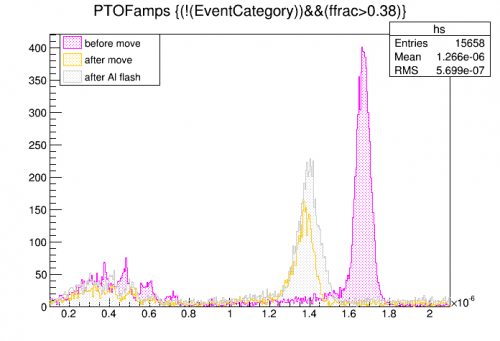 | 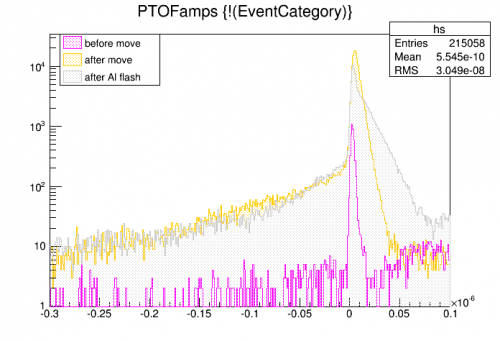 |
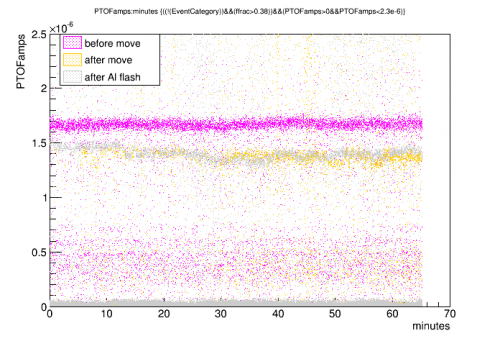
The hot Al flash did not seem to improve things. The post-flash data looks similar to the pre-flash data: lower gain, lots of low-E noise, also less stable gain.
| 0937 | Another DAQ Crash, during the HV rampdown, HV stuck at 102.3 V. |
|---|---|
| 0945 | This time I just tried restarting MIDAS, without trying to kill everything. The only thing that seemed to have crashed was mhttpd. Sequence started from where it left off and HV seems to be ramping down normally. |
| 1130 | Using the pulse viewer I can see the low-energy junk - spiky pulses - in the triggered data. Could probably take a little 0V data and be able to see the junk. Then maybe try zapping the SQUIDs to see whether that helps. |
| 1135 | Tower = 54.0 mK. Set the QET biases to Column 1 values. DCRC1pB offset is abnormal but it's possible to unrail it. |
| 1146 | Start a 15 min series at 0V, CDMS detector: Driver Gains = 1x, DCRC4/1 QET biases = (0,320,370,0)/(0,360,420,420) uA, Front-End Gains = (3/3/3)/(5/5/5) 1000 BOR & 0 Hz in-run randoms, trigger on DCRC1pD threshold = 8 Use sequence SimpleDataLoopNoFlash.msl |
| 1148 | Tower = 54.0 mK |
| 1200 | Zap SQUIDS on DCRC1&4 |
| 1210 | Tower/MC/Coldplate = 54.7/40.8/169 mK, Still = 1.09 K / 0.12 mbar / 0 mW, G1/G2= 408/374 mbar, 1K Pot = 1.64 K / 26±2 mbar. |
| Coldplate and still at low temp. | |
| 1215 | Pulse Viewer still shows some spiky low energy junk. Let's take another data series to see if it's any different after the zap. |
| 1219 | Start a 15 min series at 0V, CDMS detector: Driver Gains = 1x, DCRC4/1 QET biases = (0,320,370,0)/(0,360,420,420) uA, Front-End Gains = (3/3/3)/(5/5/5) 1000 BOR & 0 Hz in-run randoms, trigger on DCRC1pD threshold = 8 Use sequence SimpleDataLoopNoFlash.msl |
| 1220 | Tower = 60.5 mK. Crap! Something made it go up. I guess it was just from Zach working on top of the fridge. |
| 1225 | Tower = 61.8 mK. And just now something is making it go up again, even though Zach is nowhere near the fridge… |
| 1230 | Tower = 63.0 mK |
 |
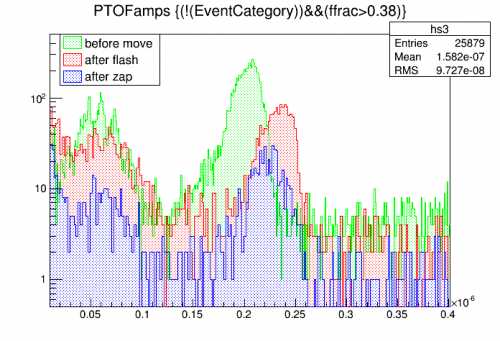 | 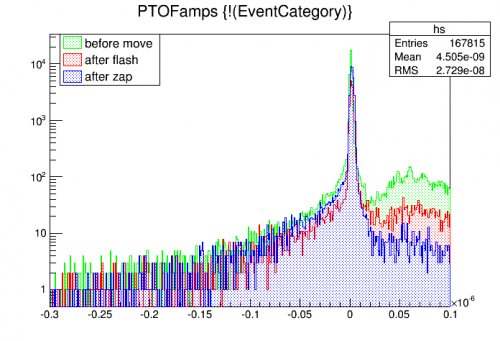 |
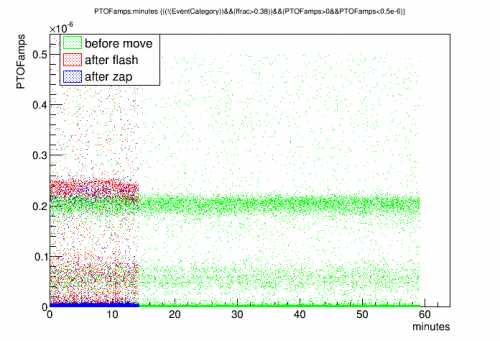
So, actually the 0V data doesn't look much different - in fact the gain looks a little higher. Note that the after-zap one was at elevated temperature.
New theory: the problems we saw with +40V data in the last two series maybe were caused by the extra HV leakage from the pause in Ebox purge. Let's try again after the purge is restarted.
| 1230 | Reestablish Ebox N2 purge after getting refilled LN2 Dewar |
|---|---|
| 1235 | MB = 28.0% |
| 1240 | Started LHe transfer @ MB = 28.0% |
| 1250 | Filled LN2 cold trap dewar. |
| 1318 | Ended LHe transfer @ MB = 92.8 % |
| 1351 | Zach leaves lab. |
| 1548 | Start a 60 min series at HV = +40V, drifting 0.0269 V/s, no prebias, CDMS detector: Driver Gains = 1x, DCRC4/1 QET biases = 1000 BOR & 5 Hz in-run randoms, trigger on DCRC1pD threshold = 8 Use sequence HVdrift_pos40V_26p9mVps_multiloop10_nopre_60min.msl Looks like I used Column1 QET biases by mistake… maybe…? |
| 1548 | Tower = 59.6 mK |
| 1550 | Vtest = 4.2 mV shortly after drift begins. Drift appears to start at +39.4 V. |
| Leakage current still kind of high even though Ebox purge is restored. About 4% HV loss. Better than when we had no purge. | |
| 1654 | Vtest = 13.2 mV, HV = 136.0 V, drift ends. Lag ratio = 1.10. |
| Leakage current shows 4% loss in HV | |
| 1700 | Tower = 59.0 mK. |
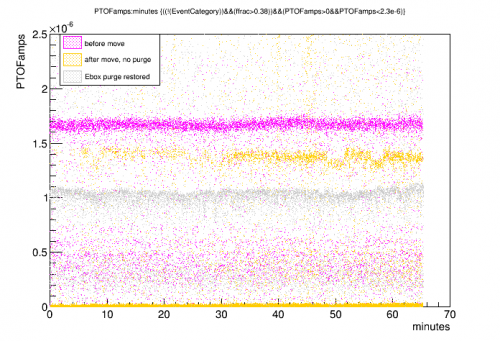 |
| New series has much lower gain. Probably because I set the QET biases to the new standard values rather than trying to match the original. Actually no, looks like I set them to Column1 values by mistake. |
| New series doesn't show the instability seen in the non-purge one |
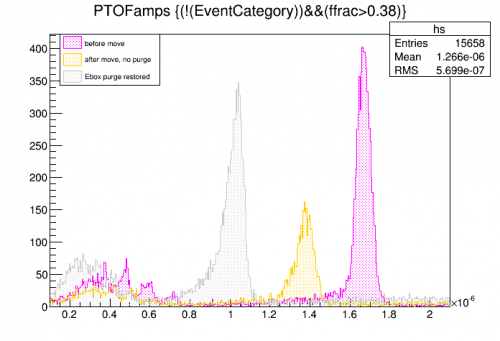 | 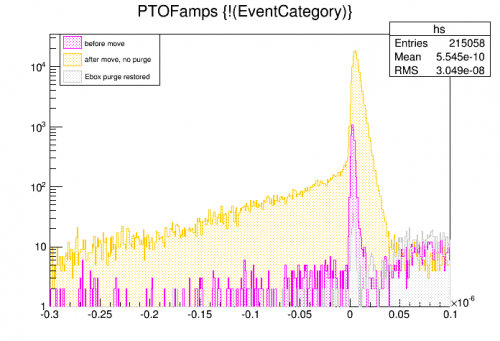 |
| Lower gain in new series but note that the counts in the peak are better. This is because the trigger rate is much lower. | The low-energy garbage is gone. |
In then new series we were able to reduce the threshold to 8 again, and the total number of triggered events was 119k, similar to the old series at 124k. But the non-purge series had 215k triggered events, even with a higher threshold of 12. The junk events seem to have been caused by the lack of purge.
| Let's do +75V data next. We can compare with the last +75V data, but it won't be exact - looks like the DCRC4 QET biases were maybe set wrong that time, and it was before the recent table anyway. And let's do a pause before the drift too, that will be another difference. | |
| 1750 | Write sequence for +75V drifted at 30.1 mV/s with a 1 min pause after rampup. HVdrift_pos75V_1min_30p1mVps_multiloop10_60min.msl |
| 1810 | I suspect that the DCRC Control Settings page was messing with me - older values were showing up. I restarted that page and now it looks like it's behaving right. So not sure whether QET biases I thought were mistakes really were mistakes. We'll have to look up the ODB files to be sure. |
| 1819 | Start a 60 min series at HV = +75V, drifting 0.0301 V/s, 1min pause after rampup, CDMS detector: Driver Gains = 1x, DCRC4/1 QET biases = *(0,300,350,0)/(0,350,400,400)uA, Front-End Gains = (3/3/3)/(5/5/5) 1000 BOR & 5 Hz in-run randoms, trigger on DCRC1pD threshold = 8 Use sequence HVdrift_pos75V_1min_30p1mVps_multiloop10_60min.msl |
| 1817 | Tower = 58.4 mK |
| 1820 | Vtest = 7.8 mV shortly after drift begins. Drift appears to start at +76.2 V. 4% HV loss. |
| 1926 | Vtest = 18.2 mV, HV = 183.7 V, drift ends. 4% HV loss. Lag ratio = 1.10. |
| 1928 | Tower = 57.6 mK. |
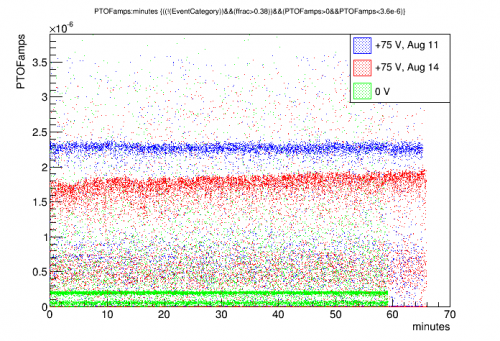 |
Gain is lower now, but this could be differences in QET biases/temperature.
On the other hand, let's look at the full spectrum (without a pF cut):
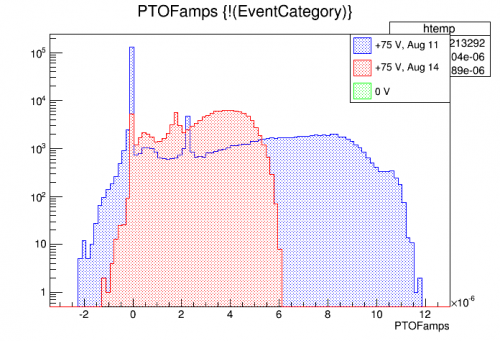 |
The highest-energy stuff is more gain-suppressed than the low-energy stuff. Of course that will all be pretty saturated. But still this is odd - maybe we do still have reduced PCE.
Let's look at this in the 0V series too:
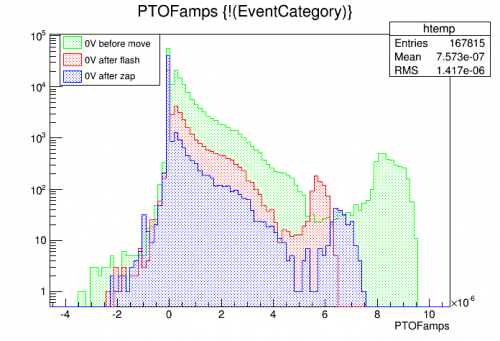 |
Again in the post-move series the high-energy stuff has lower gain, even though at 60keV they have higher gain.
| Let's try a hot Al flash again | |
| 1240 | Default DCRC1 Width/Rate = 100/10000. Set to the Al flash settings we tried before: 100/2000. After 2 min, Tower = 1.52 K. Try 150/2000. Rises to 1.77K. Leave it there for 3 minutes. Then turn off LEDs. |