2020/07/30 (Thursday)
- Lab in-person: Zach
- Virtual partner: Matt
| Setup | Run 73. DIB 1/3/4 → Stripline 43/48/41 → pi-filters 1/2/3 → Cable 3/1/2 → nothing/nothing/accessory_interposer → HV_Conn 1/3/2 → HV 1/2 → DCRCX(4)/DCRC55(1)-master; DCRC33(2) → HV control. DCRCs on overnight. Lead/poly shield erected (4 lead walls, 2 poly walls). |
|---|---|
| 0735 | MB = 72.1% |
| 0825 | Tower = 51.5 mK |
| 0920 | Zach arrives at lab. |
| 0925 | Tower/MC/Coldplate = 51.4/33.0/192 mK, Still = 1.50 K / 0.18 mbar / 5 mW, G1/G2= 400/365 mbar, 1K Pot = 1.65 K / 28±2 mbar. |
| 0940 | Fill LN2 cold trap bath |
| 0955 | Retrieve full LN2 Storage Dewar and restart E-box N2 purge |
| 1000 | Switch HV leads back to positive bias |
| 1020 | Check phonon channels, they all look fine |
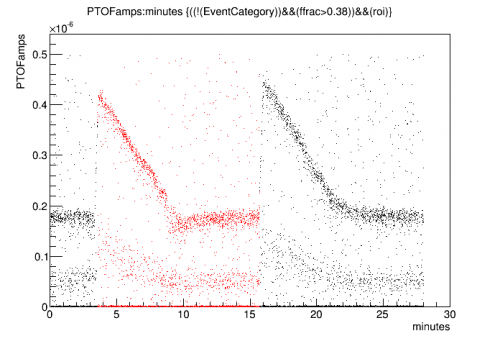
| 1044 | Start a series at 0V for 4min, then +10V for 12 min, then 0V for 12min. , CDMS detector: Driver Gains = 1x, DCRC4/1 QET biases = (0,320,390,0)/(0,360,420,440) uA, Front-End Gains = (3/3/3)/(5/5/5) 1000 BOR randoms, trigger on DCRC1pD threshold = 8 Use sequence HV_0V_4min_10V_12min_10V_12min.msl |
| note: we never flashed after last night's series. I'm trusting that leaving the detector at 0V overnight is good enough. (but this isn't 100% certain.) | |
| 1045 | Tower = 52.1 mK |
| 1050 | Vtest ~ 0.5 mV, near beginning of 10V period |
| 1054 | Vtest ~ 0.4 mV, near middle of 10V period |
| 1101 | Vtest ~ 0.35 mV, near middle of 10V period |
| 1115 | Zach leaves lab |
| 1133 | Vtest reaches its pre-bias level, about 30 minutes after removing bias. |
| 1214 | Zach body temperature = 99.2 |
| 1730 | Reset DCRC1 LED period from 5000→10000 us, to decrease the amount of heating during the 30sec flash |
|---|---|
| 1735 | Edit a sequence that is a loop-version of the 5V, 21.4 V/s drift sequence. The drift is still done in 10 second steps. the DCRC2 Charge/Bias is incremented -0.005 every 10 seconds (this assumes a linear calibration). We could also try -0.001 every 2 seconds if we want to experiment with smoother drifting. HVdrift_5V_21p4mVps_loopversion_nopre_60min.msl |
| 1745 | Start a 60 min series at HV = 5V, drifting 0.0214 V/s, no prebias, CDMS detector: Driver Gains = 1x, DCRC4/1 QET biases = (0,320,390,0)/(0,360,420,440) uA, Front-End Gains = (3/3/3)/(5/5/5) 1000 BOR randoms, trigger on DCRC1pD threshold = 8 Use sequence HVdrift_5V_21p4mVps_loopversion_nopre_60min.msl |
| 1745 | Tower = 51.5 mK |
| 1746 | Vtest ~ 0.25 mV near beginning of drift |
| 1803 | Vtest ~ 1.0 mV, rising linearly |
| 1827 | Vtest ~ 2.0 mV |
| 1856 | Vtest ~ 3.0 mV, just before end of drift |
| This sequence actually took longer than the non-loop version for some reason - 71 minutes compared to 66 minutes. So it's actually more sluggish. | |
| 1945 | Tower = 53.1 mK and cooling. 45 minutes after flash, it is within 2 mK of preflash temperature |
| 2005 | Tower = 52.4 mK and cooling. 65 minutes after flash, it is within 1 mK of preflash temperature |
| 2010 | Create new sequence like the last one, but increasing the number of loop steps by a factor of 5. This will maybe be smoother bias drifting. HVdrift_5V_21p4mVps_fastloop_nopre_60min.msl |
| 2054 | Start a 60 min series at HV = 5V, drifting 0.0214 V/s, no prebias, CDMS detector: Driver Gains = 1x, DCRC4/1 QET biases = (0,320,390,0)/(0,360,420,440) uA, Front-End Gains = (3/3/3)/(5/5/5) 1000 BOR randoms, trigger on DCRC1pD threshold = 8 Use sequence HVdrift_5V_21p4mVps_fastloop_nopre_60min.msl |
| 2055 | Tower = 51.6 mK |
| 2055 | Vtest ~ 0.25 mV near beginning of drift. Seems to be rising much more slowly. |
| 2109 | Vtest ~ 0.5 mV, rising linearly. Definitely looks like the spikes in Vtest are smaller with this faster loop. |
| 2112 | Drift sequence loop is at 265/1800, 18 minutes after starting. That suggests the drift will take a little over 2 hours - very sluggish! |
| 2128 | Vtest ~ 1.0 mV, rising linearly. |
| 2138 | Drift sequence loop is at 664/1800, 44 minutes after starting. Looks like it will take very close to 2 hours. |
| 2304 | Vtest ~ 2.8 mV, just before end of drift. |
- First series of loop-version data looks about as unstable as the earlier data
- Second series of fast-loop data was so slow that the Luke gain falls to 1 in a few minutes. But it looks pretty smooth. Since it took around 2 hours, let's try modifying it to drift twice as fast.