2020/07/26 (Sunday)
- Lab in-person: Matt
- Virtual partner: Michael
| 1020 | Matt Fritts body temperature = 96.9 F |
|---|---|
| Setup | Run 73. DIB 1/3/4 → Stripline 43/48/41 → Cable 3/1/2 → nothing/nothing/accessory_interposer → HV_Conn 1/3/2 → HV 1/2 → DCRCX(4)/DCRC50(3)-master; DCRC33(2) → HV control. DCRCs on overnight. Lead/poly shield erected (4 lead walls, 2 poly walls). |
| 1025 | Tower = 52.7 mK |
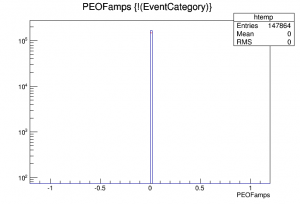
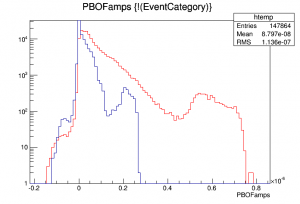
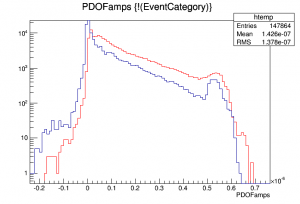
| Blue: Run73 07200725_0812; Red: Run72 07200304_1033 | ||
|---|---|---|
 |  |  |
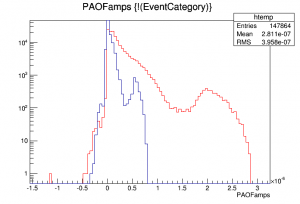 | 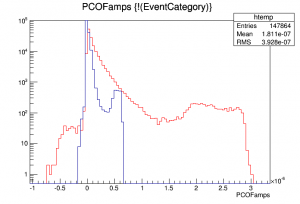 | 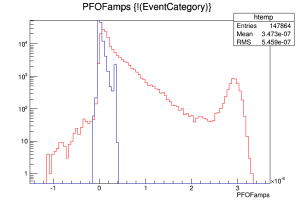 |
| PTOF spectra comparing R73 to R72 0-volt data, showing how much lower the amplitudes are in the current run, for almose all channels. | ||
| Top row is DCRC4, bottom is DCRC3. Note that one DCRC4 channel seems to be behaving normally. Maybe DCRC3 is acting screwy. | ||
| data series | Tower temperature | QET biases |
|---|---|---|
| Run72 07200304_1033 | 55.7 mK | (na/360/430)/(360/420/440) |
| Run73 07200725_0812 | 53.4 mK | (0,330,360)/(380,400,460) |
| Note that PD was set significantly lower in this run, which may account for it's comparatively high gain. So maybe it's not a DCRC thing, maybe it's affecting all channels |
||
| 1140 | Set QET biases to the same as the Run72 dataset mentioned above. Let's take some data like that for comparison. Note that the Tower is somewhat cooler now than the Run72 dataset which may mean the TESs will be a little higher in transition now than previously, which would make the gain slightly lower now. |
|---|---|
| note: Write Data was left on, so there will be a couple junk datasets from when I ran the pulse viewer. | |
| 1140 | Tower = 52.0 mK. |
| 1146 | Start a 60 min series at HV = 0, CDMS detector: Driver Gains = 1x, DCRC4/3 QET biases = (0,360,430,0)/(0,360,420,440) uA, Front-End Gains = (3/3/3)/(5/5/5) 1000 BOR randoms, trigger on DCRC1pD threshold = 10 Use sequence SimpleDataLoopNoFlash.msl |
| 1210 | Matt arrives in lab |
| 1215 | Tower/MC/Coldplate = 52.9/30.1/188 mK, Still = 1.45 K / 0.18 mbar / 5 mW, G1/G2= 328/305 mbar, 1K Pot = 1.65 K / 28±2 mbar. |
| 1215 | MB = 58.1% |
| 1220 | Try powering DCRC1 again - this time it turns on! Huh. Well let's try putting it back in to HV2, in place of DCRC3. |
| 1225 | Aborted data series early. Turned off DAQ programs. Power down DCRC3. Replaced with DCRC1. Plug-in DCRC55(1) into HV2. Powered up. |
| 1235 | Fill LN2 cold trap bath |
| 1245 | Restart MIDAS, set up ODB to use DCRC1 instead of DCRC3, restart the 3 DAQ programs |
| Setup | Run 73. DIB 1/3/4 → Stripline 43/48/41 → Cable 3/1/2 → nothing/nothing/accessory_interposer → HV_Conn 1/3/2 → HV 1/2 → DCRCX(4)/DCRC55(1)-master; DCRC33(2) → HV control. DCRCs on overnight. Lead/poly shield erected (4 lead walls, 2 poly walls). |
| 1250 | Zap SQUIDs in all phonon channels |
| 1250 | Set QET settings on DCRC1 the same as they were for DCRC3 |
| looking at the Pulse Viewer, this doesn't look much different - seems like the pulses are still unusually weak | |
| 1315 | Try turning on the LEDs for about 15 seconds using DCRC1 now. Tower temperature spikes up to 740 mK. So apparently DCRC3 doesn't power the LEDs properly. |
| 1330 | Matt leaves lab. |
| 1415 | After about 1 hour the Tower had cooled back to within 2 mK of base. |
| 1445 | Tower = 54.3 mK, still cooling after the flash. |
| Let's take more 0-Volt data. Like this morning we'll use the exact same QET biases as in Run72, but this time we're using DCRC1 (so the exact same DCRCs as Run72) | |
| 1456 | Start a 60 min series at HV = 0, CDMS detector: Driver Gains = 1x, DCRC4/1 QET biases = (0,360,430,0)/(0,360,420,440) uA, Front-End Gains = (3/3/3)/(5/5/5) 1000 BOR randoms, trigger on DCRC1pD threshold = 10 Use sequence SimpleDataLoopNoFlash.msl |
| note: we should be able to process this using the Run72 processing environment | |
| 1500 | Tower = 54.2 mK |