2019/11/22 (Friday)
| Setup | DIB1/2/4 → 3.2 MHz filters → cable 1/2/3 → gender changer 1/2/3 → movable source controller/board with external Feedback resistor/nothing → DCRC55(1)/DCRC33(2)/DCRC50(3) |
|---|---|
| Overnight | Ran a script that moved the source a few steps every few min. Tower ranged between 100-550 mK. There's a pattern where there are some lower temperature spikes (420 mK max), and observations yesterday suggest these have better waveforms so probably are more successful moves. Around 60% seem to have the better waveforms. |
| 0654 | Move sequence ended about 6 minutes ago, on schedule. Tower = 72.4 mK and falling. |
| 0658 | Do a hot Al flash for 90s using the sequence Al_flash.msl. Tower peaks at 1.6 K. |
| Final motor waveform on the scope looks okay. Which one is Vtrim? Well, the smaller (blue) waveform, which represents current through the coil, has flat tops, at +2.8V / -2.4V | |
| 0910 | Tower/MC/Coldplate = 33.4/29.9/191 mK, Still = 1.55 K/ 0.120 mbar / 0 mW, G1/G2= 246/218 mbar, 1K Pot = 1.63 K / 20±1 mbar. MB = 69.1% |
| 0910 | Turn off motor power supply, power down arduino. Check that Keithley meter is not connected to breakout box. |
| 0915 | Fill LN2 cold trap bath. |
| 0915 | Check the channels - they all look good! Adjusted the driver offset on one of them to get the baseline near -0.9V |
| 0915 | Start 1x S1/S2=-4/+4,+4/-4 V loop of 30 min Bkg data series, Driver gain = 1, with 1000 initial randoms, with 30s flashes and 30 min cooldowns trigger on DCRC2pA/B/C = 8/8/8 ADC using sequence qbias_mp4_pm4_loop.msl |
| 1010 | First look at today's data shows that we definitely moved, in fact looks like we overshot our target of y=0 mm by a little bit. |
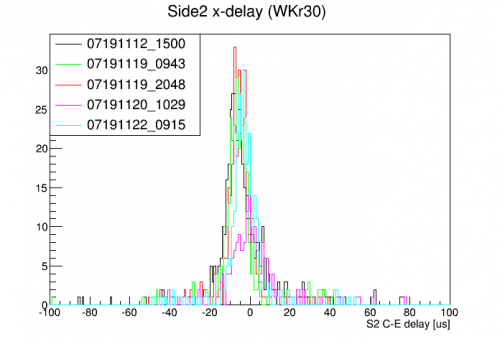 | 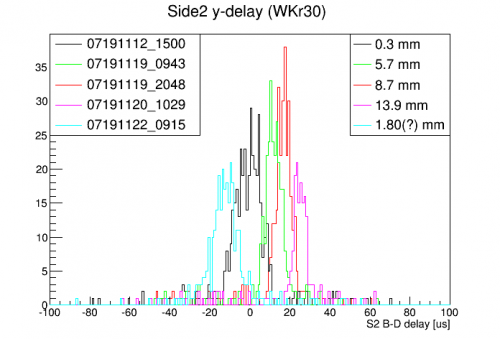 |
| The y positions shown above are guesses. In the most recent case (cyan) my guess for motor step efficiency for running backward seems to be an underestimate. |
|
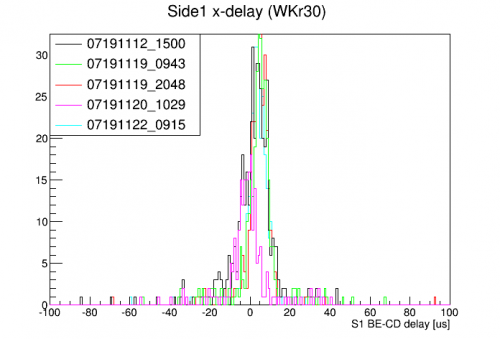 | 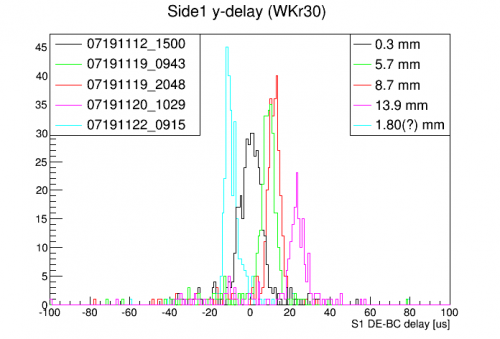 |
| Using the guessed positions of the first four series considered above (these guesses are based on all the moves we've done, the known positions of center and endstop, and then adjusting the step efficiency to match these) I fit the Side2 y-delay versus y-position to a quadratic, getting a pretty good fit, and used that to calculate an estimate of the current position. Current position estimate: -2.40 mm |
|
| Interestingly, the above position makes sense if our step-efficiency for this backward running is 101%. So best guess is that in this mode we are not missing any steps. | |
| Let's try to move over the first blocker. First edge is -4.59 mm, second edge is -7.19 mm. We'll move -4*54 steps, which should take us to -5.97 mm. | |
| 1135 | Power arduino and connect to it via telnet. Arduino responds to two “marco”s with “polo”. Turn on motor power supply, which is set to 6.4 V. In telnet session set dwell to 40 ms. Scope is on. |
| 1140 | Modify stepper_loop.py, changing “nrepeat” to 54. |
| 1145 | Tower = 34 mK. Move 54x-4 steps with 4 min wait in between using stepper_loop.py. Pipe this output to /home/mast/cdms/arduino/stepper_loop.out. We are targeting the middle of the first blocker. This should end at 15:22. |
| First move produces temperature spike to 430 mK, and pulse shapes look good | |
| Did a different fit to estimate this morning's position. Fitting the (delay,position) points to a quadratic, then extending from the positive y to negative y, doesn't make a lot of sense - it should curve the opposite way. The alternative estimate takes the curve in positive y (which shows decreasing sensitivity to position as y increases, which is plausible) and assumes the same shape for negative y. In that case I get -4.02 mm, even farther. However this would imply 111% step efficiency - so this estimate is probably worse. So we'll stick with an assumption of 100% step efficiency. | |
| 1400 | Again there is a pattern of “good” (cooler, nicer waveforms) and “bad” (warmer, uglier waveforms) moves. |
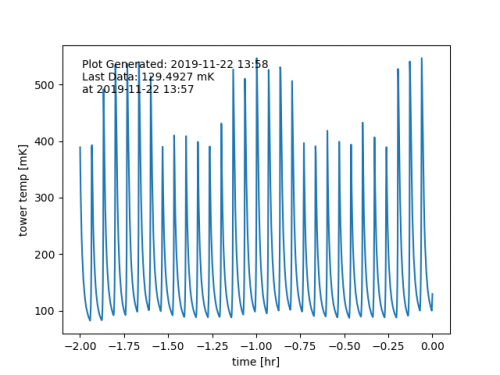 |
| 1450 | This pattern of “good” and “bad” has an overall period of 12 moves, which is 48 steps, which is 1 rotation. This suggests that it's caused by there being a part of the rotation that's more difficult. The 12-move period looks pretty robust, so this suggests that we really are getting 100% step efficiency now. |
|---|---|
| This pattern can be most easily identified by looking for a strong drop in peak height following a block of several (4-6) high ones. Every 12th move shows this pattern. | |
| 1530 | Move sequence ended a little early. Do a hot Al flash for 90s using the sequence Al_flash.msl. Tower peaks at 1.63 K. |
| 1555 | Tower = 62 mK and cooling |
| 1555 | Turn off motor power supply, power down arduino. Check that Keithley meter is not connected to breakout box. |
| 1600 | Tower = 50 mK. Check all the channels. They all look good! (Except the known issue with DCRC2 QO.) |
| 1615 | Tower = 39.6 mK and falling |
| 1640 | Tower = 35.5 mK and falling, albeit much more slowly now. |
| 1643 | DCRC1 pD was railed, reset polarity and adjust driver offset so baseline is near -0.9. |
| 1645 | trigger on DCRC2pA/B/C = 8/8/8 ADC using sequence qbias_mp4_pm4_loop.msl |
| Ran the wrong sequence by mistake. | |
| 1645 | Start 1x S1/S2=+4/-4,-4/+4 V loop of 30 min Bkg data series, Driver gain = 1, with 1000 initial randoms, with 30s flashes and 30 min cooldowns trigger on DCRC2pA/B/C = 8/8/8 ADC using sequence qbias_pm4_mp4_loop.msl |
| 1648 | Fill LN2 cold trap bath. |
| 1650 | Noticed DCRC1 pD railed again, reset the polarity, looks fine now. I'm going to monitor this channel for a bit. |
| During the second series DCRC1pD was railed throughout | |
| 1842 | Charge pulses look weird, telnet to DCRCs. Display calibration register values on RevC.1 using the command cald 1. For RevC, the calibrations are done in dcrc_driver. |
On DCRC1, the charge cals are
A=00  D=8067  QinnerOffset  Qinner bias is zero with this setting, DAC
A=01  D=01AB  QinnerSlope   The Qinner bias setting slope, uV/DAC
A=02  D=8018  QouterOffset  Qoute50r bias is zero with this setting, DAC
A=03  D=01AB  QouterSlope   The Qouter bias setting slope, uV/DAC
and on DCRC3 they are
A=00  D=80A3  QinnerOffset  Qinner bias is zero with this setting, DAC
A=01  D=01A8  QinnerSlope   The Qinner bias setting slope, uV/DAC
A=02  D=8027  QouterOffset  Qouter bias is zero with this setting, DAC
A=03  D=01AC  QouterSlope   The Qouter bias setting slope, uV/DAC
| 1852 | Start a run and look at charge channels. Pulses are rare with some strong but very few, (I'd say 1 every 30 seconds or so?) there are a few negative pulses thrown in there. Let's try restarting the drivers just to make sure everything is fine. |
|---|---|
| 1859 | There seems to be more pulses now than before, maybe about 2-3 every 30 seconds or so. But this isn't super constant. Pulses are again swapping polarities though there are larger negative pulses than before restarting. |
| 1913 | Manually set DCRC 1 bias from 0 V to 4 V and back, reading out 59 and 5A for each. Originally 59 –> 8067, 5A –> 8018. Change to 4 volts 59 –> A4FF, 5A –> A4B0. Set back to 0 V 59 –> 8067, 5A –> 8018. |
| above indicates that MIDAS is issuing commands correctly | |
| Another look at today's series with BatViewer shows that the first series this morning had downward charge pulses (both sides), the second had upward pulses. But this evening it's reversed: first series has upward, second has downward. | |
| 1935 | Mystery solved - Derek ran the wrong sequence, so the first series this evening is +/-, the second is -/+. |
| 1945 | Now, comparing the recent -4/+4 V data to ones from earlier - it definitely looks like we are over a blocker! Looks like less than 25% as many events in the 60keV peak than any of the other series. |
| OK, now we'll move 32 steps at a time, which is around 0.5 mm, and see when we get past the blocker. | |
| 2035 | Power arduino and connect to it via telnet. Arduino responds to two “marco”s with “polo”. Turn on motor power supply, which is set to 6.4 V. In telnet session set dwell to 40 ms. Scope is on. |
| 2040 | Modify stepper_loop.py, changing “nrepeat” to 8. |
| 2043 | Tower = 32.8 mK. Move 8x-4 steps with 4 min wait in between using stepper_loop.py. Pipe this output to /home/mast/cdms/arduino/stepper_loop.out. We are seeing whether this gets us past the first blocker. This should end at 21:15. |
| 2121 | Move sequence is finished. Tower = 56.9 mK. Do a hot Al flash for 90s using the sequence Al_flash.msl. Tower peaks at 1.6 K. |