2019/11/20 (Wednesday)
| Setup | DIB1/2/4 → 3.2 MHz filters → cable 1/2/3 → gender changer 1/2/3 → movable source controller/board with external Feedback resistor/nothing → DCRC55(1)/DCRC33(2)/DCRC50(3) |
|---|---|
| Overnight | Ran a script that moved the source a few steps every few min. Tower ranged between 100-750 mK. Looks like we reached an endstop during the 46th move at 2:59 AM, when the Keithley resistance measurement fell to 30 Ω. The next 3 moves had the same temperature profile as previous, but then the final 11 moves only heated to ~450 mK, a bit lower. It may be that the endstop was flexing a little for those 3 moves, then things stopped entirely after that. |
| 0656 | Do a hot Al flash for 90s using the sequence Al_flash.msl. Tower peaks at 1.6 K. |
| 0815 | Final motor waveform on the scope looks good, Vtrim flat at +/- 3V. |
| 0820 | Fill LN2 cold trap full. |
| 0821 | Tower/MC/Coldplate = 40.8/30.6/193 mK, Still = 1.48 K/ 0.130 mbar / 0 mW, G1/G2= 233/213 mbar, 1K Pot = 1.63 K / 22±1 mbar. MB = 69.1% |
| 0826 | Check which endstop connection is grounded, indeed it's the one labeled SP-2 on the breakoutbox extension as we thought. Disconnect Keithley from these lines and analog ground to reduce noise. Also switch it back to volts mode and disable it in Omni_Logger. |
| 0830 | Power down motor power supply, power down arduino. |
| 0835 | Tower = 37.0 mK. Alot of channels are railed and DCRC2pB has funny-shaped, inverted pulses. Zap SQUIDs. |
| 0856 | Phonons look fine now, but DCRC2QI is showing ~1 Vpp, 590 Hz sine wave! Turn DCRC2 15V power off and back on, wave returns. Changing DCRC2 test signal frequency doesn't modify the signal. The DCRCQI offset just shift the signal. All other channels look normal. |
| 0903 | Turn DCRC programs off and back on, no change. Turn DCRC programs off, power cycle all 3 DCRCs, and restart DCRC programs. Sine wave still present on DCRC2QI. Try unplugging various parts of the motor an Keithley setup without effect. |
| 0916 | Actually, DCRC2 phonons look kinda jagged. Not sure if that's a cause or an effect. Set all DCRC2 SQUID bias, lockpoint, QET bias = 0. This doesn't help. Restore these values. |
| 0923 | Check if DCRC2QI sine wave is synchronized with DCRC clock by triggering on test signal, they are not synchronized. So it's either an outside signal or some resonance in the charge circuit. Moving the board around doesn't seem to help. |
| 0925 | Turn off DCRC programs and power down DCRC2. Do an electrical check on DIB2 using the breakout box. FB coil C reads low, but that's because we're using an external FB resistor on that one. chassis→QI FB = 38 MΩ, chassis→QI Drain/Source = 1.2/1.2 MΩ, QI Drain/Source→chassis = OL/OL. QI bias → chassis = OL. Looks like we're shorted to ground between the FB resistor and the FET. We saw this in a 77K electrical check, though it wasn't quite as bad then. |
| 0953 | Banging on the fridge makes these values jump, but they don't change permanently. |
| 0954 | Let's see if DCRC1 can handle the short. Put DCRC1 on DIB2 and power it up. Nope, same sort of sine wave in QI. We might just have to live with it. Go back to standard setup. |
| 1002 | Zap SQUIDs. |
| 1010 | Now DCRC2 QI just shows crazy, jagged noise, and it screws up a lot of other channels even on other DCRCs. Disabling DCRC2 15V power makes it go away, but we also loose DCRC2 QO then. Turning it off also causes some heating. |
| 1023 | Ground DIB2 QI FB to chassis and turn on DCRC2 15V power. This will hold the DCRC2 QI signal near 0, but will allow us to run DCRC2 QO. Pulses look good on all channels now. |
| 1027 | Tower = 36.3 mK |
| 1029 | Start 1x S1/S2=-4/+4,+4/-4 V loop of 30 min Bkg data series, Driver gain = 1, with 1000 initial randoms, with 30s flashes and 30 min cooldowns trigger on DCRC2pA/B/C = 8/8/8 ADC using sequence qbias_mp4_pm4_loop.msl |
| 1109 | MIDAS is stuck in the transition of trying to end the first series. Stop the sequence and play with /RunInfo State and transition to get it stopped. Set charge biases to 0. |
| 1111 | Try to start a series without logging, dcrcdriver crashes and MIDAS gets stuck in another loop. Shut down DCRC programs and restart MIDAS. Things look better now. |
| 1116 | Flash detector. |
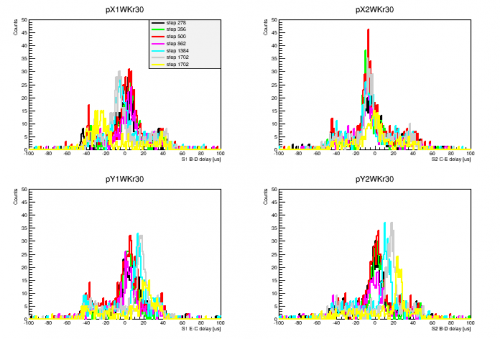
| 1136 | The data above looks alright, can see more evidence of motion, though we have to be a little more clever in removing surface events without the use of QIS2. Let's start moving back the other direction. |
| 1138 | Endstop2 resistance is 15.2 Ω with the Fluke meter. This measurement heats the fridge a little. |
|---|---|
| 1140 | Power and connect to arduino. Tell it 'marco' till it responds. Power motor power supply to 8.0 V. Set dwell to 40 ms. Turn on scope. |
| 1143 | Move -4 steps, tower spikes to 425 mK, motor waveforms look good, endstop2 resistance = 23 Ω. |
| 1148 | Tower = 59.4 mK. Move -4 steps, tower spikes to 410 mK, motor waveforms look good, endstop2 resistance = 24 Ω. |
| 1155 | Tower = 66.9 mK. Move -4 steps, tower spikes to 425 mK, motor waveforms look good, endstop2 resistance = 31 Ω. |
| 1159 | Tower = 88.2 mK. Move -4 steps, tower spikes to 400 mK, motor waveforms look good, endstop2 resistance = 21 Ω. |
| 1202 | This is boring, set up the Keithley in resistance mode using the Omni_Logger to watch this. Quit arduino telnet session. Modify /home/mast/cdms/arduino/stepper_loop.py with desired settings. |
| 1206 | Move by 60x-4 steps with 4 min pause in between using script /home/mast/cdms/arduino/stepper_loop.py. Note: this script was stopped after the 34th step. |
| 1215 | Endstop2 resistance is changing by a few Ω with every move, sometimes up, sometimes down. Presumably this is just small changes in the contact between source holder and endstop. |
| 1230 | We've reached the 7th move in the sequence, still in contact with the endstop. |
| 1243 | On the 10th move, endstop2 resistance → 36 Ω, highest yet. Maybe it's about to lose contact. |
| 1304 | On the 15th move, endstop2 resistance → 59 Ω, highest yet. Maybe this time it's about to lose contact. |
| 1320 | On the 19th move, endstop2 resistance → 81 Ω, highest yet. Maybe THIS time it's about to lose contact. (Nick estimates about a 1/4-turn “slop” by messing with the other motor… that would be 12 steps, 3 moves.) |
| 1340 | Endstop2 resistance continues to change kinda randomly with every move, by as much as 5 Ω. Up to the 25th move now, still hasn't lost contact. |
| 1415 | For the last several moves, endstop2 resistance hasn't changed much, hanging around 20-25 Ω. We're on move 33, that's over 2 mm. We're starting to think it's stuck. Maybe in this direction the 4-step moves aren't working. |
| 1422 | Kill the movement script after the 34th step. This doesn't seem to be working. |
| 1423 | Open telnet session with arduino and Move -6 steps. Tower heats to 560 mK. endstop2 resistance = 14 Ω. Motor waveforms show +/-3V V_trim for all but maybe the final step. |
| 1427 | Tower = 106 mK. Move -6 steps. Tower heats to 560 mK. endstop2 resistance = 13 Ω. Motor waveforms show +/-3V V_trim for all but maybe the final step. |
| 1433 | Switch scope to monitor motor coil B voltage and trim pot B voltage. Tower = 85 mK. Move -6 steps. Tower heats to 500 mK. endstop2 resistance = 14 Ω. Motor waveforms show +/-0.75V V_trim, but I'm not sure what to compare that to. |
| 1437 | Both motor coils A/B w/ trim pots = 120/130 Ω. So they're still both connected. Well, maybe we just broke or bent the endstop so it's permanently shorted? Let's just move some more and take data. |
| 1440 | Move by 15x-4 steps with 4 min pause in between using script /home/mast/cdms/arduino/stepper_loop.py. |
| 1548 | Sequence has finished, do a hot Al flash for 90s. |
| 1640 | Fill LN2 cold trap full. |
| 1645 | Start -4/+4 V 30 min Bkg data series, Driver gain = 1, with 1000 initial randoms, with 30s flashes and 30 min cooldowns trigger on DCRC2pA/B/C = 8/8/8 ADC |
| 1716 | condor is all gummed up with old data because I restarted autoprocessing. Will have to wait to see this latest data. Let's hope for the best and set up to continue moving overnight. |
| 1717 | Power on arduino, set dwell to 40 ms, then quit telnet session. Power up motor power supply to 8.0V, and turn on scope. Also set up Keithley to log endstop2 resistance. |
| 1720 | Move 120*-4 steps, with 4 min wait times, using stepper_loop.py. Pipe output to /home/mast/cdms/arduino/stepper_loop.out. Should take 8 hours |