2019/11/19 (Tuesday)
| Setup | DIB1/2/4 → 3.2 MHz filters → cable 1/2/3 → gender changer 1/2/3 → movable source controller/board with external Feedback resistor/nothing → DCRC55(1)/DCRC33(2)/DCRC50(3) |
|---|---|
| Overnight | Ran a script that moved the source a few steps every 12 min. During much of the night, the tower heating was higher for every other move. Not really sure why this happens, but the motor waveforms yesterday indicated that these are moves where the coil resistance rises sooner, so less stepping occurs during them. |
| 0741 | Do a hot Al flash for 90s using the sequence Al_flash.msl. Tower peaks at 1.47 K. |
| 0837 | Power down arduino and motor power supply. |
| 0842 | Start 1x S1/S2=+4/-4,-4/+4 V loop of 30 min Bkg data series, Driver gain = 1, with 1000 initial randoms, with 30s flashes and 30 min cooldowns trigger on DCRC2pA/B/C = 8/8/8 ADC using sequence qbias_pm4_mp4_loop.msl |
| 0843 | Tower/MC/Coldplate = 35.8/30.6/194 mK, Still = 1.54 K/ 0.130 mbar / 0 mW, G1/G2= 232/223 mbar, 1K Pot = 1.64 K / 24±1 mbar. MB= 30.6% |
| 0850 | Fill LN2 cold trap full. |
| 0950 | Check pulses in all channels, still look fine. |
| 1045 | There's evidence that the source is moving now. Let's move it some more, then take more data. |
X and Y 30% rise delays. Each partition is the difference of 2 channels, so the S1 x-y are rotated by 45° w.r.t. the S2 x-y. With this definition, positive Y2 corresponds to negative X1 and positive Y1. Note that the “steps” are really attempted steps, but we suspect that no appreciable movement has occurred until “step” 1384. This plot uses -4/+4 V data from periods where we trust the voltage bias and only when a hot Al flash has been done since the previous move.
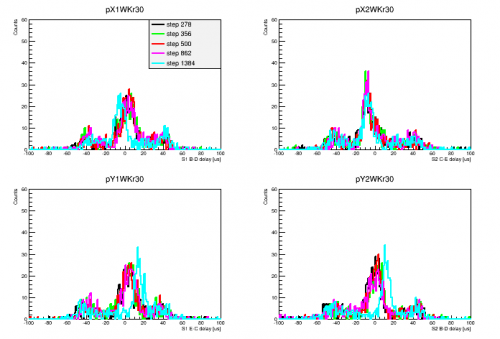 | 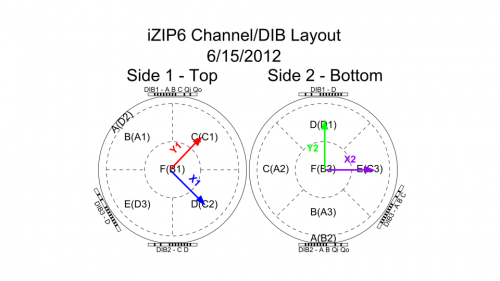 |
//S2
z[iser]->SetAlias("pX2WKr30","1e6*(-PES2WKr30+PCS2WKr30) + 99999*(PES2WKr30==0 || PCS2WKr30==0)");
z[iser]->SetAlias("pY2WKr30","1e6*(-PDS2WKr30+PBS2WKr30) + 99999*(PDS2WKr30==0 || PBS2WKr30==0)");

//S1 Rotated clockwise
z[iser]->SetAlias("pX1WKr30","1e6*(-PDS1WKr30+PBS1WKr30) + 99999*(PDS1WKr30==0 || PBS1WKr30==0)");
z[iser]->SetAlias("pY1WKr30","1e6*(-PCS1WKr30+PES1WKr30) + 99999*(PCS1WKr30==0 || PES1WKr30==0)");
Corresponding phonon energy partitions show no such systematic shift
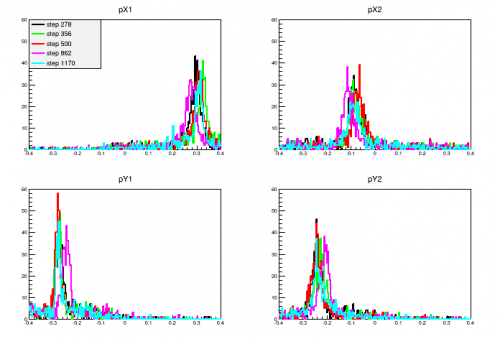
| 1046 | Power and connect to arduino. Power motor power supply to 8.0 V. Set dwell to 40 ms. Let's see if we can speed up the moving process with shorter wait times. |
|---|---|
| 1048 | Move +6 steps. Tower spikes to 677 mK. Motor waveforms look decent, current falling by final step. |
| 1053 | Tower = 85.3. Move +6 steps. Tower spikes to 698 mK. Motor waveforms look decent, current falling by final step. |
| 1058 | Tower = 96.3. Move +6 steps. Tower spikes to 700 mK. Motor waveforms look decent, current falling by final step. So every 5 min might actually be fine. Let's push it up to 6 min to be safe. |
| 1104 | Move by 50x+6 steps with 6 min pause in between using script /home/mast/cdms/arduino/stepper_loop.py. This should go until ~4 PM and move as much as 4.96 mm further. |
| 1152 | Tower temps spike to 650-700 mK each move. Motor coil waveforms have been looking like 4-5 steps have good current. |
| 1204 | Commence LHe transfer. MB = 25.4% |
| 1240 | Cease LHe transfer. MB = 92.9% |
| 1611 | Move script has finished. Tower never fell below 90 mK or spiked above 750 mK. Most waveforms looked okay, with 3-5 steps having flat current signal. Power down motor power supply, then power down arduino. |
| 1614 | Tower = 57.7 mK. Do a hot Al flash for 90s with sequence Al_flash.msl. |
| 1638 | Fill LN2 cold trap full. |
| 1722 | Tower = 35.7 mK |
| 1723 | Start 1x S1/S2=-4/+4,+4/-4 V loop of 30 min Bkg data series, Driver gain = 1, with 1000 initial randoms, with 30s flashes and 30 min cooldowns trigger on DCRC2pA/B/C = 8/8/8 ADC using sequence qbias_mp4_pm4_loop.msl Note this sequence swaps the bias order from what we have been doing. This is because the -/+ data has been easier to interpret, so we'd like it to be done first. |
| 1725 | Abort sequence, DCRC1pB railed already. Adjust the driver offset quickly and start a new sequence. |
| 1727 | Start 1x S1/S2=-4/+4,+4/-4 V loop of 30 min Bkg data series, Driver gain = 1, with 1000 initial randoms, with 30s flashes and 30 min cooldowns trigger on DCRC2pA/B/C = 8/8/8 ADC using sequence qbias_mp4_pm4_loop.msl Note this sequence swaps the bias order from what we have been doing. This is because the -/+ data has been easier to interpret, so we'd like it to be done first. |
| 1734 | Enable logging of Keithley 617 in resistance mode on Omni-Logger. Short the measurement leads together for now. We might need this later to monitor the source mover endstop resistance remotely. |
| 1830 | Data from 07191119_1727 looks funny, the trigger rate fell way off after 250 s. We might only have good neutralization for the first few minutes and restarting the data taking wasted some of that time? |
| 1938 | Start S1/S2=-4/+4 30 min Bkg data series, Driver gain = 1, with 1000 initial randoms, with 30s flash and 30 min cooldowns trigger on DCRC2pA/B/C = 8/8/8 ADC using sequence take_and_flash_loop.msl |
| 2034 | This latest data looks junky too, almost like the bias isn't being set properly again. The telnet session to DCRC1 has hung, close the window and re-start it. DCRC1 registers 59/5A = 8067/8018 as they should at 0V. However, DCRC registers 59/5A = 2000/2000 and DCRC2 QI/QO mesaure -0.2/-0.2 V at diverter board. This 2000/2000 setting are the same values DCRC1 had when the DAQ was misbehaving last week. |
| 2035 | Restart DAQ propgrams: triggerfe2, towerfe3_01 and dcrc_driver01. DCRC registers 59/5A = 2000/2000. Set DCRC2/Charge/Bias[0]=1. Measure DCRC2 QI = 0.7V at diverter board. Set DCRC2/Charge/Bias[0]=0 |
| 2047 | Actually, it looks like there's some occasional spikey noise in the charge channels. It started to show up around the time I put the Keithley in resistance mode, enabled in in Omni-Logger and, to short the measurement leads, clipped them both to the breakout box chassis. Could this be coupling some noise into the DCRCs that screwed up the triggering? Undo all that stuff. |
| 2048 | Start S1/S2=-4/+4 30 min Bkg data series, Driver gain = 1, with 1000 initial randoms, with 30s flash and 30 min cooldowns trigger on DCRC2pA/B/C = 8/8/8 ADC using sequence take_and_flash_loop.msl |
| 2054 | Yep, the noise spikes are gone now, sheesh! [image not archived: facepalm.svg] |
There, we go, it's still movin!
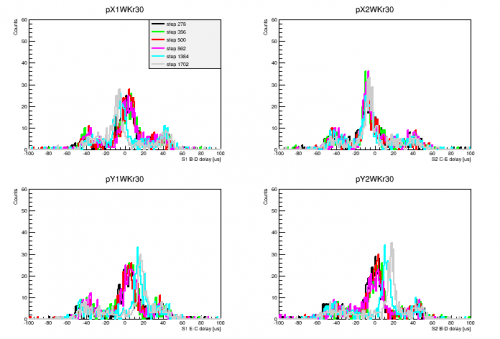
| 2130 | Tower = 34.8 mK. Power and connect to arduino. Power motor power supply to 8.0 V. Set dwell to 40 ms. Seems like we're only getting ~4 steps each move anyway, so let's just attempt 4 and see if it reduces heating and wait time. |
|---|---|
| 2132 | Move +4 steps. Tower spikes to 475 mK, pulse train looks good, trim pot voltage at ~3V for all steps. |
| 2135 | Tower = 90.9 mK. Move +4 steps. Tower spikes to 505 mK, pulse train looks good, trim pot voltage at ~3V for all steps. |
| 2138 | Tower = 110 mK. |
| 2139 | Tower = 88.8 mK. Move +4 steps. Tower spikes to 505 mK, pulse train looks good, trim pot voltage at ~3V for all steps. |
| 2143 | Tower = 93.2 mK. Looks like 4 steps and a 4-minute pause will do. |
| 2144 | Now, let's set up that Keithley. Set Keithley to resistance mode and enable it using Omni-logger. Short together the 3 leads, 2 of which go to the end stop, just in case we don't know which is the near endstop. Connect electrometer leads across these and analog ground on a DCRC. Currently reading ~10 GΩ and climbing slowly. Now, if we hit an endstop, we should see the resistance go down. |
| 2149 | Quit the current arduino telnet session and set up the automated script to run 4 steps at a time, with a 4 min wait and to run for 30 such moves, so the next 2 hours. |
| 2154 | Move by 30x+4 steps with 4 min pause in between using script /home/mast/cdms/arduino/stepper_loop.py. Pipe output to /home/mast/cdms/arduino/stepper_loop.out. This should go until ~midnight and move as much as 2.0 mm further. Sequence is running under username mast on denali2 if it needs to be killed. |
| 2156 | Keithley now reading 50 GΩ and climbing slowly. Short the leads for a second just to test it, resistance falls back to a few GΩ and starts climbing again. |
| 2353 | Sequence has finished, tower temp was 100-700 mK. We still haven't hit an endstop. Let's run it for a few more hours tonight, hopefully it won't break the endstop if we hit it during this time! |
| 1158 | Move by 60x+4 steps with 4 min pause in between using script /home/mast/cdms/arduino/stepper_loop.py. Pipe output to /home/mast/cdms/arduino/stepper_loop.out. This should go until 4AM . Sequence is running under username mast on denali2 if it needs to be killed. |