2019/03/11 (Monday)
| Status: | Cooling to base. Tower cooldown is very slow. |
|---|---|
| Problem with He recovery. Between the Mar 8 and Mar 10 transfers the recovery meter barely moved - only 4 cuft, that's 0.15 L equivalent, while we boiled away 35 L from the bath. Monitoring the meter overnight, it's slightly better this time but still terrible: around 26 cuft recovered, that's around 1 L equivalent, for a boiloff of about 13 L. Not sure what's wrong. I don't know if there's something different in the recovery system now that Mike has taken over from Bill Voje. I tried to check the pressure at the bag yesterday, about 2 PSI. Not at all clear why the recovery during boiloff is bad since it seems fine during transfer. Why doesn't the boiloff He push through the reco when the pressure is high enough? |
|
| 0955 | Tower/MC/Coldplate = 55.2/31.9/195 mK, Still = 1.68±0.04 K / 0.150 mbar, G1/G2 = 178/158 mbar, 1K Pot = 1.78 K / 18 mbar. MB = 66.5% |
| Tower cooling at a rate of 2.6±0.1 mK/day | |
| 1005 | Fill LN2 cold trap bath |
| 1235 | Plug cables cable 3/1/2 → HVConn 1/3/2. Plug DCRCs into HV box, HV 1/2 → DCRCX(4)/DCRC50(3) |
| 1250 | Set ODB configuration, then power up the DCRCs. Tower temperature increases. Start MIDAS DAQ programs. |
| 1255 | Transfer the DCRC55(1) Lockpoint and SQUIDbias settings to DCRCX(4), since we are using the same SQUETS as last run, and DCRC55(1) was in the HV1 position last run. (DCRC5(1) is currently with Sten at FNAL.) Actually need to set these on DCRC50(3) too because they got changed. Use SQUID settings from Run 68 |
| 1255 | Tower has increased from 54.8 → 57.5 mK and keeps increasing. Fridge pressures are higher too. |
| 1300 | Zap SQUIDs on DCRCs 3,4 |
| 1305 | Tower peaks at 63 mK, now falling |
| 1320 | Tower down to 58.0 mK |
| 1330 | Playing with QET biases. First pulses seen. |
| 1340 | Pulses seen in all 6 channels. Looks like we need surprisingly high QET biases, most are around 700 uA at the moment. |
| 1350 | Adjust QET biases to get nice looking pulses on all 6 channels |
| 1405 | Tower = 57.3 mK and falling |
| 1410 | Applying HV to electrode, watching DCRC4 pA baseline and noise. Waiting a few minutes each time for Vtest to fall a bit. |
| DCRC4pA | Driver gain x1 | |||
|---|---|---|---|---|
| HV [v] | Vtest [mV] | V electrode [V] | baseline [V] | noise @ 1 kHz |
| 0 | 0 | 0 | 0.122 | 8.00E-07 |
| 5 | 3 | 3.8 | 0.12 | 8.00E-07 |
| 10 | 3.8 | 8.48 | 0.12 | 8.00E-07 |
| 20 | 7 | 17.2 | 0.12 | 8.00E-07 |
| 30 | 6.8 | 27.28 | 0.121 | 8.00E-07 |
| 40 | 8 | 36.8 | 0.12 | 8.00E-07 |
| 60 | 8 | 56.8 | 0.121 | 9.00E-07 |
| 80 | 11 | 75.6 | 0.119 | 9.00E-07 |
| 100 | 12 | 95.2 | 0.118 | 9.00E-07 |
| 120 | 12.8 | 114.88 | 0.119 | 1.00E-06 |
| 136 | 15 | 130 | 0.119 | 1.00E-06 |
| 150 | 17 | 143.2 | 0.12 | 1.00E-06 |
| 175 | 20.5 | 166.8 | 0.12 | 1.00E-06 |
| 200 | 24 | 190.4 | 0.121 | 1.00E-06 |
Very little increase in noise seen. Given a dielectric constant for Ge of 16.2 and assuming a gap of 0.7 mm, Vdetector = 74% Velectrode, so this is quite a high Luke gain (48). So if there's no noticeable increase in noise this is very good. Either that or we are somehow not biasing the detector. Gotta take some data and calibrate it to be sure.
| 1446 | Start background series at HV = 200 V CDMS detector: Driver Gains = 1x, QET biases = (500/430/520)/(500/440/410) uA, Front-End Gains = (1/1/1)/(10/15/10) 1000 BOR randoms, trigger on DCRC3pB threshold = 4 Basic processing of this data is at /data/chocula/mast/myProcessedData/midasrq/byseries/07190311_1446. OF isn't working yet for some reason. |
|---|---|
| 1450 | Vtest = 21.85 mV, Tower = 55.9 mK |
| 1525 | Vtest = 21.31 mV, Tower = 55.9 mK |
| 1550 | Dial HV down to 0V |
| 1555 | Vtest = -6 mV so Velectrode is down to 2.4 V. |
| 1555 | Stop data |
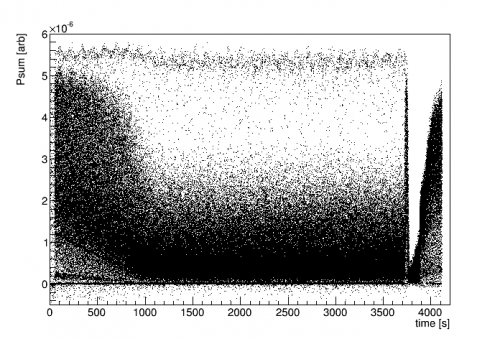
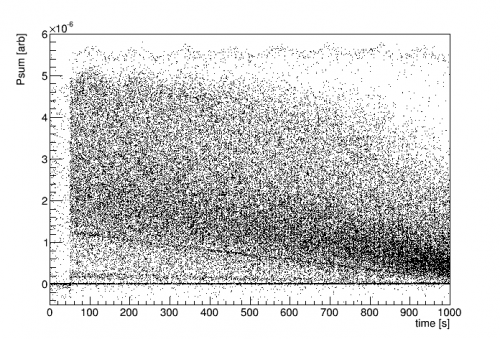
Quick results of processing this data. Using a rough channel balancing for Psum. Can see some lines decreasing in the first 1000s and turning down the bias at 3700s. Interesting oscillations at the highest energy.
 |  |
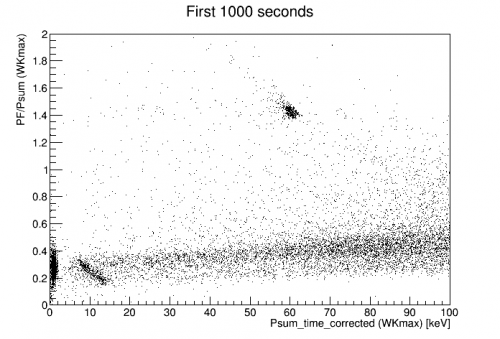
With a time-dependent calibration factor, can see two blobs look at energy vs. F partition. These seem to be the 60keV Am (central=high PF) and 10keV activation (distributed).
 |
| 1555 | Flash LEDs for 30 seconds. Tower gets hotter but not by nearly as much as we are used to: peaks at 57.8 mK |
|---|---|
| 1610 | Try “manually” turning LEDs on and off on the ODB. Turn on 15V power, then toggle on LEDs. The one LED connected to DIB4 (which is connected to DCRC3) did not cause a temperature increase when turned on. LED1 on DCRC4 (DIB1) when switched on for a few seconds caused a significantly greater temperature increase than the sequence, peak at 62.7 mK (still kinda low). LED2 on DCRC4 (DIB1) causes a similar temperature increase. |
| 1615 | Stop DAQ programs then stop and restart MIDAS, because the data we took earlier did not get copied to /byseries, so we're thinking LazyLogger was off. Looks like it started with the DAQ restart. |
| 1655 | Fill LN2 cold trap bath |
| 1655 | Tower = 55.7 mK. MB = 56.4% |