2018/09/26 (Wednesday)
| Setup: DIB1/3/4 → 3.2 MHz filters 2/3/1 → cable 3/1/2 → gender changer 3/?/2 → HVConn 1/3/2 → HV 1/2 → DCRC55(1)/DCRC50(3) 1.1kV → NaI B/C → Ortec 452(gain=5, shaping = 6 us, output=10V) / Ortec 450(gain=5, shaping = 5 us integration, Neg input) → x10/x10 attenuator → DCRCX(4) DCRC33(2) → kepco 1kV power supply → HV input |
|
| status: | 22Na -125V data overnight, tower = 29.7 mK |
| 0945 | Fill LN2 cold trap. |
| 1200 | Playing with the NaI setup. Realize that the PMTs reading out the NaI detectors have been biased at 1.2 kV instead of 1.1 kV this whole run. There is a fine bias knob which I foolishly misinterpreted as being 10's of V instead of 100's of V. This could be enough to make the NaI signal too large for the amplifiers above ~3MeV. Took some data using the EasyMCA in each of these configurations. |
 |  |
| NaI B bkg +22Na spectrum at 1.2kV | NaI B bkg +22Na spectrum at 1.1kV |
Reducing the NaI PMT bias from 1.2kV (left) to 1.1kV (right) reduces the signal by ~60%. However, reducing the bias also reveals a new peak around 4.3 MeV. If this is physical, it may indicate the amplifier was saturating and losing resolution for these large events.
I also read in the PMT manual that the dynode connections should be terminated when not in use, so took some data in that configuration at 1.1kV. The spectrum below shows that the maximum signal is doubled, but the possible 4.5MeV peak is gone.
 |
| 1230 | Return to same NaI setup as last night, but now with the bias actually at 1.1 kV instead of 1.2 kV |
|---|---|
| 1525 | Commence LHe transfer, MB = 29.6%. We used the new 250L Dewar, and this time tried using the heater instead of pressurizing with helium from the gas cylinder. Used an extension cord to plug it in. Shortly after starting the transfer, after the pressure fell off, we set it to 4 psi. The pressure on the Dewar gauge and on the wall recovery gauge both rose, and the pressure at recovery was too high (3 psi), so we turned it back off. After the pressure fell again we turned it back on and were able to leave it - the Dewar pressure was at about 3 PSI but the wall pressure stayed below 2 psi. It seemed to work fine. Transfer probably a little faster than usual. |
| 1536 | Start NaI amplifier test Setup: DC Voltage supply (0-20V) → Ortec 419 Pulse Generator(Ext Voltage Ref, Min risetime) → Ortec 452(gain=5, shaping = 6 us, output=10V) / Ortec 575A(gain=4, shaping = 3 us, Neg input) → x10/x10 attenuator → DCRCX(4) pB/pA. Trigger on DCRC4pA=5. Vary the DC voltage supply voltage every ~1min from 0-6.0 V in 0.1 V increments. |
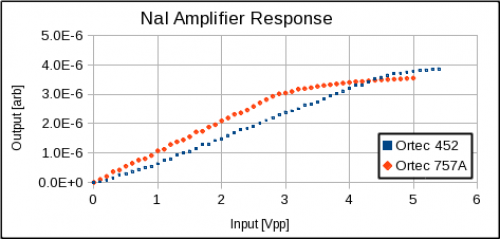 |
Preliminary results of this test dataset. There were some problems distinguishing peaks in the data, so there are 5-8 missing values for each amplifier. This distorts the curve somewhat, but it is already clear that the amplifiers both start to saturate eventually.
| 1630 | Fill LN2 cold trap full. |
|---|---|
| 1632 | Return 22Na source to safe. |
| 1700 | Start 8x2hr bkg series at HV = -125 V with 15% prebias for 5 min, split into 10 min subruns, with CDMS and NaI detectors running and DCRC2 as HV controller. Using sequence HVscan-125×8-15_5PreBias-DCRC2_250V-30Flash-30wait-2hrData-10minSubRun.msl CDMS detector: Driver Gains = 2x, QET biases = (280/260/305)/(140/280/295) uA, Front-End Gains = (10/10/10)/(10/15/10) NaI detector: 1.1kV → NaI B/C → Ortec 450(gain=5, shaping = 5 us integration, Neg input)/Ortec 575A(gain=4, shaping = 3 us, Neg input) → x10/x10 attenuator → DCRC4PB/PA, Driver Gains = 1/1, PhononWaveFormLength = 1024 (512 samples), PhononPrepulseSamples = 64 (64 samples) 1000 BOR randoms, trigger on DCRC3pB/C/D threshold = 7/10/9 Note the correct NaI bias and the new NaI amplifier arrangement. |