previous day
Planned tests:
Confirm that RevC.1 boards can't produce good pulses. Currently DIB2→DCRC55, so see if these pulses look bad compared to Friday DIB2→DCRC33. Try with no other boards powered. (Pulse pictures and take some data.)
Check whether RevC.1 pulses improved with filter (the best RevC pulses came with the 100MHz filter.) Set up DIB2→100MHz filter→DCRC55 and look with no other boards powered. (Pulse pictures and take some data.)
We have been investigating the interference of biasing one DIB's QETs on another DIB's pulse shapes. Also should explore the affect on the second DIB's baseline noise. If a repeatable effect is seen, take some randoms.
Look again at 10 keV line. Return to our standard configuration (DIB1/2/3→none/100MHz/none→DCRC55/33/50) and take some background data. Will need aggressive flashing.
Study whether noise changes every time you repower the boards. In standard configuration, take random data after unplugging and replugging the DCRCs several times.
Other tests (AV):
Investigate timing link further by taking some data with timing link not set up on RevC, then set up in our standard way. Do the same switching to a DCRC RevC.1 the master.
Make a systematic study of the interaction of ZAPing and biasing channels. Basically set up timing link across all boards in the standard way then ZAP all (taking settings to zero) then restore settings one channel at a time and observe pulses/take short data.
| 0851 | Fill LN2 cold trap full. |
| 1154 | Unplug all DCRCs. Power DIB2→no filter→DCRC55. Zap SQUIDs. Set phonon settings, with Frontend/Output gains set to 7/1. |
| 1320 | Connect exhaust of 1K Pot Pump to He recovery and open valve. |
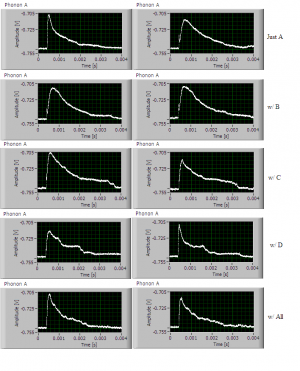
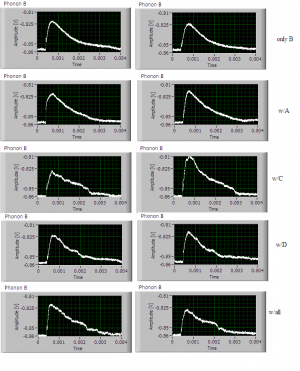
| 1330 | Studying pulses on DIB2→DCRC55 with no other DCRC powered. Sometimes the pulse shapes are pretty good - it seems to depend on which other QETs are activated. The figures below each focus on a different phonon channel, showing pulses from that channel with various combinations of other channels either Grounded or set to standard Non-Inverting. The top row is only that channel, the next three rows show the effect of turning on one of the other channels, and the bottom row shows the case in which all channels are on. Pulses were chosen to fit in a 50 mV high window. |
| DIB2→DCRC55 pulses, with no other DCRC powered |
| with various combinations of other phonon channels on the same DIB grounded |
| phononA | phononB |
 |  |
| phononC | phononD |
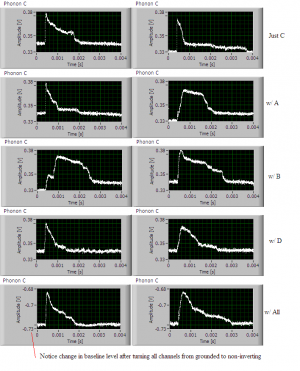 | 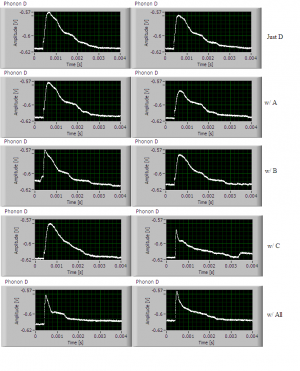 |
Basic pattern: pA and pB are good by themselves and have little effect on the other channels. pC and pD are poor by themselves and also degrade other channels when they are on.
| 1447 | Put 100MHz filter on DIB2, so DIB2→100MHz filter→DCRC55. Power DCRC55, zap SQUIDs. |
| 1520 | Apply phonon settings, with gains = 7/1. |
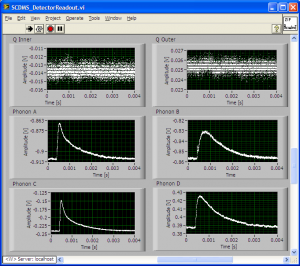
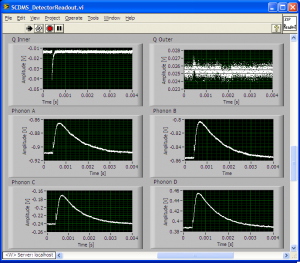
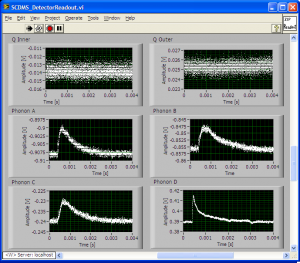
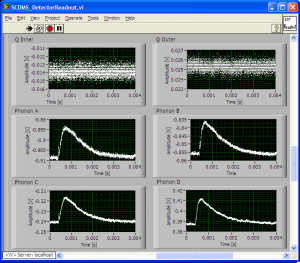
| 1525 | Sumbitch! pulses look pretty nice! |
| DIB2→100MHz filter→DCRC55 pulses with no other DCRC powered |
 | | |
 |  |  |
| 1600 | Set up as follows: DIB1/2/3→100MHz/none/none→DCRC55/31/50. This is similar to the most recent 3-DCRC data configuration except for the filters. |
| 1619 | Turn on DIB1→100MHz→DCRC55, zap SQUIDs, apply phonon settings with 7/1 gain settings. |
| 1724 | Phonon shapes are not great. pA/B/C/D are mediocre/good/poor/poor. pC and pD seem to make pA a bit worse when they are on. However pulses are somewhat improved from the no-filter case on Friday. With no filter pB did not look good. |
next day