−Table of Contents
PuBe source containment and shielded storage
Pube Source container dimensions
The stainless steel PuBe source encapsulation sits in a steel can.
| Outer Diameter of steel can | 4.5 | cm |
|---|---|---|
| Height of steel can | 11 | cm |
| Height of PuBe source in steel can | 5.5 | cm |
The can hooks to the end of a Lucite rod that allows it to be lowered into the howitzer or the paraffin drum.
Howitzer
When the PuBe source was under the control of Kurt Wick it was kept at all times in a howitzer, which has ports to insert materials for activation to use in lab classes on radioactivity.
The howitzer containment for the source is cylindrical with the following dimensions:
| Diameter | 30 | in |
|---|---|---|
| Height of main body | 31 | in |
| Full height including wheels and c-rings on top | 38 | in |
| Weight, including locks and inserts (but not source) | 864.5 | lbs |
| Weight, with locks and inserts removed | 857.0 | lbs |
The source can on its lucite rod can be lowered into the top of the howitzer. A lid can be placed over the rod and padlocked.
The howitzer has three ports along the diameter halfway up which allow samples to be placed near the source in the center for activation. There also seem to be three vertical sample ports at the top for the same purpose.
It is not known what the howitzer is made of. Presumably it is mostly neutron moderating material. The visible surfaces seem to be painted steel or another metal. As far as can be seen there is no dedicated gamma shielding, e.g. lead.
The dimensions above imply an average density around 1.1 g/cm^3. HDPE has a density of 0.94 g/cm^3.
Paraffin drum
A paraffin-filled drum with a steel tube extending into it is used as a smaller neutron-moderating containment vessel. We have used this drum in the lab as part of a setup to produce thermalized neutrons.
| Barrel outer diameter | 41.5 | cm |
|---|---|---|
| Barrel height | 54.5 | cm |
| Depth from top of barrel to top of paraffin | 9-10 | cm |
| Depth from top of barrel to bottom of tube | 28.5 | cm |
| Elevation of bottom of source from bottom of barrel | 26 | cm |
| Elevation of top of source from bottom of barrel | 31.5 | cm |
Red Box
Containment: Howitzer versus Box
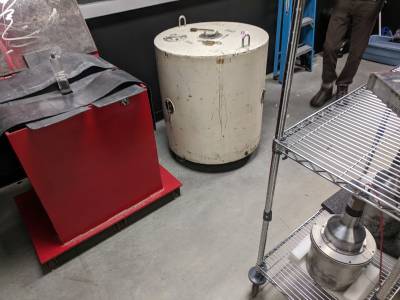
There are two different containers for the PuBe source: the red box and the howitzer, shown below.
 |
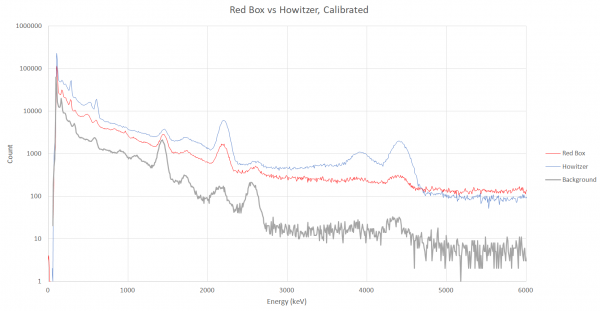
We were interested in the differences in spectra obtained through the different containers, so we took data (using the methods described here) with the source in each container, as well as with the source removed to a far corner of the lab to observe just the lab (PAN 443) background.
Technical Notes: - The detector was equidistant from each source location, 1.35m away from the midpoint of the line connecting the two source locations. Each source was 0.56m from that midpoint.
- The NaI detector is 7.75 inches in diameter and 6 inches high, according to the Geant4 simulation code written by Anthony.-
- UPDATE: it's probably 8 inches in diameter.
- Measurements runtimes were as follows: Background 396s live, 400s total; Red Box 390s, 400s total; Howitzer 380s live, 400 total.
- The conversion between channel number N and keV E is E = 8.21*N-94.8. This means each bin has a width of 8.21 keV.
- Full dataset: container_dataset.xlsx
 |
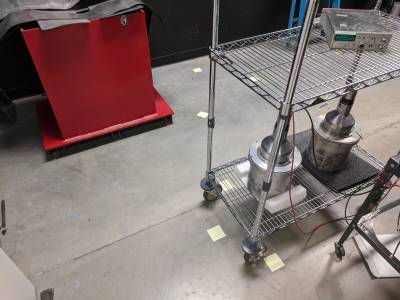
Note: for the background spectra, the source was removed inside of the howitzer container for safety reasons, as shown below. Therefore, the background spectra does not include any latent radiation produced by the howitzer container itself.
 |
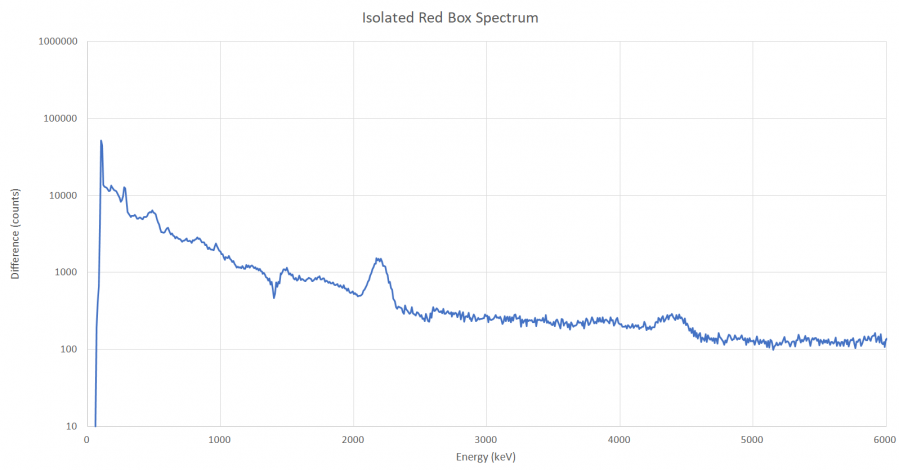
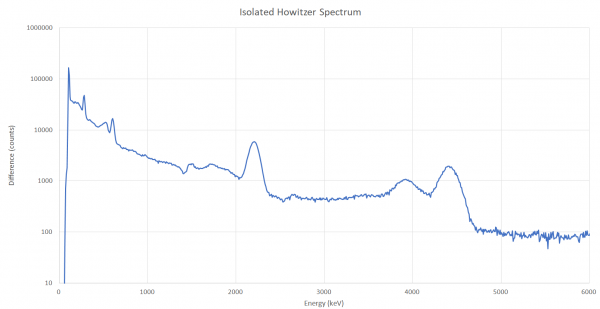
Finally, simply subtracting the data sets can give a rough idea of each container's isolated spectrum:
 |
 |
Analysis
data and analysis, first measurement data and analysis, near, far, and shielded measurements gamma attenuation calculations for various materials
To estimate the effectiveness of the shielding we can attempt to calculate the effective, shielded activity in uCi, to compare to our other gamma sources. If it is comparable to one of our stronger sources then we should probably consider the shielding inadequate, at least if it's stored in an area where people work.
Using the dimensions above, an estimate of the solid angle fraction taken by the NaI detector is 1/895. If we take the measured hit rate and divide by this fraction we get an effective 4pi rate. This should be an underestimate because it assumes all gammas interact with the detector (even glancing hits).
To get the total number of hits in each measurement we can integrate the count histograms. In each histogram there is a strong spike a little above threshold, around 100 keV. I don't know why. We can leave this low spike out of the count, a conservative choice again - if anything the result will be an underestimate. We find these approximate hit counts:
- Howitzer: 2.5e6 hits; Red box: 1.3e6 hits; background: 0.46e6 hits
If we were to include the low-energy spike these would be about 15% higher.
Using the live times and the solid angle fraction we now calculate the equivalent activity in uCi (the unit we generally use for the sources):
- Howitzer: 159 uCi; Red box: 81 uCi; background: 28 uCi
Interestingly even “background” represents an activity stronger than most of our sources (or more precisely: the background in the room is equivalent to standing 1.5 m from a 28 uCi source, assuming no error in this calculation). Note that we didn't completely remove the PuBe events in the background calculation - the howitzer was moved probably about 10 times further than it was, and we can still see 4.5 MeV gammas from the source and the 2.2 MeV n-capture on H line. But these are subdominant to the standard background lines from U/Th and K.
update: a quick calculation suggests this is a normal background radiation rate. Typical quoted background rates are a few mSv/year. The average energy in the measured background spectrum is 720 keV. If we imagine a 70-kg human with 1 m^2 cross-sectional area and assume that all the incident gammas from the background are absorbed in the body. It comes out to about 2 mSv/year. The wikipedia article on background radiation has a table, and this rate seems to be in the ballpark - it's a bit confusing because some natural dose comes from ambient flux but other sources are inhaled air and consumed food. But it looks close to normal.
note: the unit for exposure on the dosimeter reports is millirem/quarter. So doses less than this would not register. But… 1 mrem/0.25year is equal to 0.04 mSv/year. Shouldn't these be registering background radiation? Even just terrestrial radiation from ground is 0.2 mSv/year on average, 5 times greater than this. Maybe the dosimeter reports subtract a standard background?
Subtracting background gives equivalent activities of 131 uCi for the howitzer, 53 uCi for the red box. If these were bare sources we'd surely store them in the lead-lined safe, so that suggests that the shielding should be improved.
Are these values surprising? Well, the calculated neutron rate from the source is about 62 uCi, and the high-energy gamma rate is about the same as this - the total of the two is 124 uCi. The calculation for the howitzer is greater than this but in the same ballpark. This could make sense if 1) the high energy gammas are essentially not shielded and 2) every neutron is captured in the moderator, subsequently releasing a gamma that is not shielded. Is this really what's happening? In simple terms of activity, the howitzer seems useless - but of course the neutrons are worse than the gammas, because they are higher energy and more penetrating, and also nuclear recoils cause more biological damage than electron recoils.
If we really want effective shielding, this scenario suggests that we want lead outside of poly is better than poly outside of lead, because the latter would emit unshielded capture gammas.
Radiation limit notes from Radiation Safety
Radiation Safety states that
<blockquote>Appropriate shielding must be provided so that the exposure rate from radiation sources is less than 2.5 mR/hr. at 12 inches in any controlled area</blockquote>
If we consider the Howitzer, and say the equivalent activity is 131 uCi, and suppose that's all effectively 2.2 MeV, and assign 50% absorption probability for a human body, and put that body right next to the Howitzer (15 inches from the source), it comes to about 2.4 mR/hr - just under the allowed limit. Of course we can try to do this calculation more carefully.
Two mysteries:
- Considering normal environmental background radiation, why don't our dosimeters read higher than 0 mrem per quarter? It should be several mrem at least.
- Why does the measured rate of the PuBe in the Howitzer actually exceed the estimated total n and high-energy gamma rate? Particularly if you consider the detection efficiency of the NaI.
Howitzer dose rate calculation
| Sum | ||||||
|---|---|---|---|---|---|---|
| Gamma energy [MeV] | 2.2 | 3.9 | 4.4 | 0.28 | 0.60 | |
| Peak count | 78763 | 22750 | 47820 | 69420 | 39564 | 258317 |
| Live time [s] | 380 | |||||
| NaI absorbed rate [Bq] | 207.3 | 59.9 | 125.8 | 182.7 | 104.1 | 679.8 |
| NaI absorption coefficient [1/cm] | 0.0772 | 0.0768 | 0.0780 | 0.388 | 0.128 | |
| Thickness-averaged NaI absorption probability | 0.679 | 0.677 | 0.683 | 0.984 | 0.836 | |
| NaI incident rate [Bq] | 305.3 | 88.5 | 184.2 | 185.7 | 124.5 | 888.2 |
| NaI solid angle fraction | 0.001118 | |||||
| Rate [Bq] | 273.1e3 | 79.2e3 | 164.8e3 | 166.1e3 | 111.4e3 | 794.4e3 |
| Rate [uCi] | 7.38 | 2.14 | 4.45 | 4.49 | 3.01 | 21.47 |
| Body tissue interaction coefficient [1/cm] | 0.0470 | 0.0342 | 0.0322 | 0.1211 | 0.0887 | |
| 15cm body tissue interaction probability | 0.506 | 0.402 | 0.383 | 0.837 | 0.736 | |
| dose rate at edge of howitzer [mrem/hr] | 0.0643 | 0.0263 | 0.0587 | 0.0082 | 0.0104 | 0.1679 |
| dose rate at edge of howitzer [mSv/yr] | 5.639 | 2.303 | 5.147 | 0.722 | 0.912 | 14.723 |
The strategy for estimating the dose rate of the source in the howitzer is to first assume that the radiation is composed of a few discrete gamma rays (no fast neutrons), use the NaI spectrum and NaI absorption properties to get the rate of each gamma, then calculate the dose absorbed by a human body right at the edge of the howitzer.
Notes on the calculation:
- Gamma energies: there are clear gamma peaks associated with the source in the howitzer at 2.2 MeV (n,gamma on hydrogen in the poly) and 3.9 and 4.4 MeV (which I think are emitted from C-12 after alpha,n; ref2). But there are two other lines clearly present in the spectrum above background, at around 280 keV and 600 keV. I don't know what these are, but I include them. Note that the assumption of only these gammas coming from the howitzer is wrong, because there will also be some gammas that Compton scatter first before hitting the detector. These are left out of the calculation which will underestimate the dose rate.
UPDATE: thinking more carefully about the lines present in the PuBe spectra, the only two that clearly should be present are 4.43 MeV from Be(α,n)C and 2.23 MeV from H n-capture. The apparent 3.9 MeV line is probably a combination of the Compton edge of the (α,n) line (4.19 MeV) and its single-escape peak (3.92 MeV). As for the lower lines seen at 600 and 280 keV, it seems quite likely that there is a calibration error and that these are actually 511 keV (since there should be plenty of pair production) and the (α,n) backscatter peak at 240 keV (and for H n-capture this would be 229 keV, maybe it's a combined line). The ratio between the peaks seems to come out just right. - Peak count: I simply subtract a linear background from the base of each peak to get an estimated full-energy count.
- Live time: provided by the DAQ data output.
- NaI absorbed rate: the rate of each full-energy gamma as calculated from count and live time.
- NaI absorption coefficient: from NIST X-Ray Mass Attenuation Coefficients. I use mu_en, assuming this to be the stopping power for full-energy absorption rather than just scattering, thus this should allow calculation of the full-energy absorption efficiency for each gamma.
- Thickness-averaged NaI absorption probability: because the radiation is incident on the curved surface of the NaI detector I calculated an average absorption probability over all distances from the detector axis.
- NaI incident rate: the absorbed rate divided by the absorption probability.
- NaI solid angle fraction: cross-sectional area of detector divided by area of spherical surface centered at source with radius the source-detector distance.
- Rate: NaI incident rate divided by NaI solid angle fraction. In uCi, it can be seen that this turns out to be about 1/5 of the expected rate from the unshielded source.
- Body tissue interaction coefficient: This is also from the NIST site, for “Tissue, Soft (ICRU Four-Component)”, which is a standard material at 1 g/cm3 to calculate dose on human tissue (consisting of O, C, N, H). I use mu rather than mu_en here, because any interaction will deposit energy in the body, even if the gamma does not deposit all of its energy. Later though I assume that the full energy of the gamma is absorbed, neglecting partial absorptions, so this will overestimate the dose rate.
- 15 cm body tissue interaction probability: this is the thickness of a standard “slab phantom” meant to represent a human torso. It's not clear that this is exactly the correct thickness to use… it seems to be the smallest thickness used. If we calculate dose with a thicker phantom, the absorption probability increases but so does the mass per unit incident area, so probably a greater thickness would result in a lower dose estimate. Thus this is conservative.
- Dose rate at edge of howitzer: The formula is
dose_rate=(Activity*Gamma_Energy*Absorption_Efficiency)/(4pi*Source_Distance^2*Tissue_Density*Tissue_Thickness).
Converting the dose unit to J/kg is equivalent to dose in Gray or Sievert; multiplying that by 100 gives rad or rem.
According to this calculation the dose rate is 0.17 mrem/hr, much less than the limit of 2.5 mrem/hr at a distance of 12 inches required for shielding.
Expressed as 14.7 mSv/year, we see that standing near the howitzer gives a dose rate several times typical background radiation.
A check on the assumptions in this calculation involves looking at the total rate of hits on the detector compared to background. The total hit rate minus background is about 5.3e3 Bq. This should be a little less than the calculated incident rate, because that should include both the full-energy hits and the Compton partial-energy hits. However the total hit rate is 6 times greater than the calculated incident rate. So the assumed model does not account for all the hits. Some of this will be gammas that Compton scatter before hitting the detector, but that probably doesn't account for all of it - not sure what else is missing. Even if the total activity is 6 times greater than calculated, I don't expect the dose to be 6 times greater, because it appears that most of the excess is at low energy. If we conservatively multiply the calculated dose rate by 6 we get a dose rate of 1.0 mrem/hr, still less than half the limit.
The 2.5 mrem/hour at 12 inches limit is rather permissive by our usual standards. No source kept in the safe would violate this dose rate even if it were not shielded at all.
The annual limit for an adult worker is 5 rem = 50 mSv. If someone spent 40 hours a week every week of the year standing next to the howitzer, the conservative estimate above comes to only 21 mSv. (And unless someone sets up their desk by the howitzer, they will only get a small fraction of this.) The annual limit for a minor is only 5 mSv, so if we ever hire high-school students (or young college freshman) their time working next to the howitzer should be limited to 3 full-time months. Of course there is no reason anyone should be spending multiple hours near the howitzer.
Most of Room 433 is pretty safe because of the 1/r^2 law. Just 2 meters distance from the howitzer reduces the dose rate to less than normal background radiation (it would be roughly equivalent to the dose rate on a plane at cruising altitude).
Another requirement is that the annual limit for persons in unrestricted areas (nonoccupational limit) is 1 mSv. If we consider a person spending all their work hours in the vicinity of the howitzer, a distance of 2 meters is sufficient to fall below this limit. It's clear that no one on the 4th floor works this close to the storage area, but we should check the 3rd floor just below the howitzer too. \\Update: Vlad Pribiag's lab, PAN 353, is situated below the howitzer. From the door to that lab, if you walk forward 4 meters, then turn right and walk 10 meters, that's directly below the howitzer. I haven't yet entered the lab to see if there is a work station or something there. However, it's clear that even if there were, it's more than 2 meters below the howitzer, with a thick layer of concrete between. So it seems that it's safe regardless. (I tried knocking Monday morning (2020 Feb 24) and got no answer, so it also seems unlikely that anyone is spending a great deal of time in there.)
Howitzer dose rate calculation - better approach
Since the spectrum is not fully understood and efficiency calculations based on attenuation constants seem unreliable, it's probably better to estimate dose rate with a more direct approach.
Here I'll use the calibrated Howitzer spectrum to calculate an absorbed energy flux. We simply sum the energies of each hit in the data, divide by live time, and divide by an effective cross-sectional area of the detector. Then apply this same absorbed energy flux to hypothetical slab of tissue with standard 15 cm thickness and density 1 g/cm3 to get the dose rate. This assumes the stopping power of tissue is the same as NaI, which it is not - it's smaller for tissue. So this will be a conservative estimate of dose rate. (For the average energy it's about a 10% difference.) Note that the NaI is, conveniently, around 15cm or more thick. We take the effective cross-sectional area to be the 15cm detector height times an effective 15cm width (this is close to the width within which the thickness is at least 15cm).
When we calculate the absorbed energy rate for the Howitzer we can subtract the background absorbed energy rate to get the dose rate from the PuBe in the Howitzer alone. We can do a separate calculation of the background dose rate with a slightly modified technique - in the above we are assuming the flux comes from one direction but for the background we should assume it is isotropic. In that case we can simply take the deposited energy rate and divide by the mass of a tissue sample with the same dimensions as the NaI detector. Since the thickness of the detector is close to the standard 15 cm tissue thickness this calculation is close to the previous one (72% as large).
| Background dose rate calculation | |
|---|---|
| Background deposited energy [eV] | 2.854E+11 |
| Background live time [s] | 390 |
| Background dep. energy rate [eV/s] | 7.319E+08 |
| Background dep. energy rate [J/s] | 1.173E-10 |
| NaI volume [cm3] | 4638 |
| Tissue mass [kg] | 4.638 |
| Dose rate [Sv/s] | 2.53E-11 |
| Dose rate [mrem/year] | 79.8 |
The calculation of background dose rate above comes very close to what is expected, so this gives a lot of confidence to this technique. The pie chart from Radiation Safety gives 30 mrem for “rocks and soil” and 30 mrem for cosmic rays, so that combination is pretty close to the above.
In addition to the original Howitzer data, new datasets were taken with the detector closer (right against the Howitzer) and farther (the opposite side of the darkroom). With the three data points we can construct a rate-versus-distance formula.
| Original | Close | Far | |
|---|---|---|---|
| Distance from center of howizer [m] | 1.461540283 | 0.4826 | 4.585 |
| Howitzer total deposited energy [eV] | 2.00635E+12 | 1.49E+13 | 5.25E+11 |
| Howitzer live time [s] | 380 | 400 | 400 |
| Howitzer total dep. energy rate [eV/s] | 5.28E+09 | 3.73E+10 | 1.31E+09 |
| Howitzer net dep. energy rate [eV/s] | 4.55E+09 | 3.66E+10 | 5.81E+08 |
| Rate versus distance fit parameters: | |||
| Constant (eV/s at 1 m) | 9.4241E+09 | ||
| Exponent (distance in m) | -1.8397 | ||
As expected the rate falls off more weakly than 1/r^2, because the PuBe+Howitzer is not a point source (particularly for the 2.2 MeV gammas, which come from the entire volume of the Howitzer).
In the table below are dose rate calculations for right next to the Howitzer and at a distance of 2 m from the center of the Howitzer:
| Howitzer dose rate at two distances | ||
|---|---|---|
| Distance from center of howitzer [m] | 0.381 | 2 |
| Net rate deposited in NaI [eV/s] | 5.56E+10 | 2.63E+09 |
| Net rate deposited in NaI [J/s] | 8.91E-09 | 4.22E-10 |
| NaI effective area [cm2] | 225 | 225 |
| Deposited flux [J/s/cm2] | 3.96E-11 | 1.87E-12 |
| Tissue areal density [kg/cm2] | 0.015 | 0.015 |
| Dose rate [Sv/s] | 2.64E-09 | 1.25E-10 |
| Dose rate [mrem/year] | 8332 | 394 |
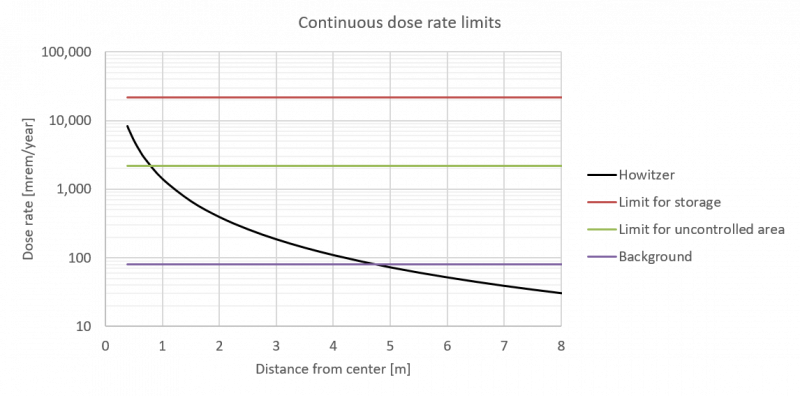
The plots below show the Howitzer rate as compared to various limits set by Radiation Safety:
Notes:
- The dose rate at the edge of the Howitzer is below the limit for source storage by more than a factor of 2
- The dose rate is below the limit for uncontrolled areas at distances greater than 0.8 m
- The dose rate falls as low as the background level at a distance around 4.5 m. This is about the distance of the nearest workbenches in PAN 443
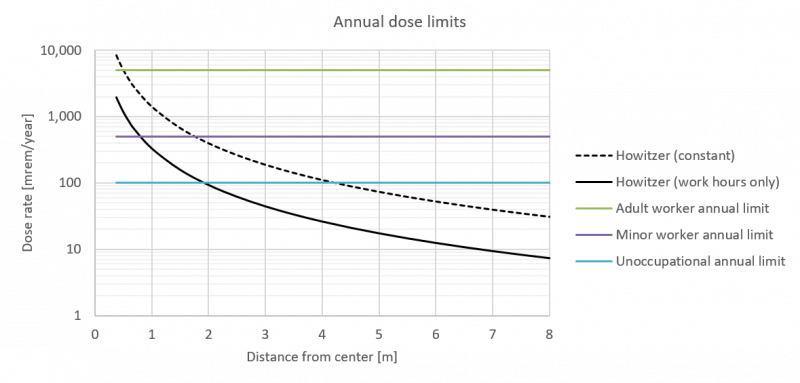
Notes:
- The limits in the plot above are total dose for a person over a year
- The annual dose from the Howitzer is shown for a full year of exposure and also for the practical limit of a full work year (52 weeks at 40 hours per week)
- For an adult worker the total possible 1-year dose from the Howitzer is below the limit
- For a minor worker, the annual limit could be exceeded if the worker was very close to the Howitzer for a full work year, by a factor of 4. So a minor worker should spend no more than 1/4 of a work year right next to the Howitzer. (Of course in practice no one would ever be near the Howitzer for that much time.)
- For the “unoccupational” limit, I assume this could apply to anyone not associated with the lab, working in the building nearby. If we imagine such a person spending all their work time near PAN 443, they will be beneath the limit at a distance of 2 m or more. The vertical distance between the 4th and 3rd floors is 5 m. So the center of the Howitzer is at least 3 m above the head of a standing person on the 3rd floor. The room adjacent to the PAN 443 dark room with the Howitzer is labeled “Electrical” - it's not accessible to most people and certainly is not a room that anyone spends much time in normally. So we are easily below this limit.
- The unoccupational limit should apply to any lab visitors as well. If a visitor stands next to the Howitzer for too long, they will eventually reach the dose limit. As it turns out they would have to stand next to it for over 4 days straight to reach the 100 mrem limit. So there is no reasonable possibility that a lab visitor could reach the dose limit from the Howitzer.
The results above make it clear that the Howitzer is sufficient on its own as shielded storage for the PuBe source by the standards of Radiation Safety regulations. But it has a rather high dose rate by the typical standards of our lab. We can think of a more desirable dose rate as maybe a few times background. The Continuous Dose Rate plot shows that the Howitzer rate reaches 10x background at around 1 m, and close to the Howitzer it approaches 100x background. It would be preferable if this were lower. That would require additional gamma shielding.
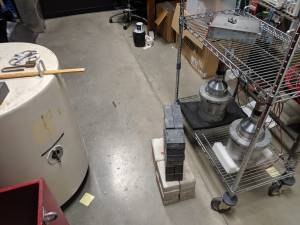
Another test was performed with a 4-inch thick lead wall erected between the Howitzer and the NaI detector, with the NaI detector around 1.4 m from the center of the Howitzer. Below is a dose rate calculation for that measurement:
 | Test with lead shield | |
|---|---|---|
| Net Rate deposited in NaI [eV/s] | 8.35E+08 | |
| Rate deposited in NaI [J/s] | 1.34E-10 | |
| NaI effective area [cm2] | 225 | |
| Deposited flux [J/s/cm2] | 5.95E-13 | |
| Tissue areal density [kg/cm2] | 0.015 | |
| Dose rate [Sv/s] | 3.97E-11 | |
| Dose rate [mrem/year] | 125 | |
With the shield the dose rate is reduced to 125 mrem/year, only 1.6x background. Without the shield it's about 700 mrem/year, 8.8x background. The strong reduction in gamma is expected from stopping power calculations - the high energy gammas require about 4 inches of lead for an order-of-magnitude attenuation. If we use steel instead we probably need closer to 6 inches.
Improving storage shielding
Assuming that the howitzer is considered insufficient for gamma shielding, we should come up with something better.
Add lead to Howitzer?
Lead sheets - these are 1/16“ thick, 3×4 feet. Two of them would wrap around howitzer. Say 1/2 inch thick, 8 layers, 16 sheets: 2560. Maybe can get something cheaper.
Steel sheets: got a quote for 24 sheets of steel, 1/4” thick X 36“ X 36”. So 6 inch thick on one side of the howitzer. Each weighs 92 lbs so kinda hard to deal with.
Add neutron moderator to red box?
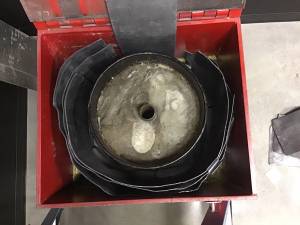
Red box inner dimensions: length 25 in, width 21 in, height 25 in. Suppose we line it with 2“ of lead brick. Then inside that we could put HDPE bricks or something, minimum thickness around 8 inches, not as good as 13 in or so from howitzer.