Co-60 Spectra
SiPM 2 (channel 0) and SiPM 4 (channel 1) were placed in their delrin holders on opposite sides of the WLS fiber of scintillator 1-74-1. No optical coupling grease was used when placing the fiber in the scintillator sample. Each event was self-triggered when both SiPM were above the trigger threshold of 8320. When the Co-60 source was present, it was placed 10 cm from the plastic.
| Table 1: Explanation of runs used. |
| Run | Source | Number of events | Data file |
| 1 | background | 10k | 130725_sipm2+4_background_8320threshold_WLSfiber.dat |
| 2 | Co-60 | 10k | 130725_sipm2+4_co-60_8320threshold_WLSfiber.dat |
| 3 | Co-60 | 100k | 130725_sipm2+4_co-60_8320threshold_wlsfiber_x10.dat |
Background
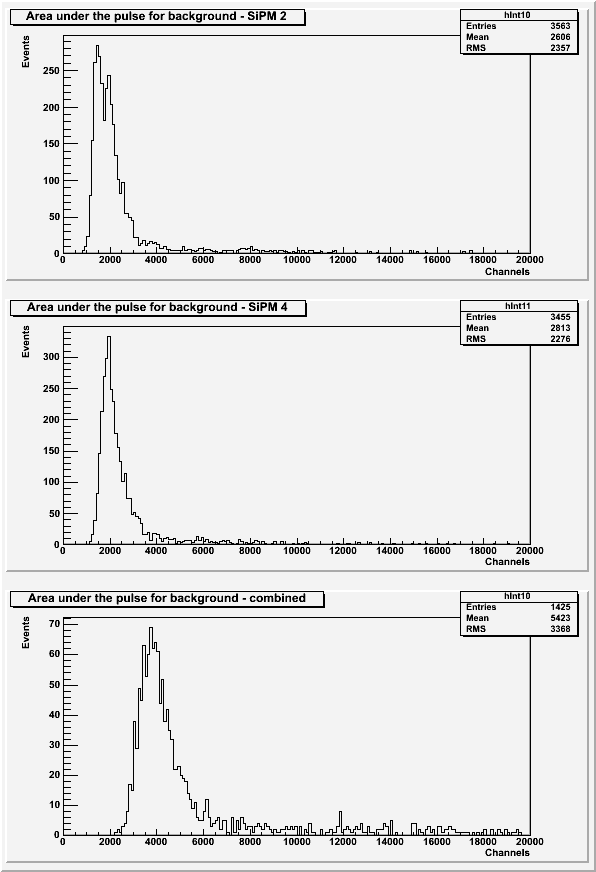
The background run was previously analyzed in the Ce-137 spectra. The histograms in Figure 1 exclude pulses with a baseline standard deviation greater than 7 or with secondary pulses present.
| Figure 1: Area under the pulse for background using SiPM 2 only, SiPM 4 only, and SiPM 2 and 4 combined. |
 |
Short Run
| Figure 2: Area under the pulse for the short run with Co-60 for SiPM 2 only, SiPM 4 only, and SiPM 2 and 4 combined. |
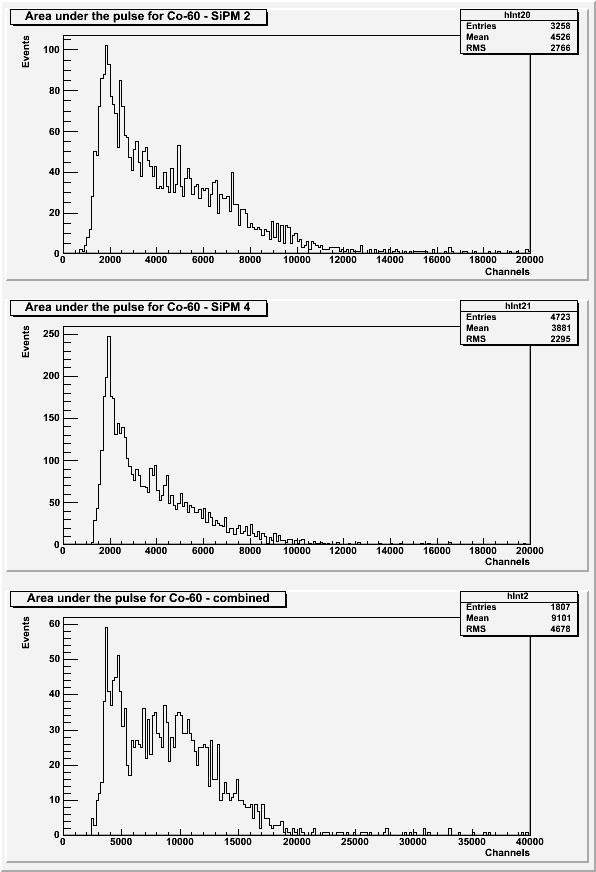 |
The histograms of Figure 2 exclude pulses with a baseline standard deviation greater than 7 or with secondary pulses present.
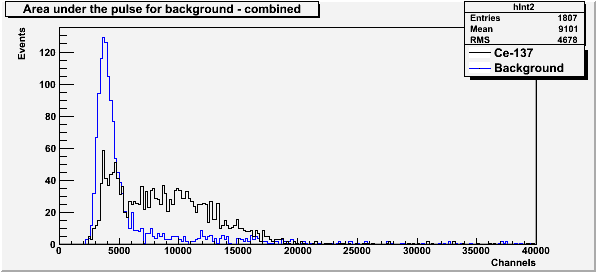
| Figure 3: Comparison between Co-60 (short run) spectrum and the background spectrum. |
 |
Long Run
| Figure 4: Area under the pulse for the long run with Co-60 for SiPM 2 only, SiPM 4 only, and SiPM 2 and 4 combined. |
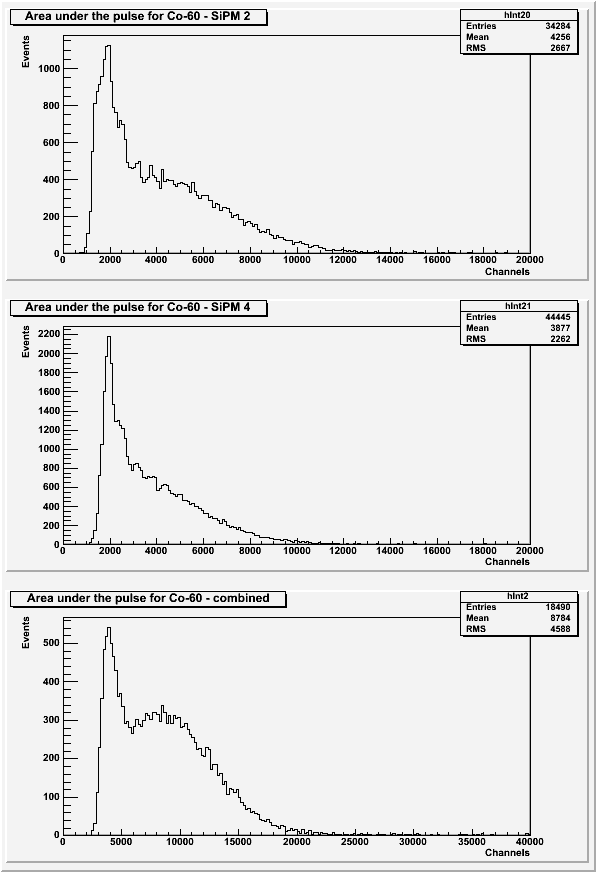 |
The histograms of Figure 4 exclude pulses with a baseline standard deviation greater than 7 or with secondary pulses present.
| Figure 5: Comparison between Co-60 (long run) and background spectra. |
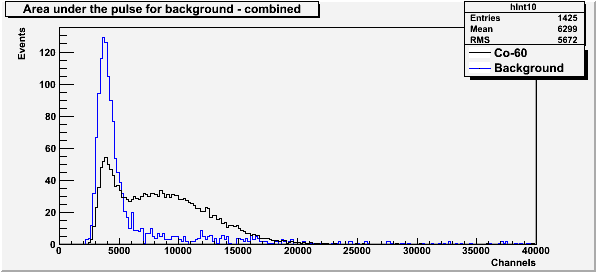 |
The Co-60 (long run) histogram in Figure 5 has been scaled by 1/10 to match the total number of events taken in the background run.