−Table of Contents
NaI detector runs done the week of 3/18
Experimental setup details:
The 1.5g vial of Gd was replaced with a vial contain much more Gd (Gd(NO3)3) (x10?, need to measure mass). The 2“ of poly at the end of the collimator (see Figures 5 and 6 here) was removed. Instead, to generate more thermal neutrons while not scattering them, a 1” thick piece of poly was placed directly in front of the 252Cf source in the collimator channel, as close to the source as possible. Data collection was not dead time limited, the same as for all the previous NaI runs using a coincidence trigger.
The amount of data collected over spring break was severely limited as one of the NaI PMTs tripped several times after I was gone. This week, using a different +HV source has stopped the tripping. I still need to run a few diagnostic tests on the old power supply.
Results
Gd Location Comparison
First, short runs examining the effect of the location of the Gd vial were compared: one where the vial was nearly at the edge of the NaI detectors closer to the source (“Shield 6, Cf-252, Gd Near”), and one where the vial was exactly between the two detectors (“Shield 6, Cf-252, Gd Center”).
| Figure 1: | Figure 2: |
|---|---|
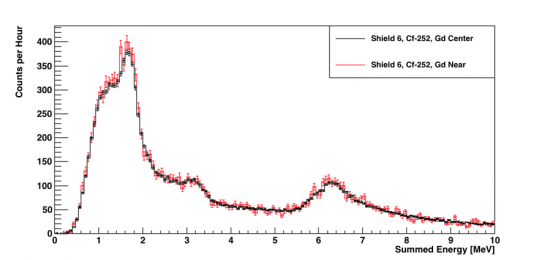 | 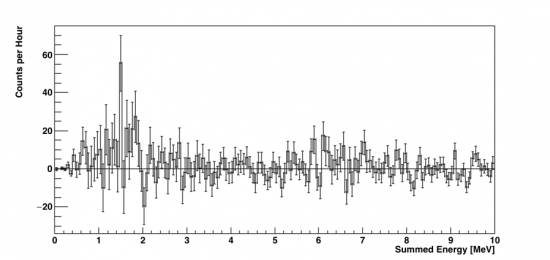 |
The run with the vial closer to the source had a higher trigger rate. The trigger rate difference was small, namely (0.086±0.029) Hz, but there was only a couple of hours of the “Near” run data, so we could run a bit longer with this configuration to push down error bars. How should we proceed?
Gd (center) run comparison with source only data
| Figure 3: | Figure 4: |
|---|---|
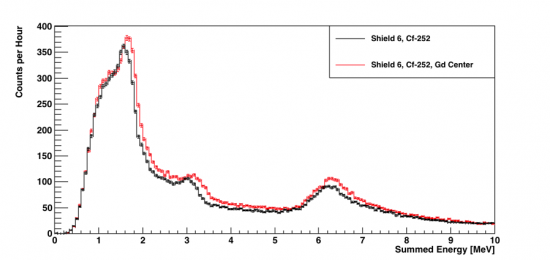 | 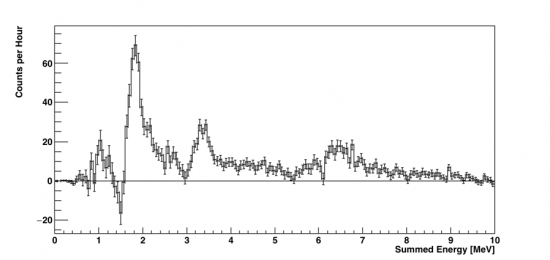 |
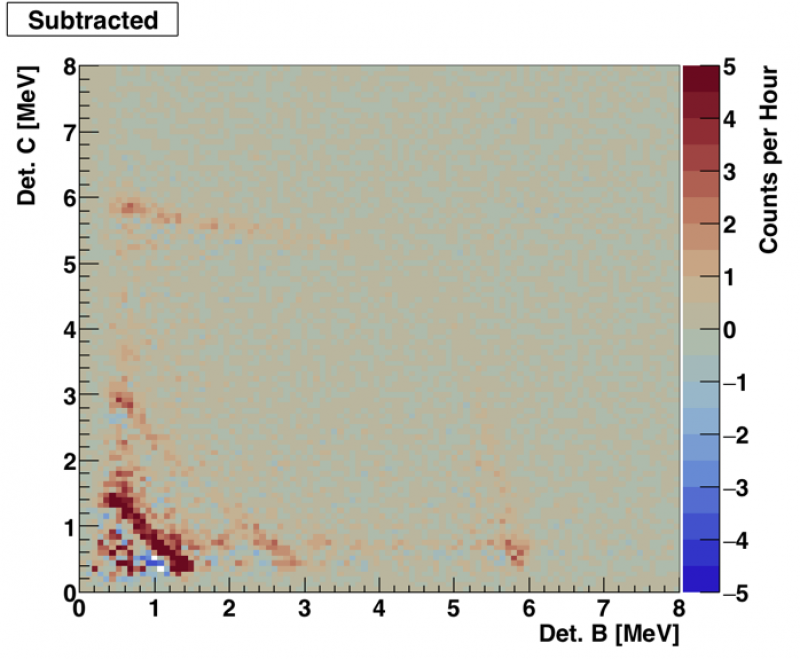
The trigger rate difference is (0.378±0.011) Hz where, the subtraction (Source) - (Source+Gd) was done. The peak locations of the two runs are slightly different because of the switch to the new HV source. A run with just the Cf-252 source and no Gd is going to be done such that the subtracted plots will match better.
| Figure 5: | |
|---|---|
 |