WLS Trapping Efficiency
I am going to be comparing a simulation to a measurement done a while ago (previous measurement).
I measured PE Counts in a PMT due to an incident muon in order to compare with the “pulse area peak location,” as is done in the measurement above. There are two parameters we might be concerned with: 83 +/- 3%, and 68 +/- 5%. The first parameter is just the raw data from peak location, and the second is the figure after scaling the peaks based on the PMT quantum efficiency of the results.
The geometry: an elliptical tube of semimajor axis 21.14 mm, semiminor axis 19.38, length 4.5 cm. Reflectivity: 95% for PTFE in all runs. Hole size: 1.2 mm (1.03 mm fiber)
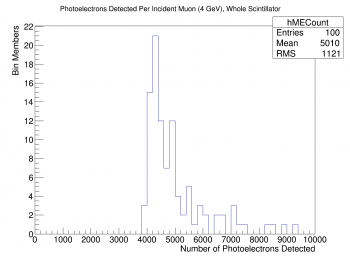
"Whole Scintillator" Muon run
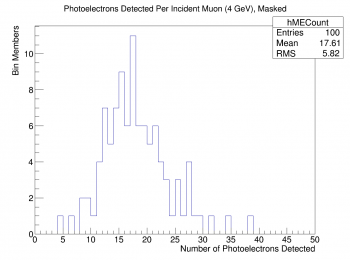
Al Mask (R=0.95) Muon run
Al Mask (R=1.00) Muon run
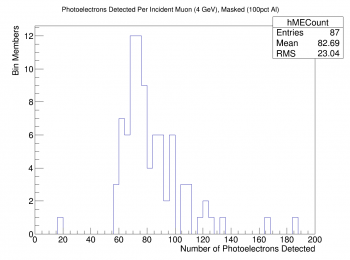
Even taking the R=1.00 masked data set together with the whole scintillator background, we get a loss of 98 +/- 10%. This is really not close to our original trapping efficiency of 83 +/- 3%; simply counting PEs from the muons might not be an appropriate way to draw a comparison between the experiment and simulation. Or, there could be something off still; for example, it wasn't explicitly labeled what the scintillator length used for the experiment was. I've been using 4.5 cm but it might be closer to 2.5 cm, which might have a significant effect.