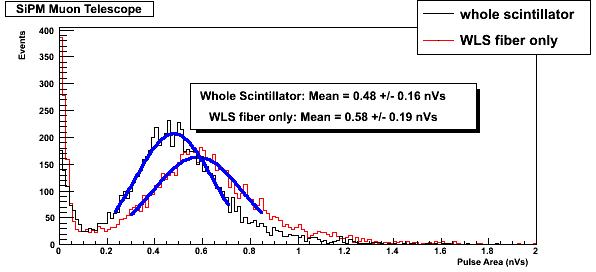
The muon telescope was set up with 2“ PMT R1332 as the middle (signal) PMT biased at -2000V. The top and bottom PMTs were 1” PMT 14 at -1200V and 2“ PMT 8575B at -1700V. The WLS fiber in the scintillator was replaced with a new (labeled “best”) WLS fiber with the far end pained with reflective TiO2. An aluminum mask with a small hole for just the WLS fiber was used to block all light from the scintillator to the PMT. This run was compared to an identical run without the mask.
| Table 1: Data files |
| Run | Date | Mask? | Number of events | Total Time (s) | Rate (Hz) |
| 1 | 2014/09/30 | No (full scintillator) | 7669 | 259292 | 0.0296 |
| 2 | 2014/09/30 | Yes (WLS fiber only) | 7930 | 350932 | 0.0226 |
| Figure 1: Comparison between peak location with and without fiber |
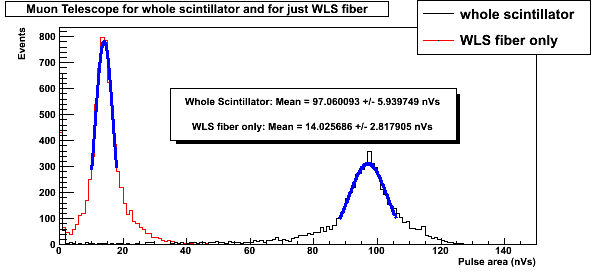 |
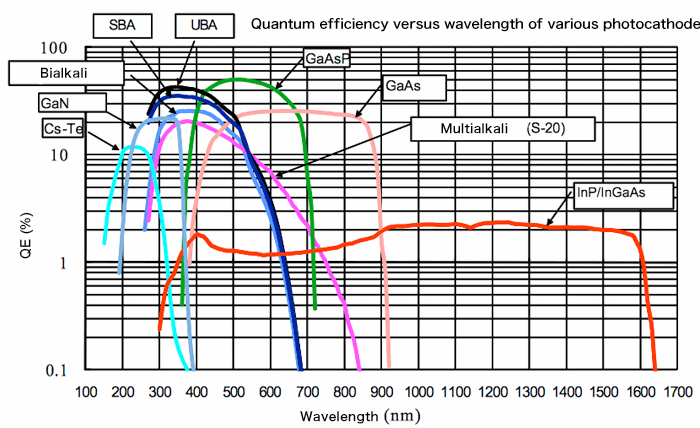
Figure 1 shows the location of the muon energy peak for Run 1 (whole scintillator) and Run 2 (WLS fiber only) with no scaling of either peak. From this, the energy loss from using the WLS fiber is 83.11 ± 3.22%. This doesn't take into account the color change by using the WLS fiber. PMT R1332 has a higher quantum efficiency for the light from the whole scintillator (bluish-purple) versus the light from the WLS fiber (yellowish-green). Figure 2 shows the quantum efficiencies for a range of PMT types. PMT R1332 is of the type Bialkali, and the quantum effeciencies for each run is shown in Table 2.
| Figure 2: Efficiency curves by PMT types |
 |
| Table 2: Efficiency for PMT R1332 |
| Run | Color | Wavelength (nm) | Efficiency |
| Full scintillator | bluish-purple | ~ 450 | 25% |
| WLS fiber only | yellowish-green | ~ 510 | 15% |
Because it is only the relative quantum efficiency that is required to compare the results between the location of the energy peak with and without the WLS fiber, the area under the pulse of Run 2 (WLS fiber only) was scaled by 1.67 (=25%/15%). This re-scaled comparison is shown in Figure 3.
| Figure 3: Comparison between peak location with and without fiber |
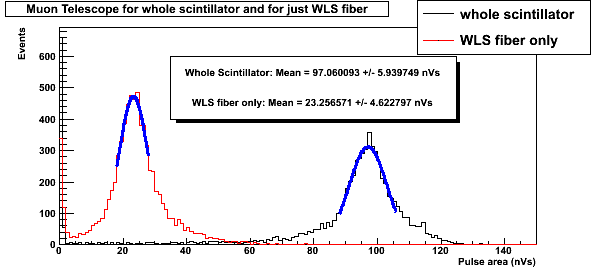 |
From Figure 3, the energy loss from using the WLS fiber is 68.3 ± 5.0%.