R71 Surface Events
Bulk Event Depth
Here we study the depth at which surface and bulk events are separated. Surface events are captured by the interleaved fringing field and thus only get half the NTL gain that bulk events receive. This gives us a way to identify the two populations in Psum. They should have similar features (e.g. primary partition) except the bulk event amplitudes should be higher by a factor of (1+8/3)/(1+4/3). For each source position, we plot the distribution of Psum for events having high primary channel partition (either PFS2/Psum or PBS2/Psum). This is fitted with a pair of gaussians, constrained to have the expected position ratio and the same widths. There is also a flat background parameter and the two gaussian amplitudes. An example of this fit is shown below.
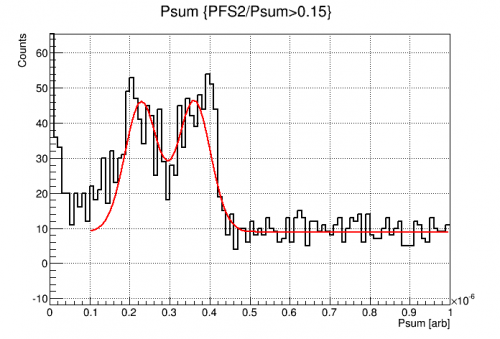 |
| Fitting Psum 60keV distribution with linked gaussians |
|---|
The ratio of the number of bulk and surface events is the ratio of the gaussian amplitudes. If we assume the 60keV penetration into Ge is exponential with attenuation coefficient u_en = 8.74/cm, and the cutoff between surface and bulk events occurs at some depth d, that depth can be calculated from the ratio of surface to bulk events as:
d = (1/u_en)*log(1+surface/bulk)
This assumes that we are seeing all 60keV events that hit the detector. If there is a surface dead layer we would be under-counting the surface events. Now, we can use the G106A mask to map out the vertical positions of the charge rails on side 2, shown as red dots below.
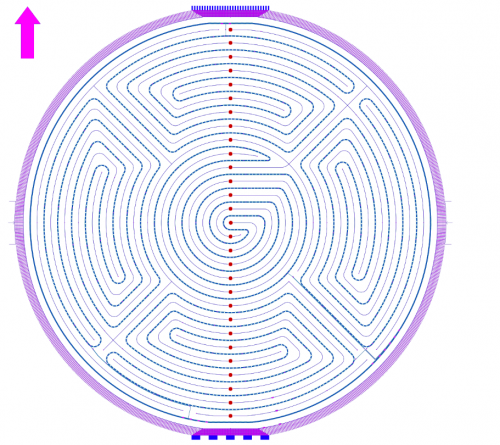 |
| G106A S2 mask with charge rail positions marked |
|---|
Finally, we can compare the surface/bulk cutoff depth to the distance from a charge rail. This is shown in the figure below.
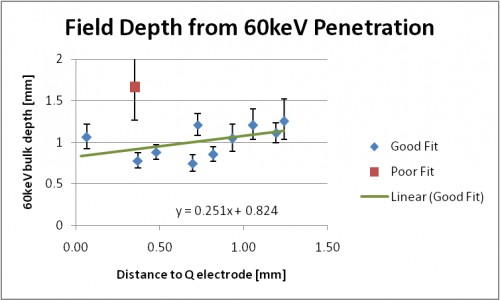 |
| Implied surface/bulk depth cutoff vs. distance to charge rail for R71 60keV data |
|---|
The scale of the depth cutoff is around 1 mm, which is reasonable considering the gap between charge and phonon rails was 1.6 mm. Excluding one point with poor spectral fit (position S, poor stats) there is a slight trend of increasing cutoff depth with distance from the charge rail. Given the electrode design, we expect events near the charge rail to be more likely to become a bulk event and those nearer a phonon rail (at distance of 1.6 mm) to be captured by the surface field.