Table of Contents
Trigger Optimization
Trigger Widths
Our RevC(.1) DCRCs run a simple trigger algorithm in order to trigger on pulses phonon or charge channels. It takes the difference of the average values measured in two windows, a baseline and a sample window, and compares this value to the trigger threshold setting. We often adjust this trigger threshold to trigger on as low-energy events as possible, but we have not thought carefully about the widths of the baseline(low) and signal(high) windows. The work below explores such settings to optimize triggering on a single phonon channel in r70.
The two-window trigger can be though of as a sort of low-pass filter that is passed over the raw trace before the trigger threshold logic is applied. We can visualize the effect of this filtering on a raw trace in the figure below. Here, a real pulse-less noise trace has had a fake, 2-pole pulse injected with an amplitude of 5 ADC.
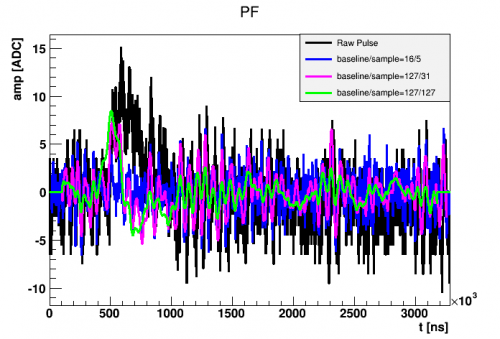 | 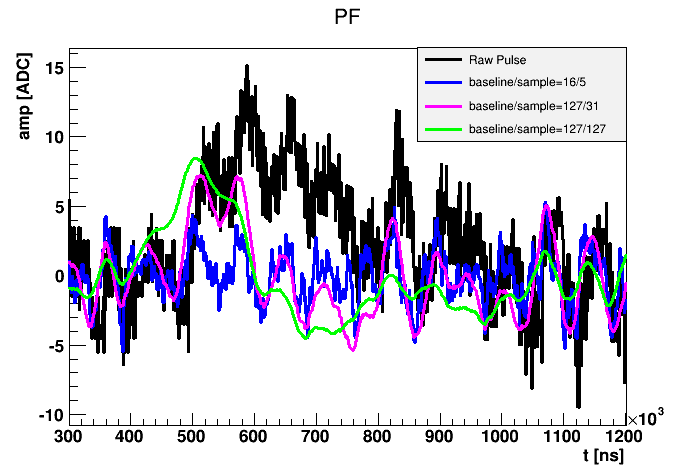 |
| Fig 1: Effect of passing trigger filter over raw trace. | |
|---|---|
The default low/hi window widths we have used are 16/5 bins. However, this example indicates that using longer windows can increase the prominence of the signal above noise. With the current DCRC firmware version, the maximum window widths are 31/127 bins. To study this systematically, 20 flat, pulseless PF noise traces were selected from series 07180793_1653. Fake pulses with rise/fall time = 25/230 μs were injected with amplitudes of 0,5,10 ADC units. Then, the trigger filter was passed over the traces with a variety of low/hi window widths and the maximum amplitude within the trace was recorded.
In the Fig. 2, the average of the maximum such trigger level observed at each combination of low/hi window levels is plotted for noise traces. As expected, longer window lengths tend to average out noise excursions, reducing the trigger level.
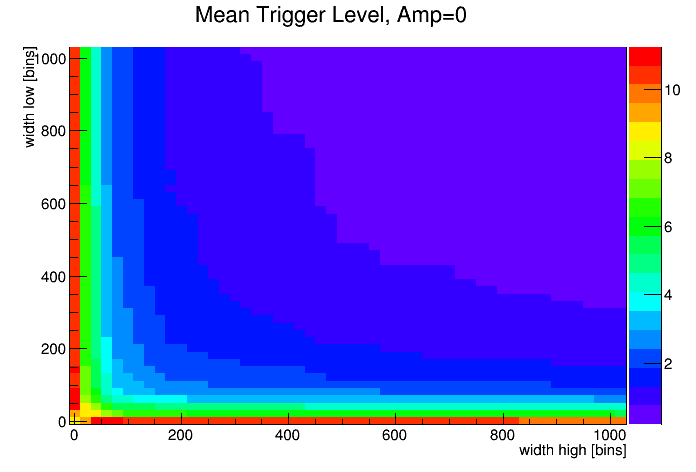 |
| Fig 2: Average trigger level for noise traces. |
|---|
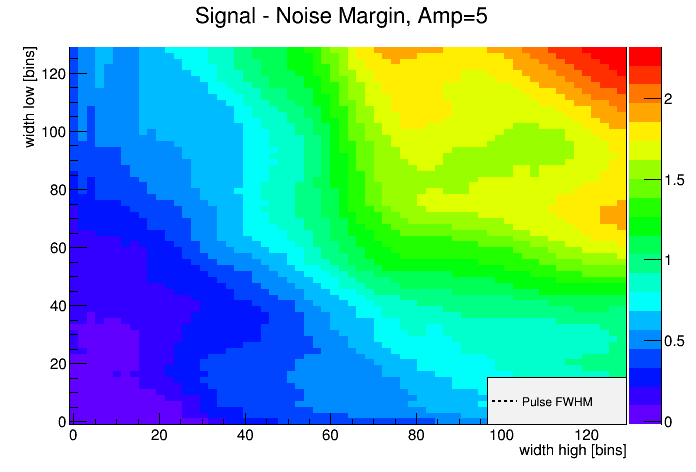
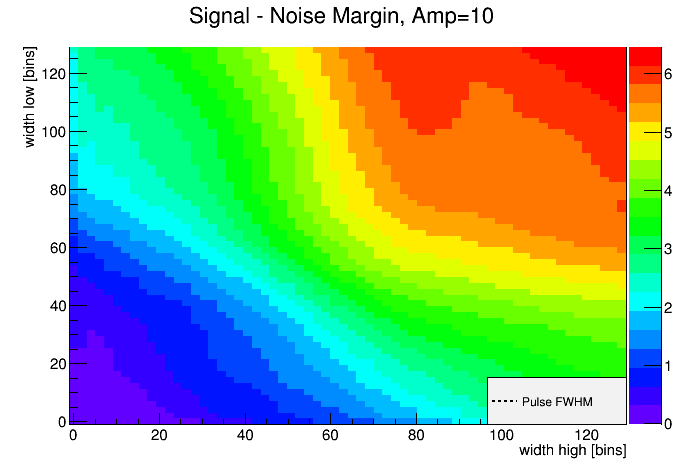
In Fig 3., we plot the difference between the max trigger level with an injected pulse from that of the same pulseless trace. The two figures are for injected pulse amplitudes of 5 and 10 ADC units. We note that the signal trigger level rises highest above the noise when the high(signal) window width is near the pulse FWHM and when the low(baseline) window width is larger than the pulse FWHM. When the high window is less than the signal scale, it is not including all the signal information it could, but as it gets much longer than the signal scale, it starts to become lost in the noise. Similarly, the low(baseline) window length should be as long as possible so as to average out noise fluctuations. This last statement is true for flat signal baselines and without pileup effects.
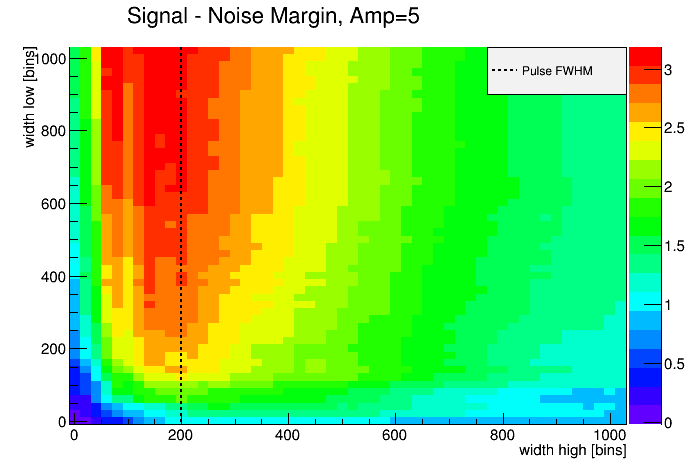 | 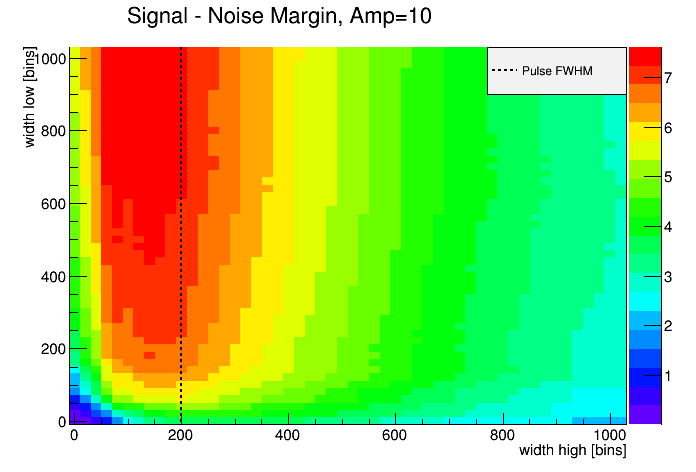 |
| Fig 3: Average Signal-Noise Margin for signal amplitude of 5 ADC (left) and 10 ADC (right). | |
|---|---|
With the current DCRC firmware version, the maximum window widths are 31/127 bins. Fig. 4. shows the range of widths from 1 to 128 bins.
 |  |
This analysis indicates that we ought to use those maximum values to optimize the trigger settings. After that, the trigger threshold level should be adjusted (as usual) to be as low as possible without obtaining an overwhelming rate of noise triggers.
Trigger Threshold
To optimize the trigger level, Bkg data was taken with several thresholds on 8/19 - 8/21. The calibrated low-energy spectra are compared in the figure below. The spectrum is based on a (roughly) balanced PsumOF quantity. The following cuts were applied to all 3 series: randoms, flat baseline, baseline standard deviation, low baseline, OF-WK timing agreement, Low-Energy Trigger Burst, OF-INT agreement, extreme OF-delay values removed, phonon-inner partition. The phonon-inner partition cut was: “PFOF/PsumOF>0.4”.
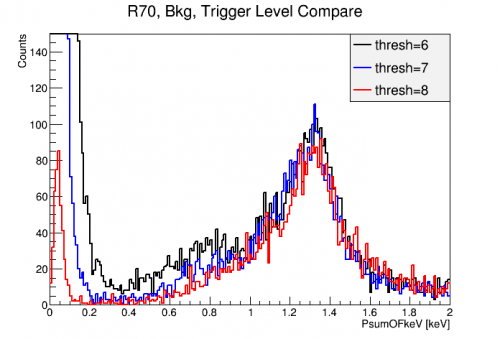 |
| Low Energy spectrum for various trigger levels. |
|---|
The series were calibrated to the Ge K- and L-shell peaks. In the thresh=6 data, there is a bump near 200 eV which is likely the M-shell. The higher thresholds have seemingly lower noise walls due to the lower number of noise triggers, but the M-shell is not visible. There is also some additional structure below 1 keV which is only present in the lowest threshold data. This is not understood yet. One hope was that raising the trigger level slightly would increase the DAQ write efficiency (due to lower number of noise triggers) without sacrificing threshold. This plot indicates that a threshold of 6 is the highest allowed to at least see events as low as the M-shell (160 eV).