Table of Contents
Unbalanced calibration in Run 66
Since we have seen improved noise width in Run 70 with unbalanced phonon channel amplitudes, we should check Run 66 as well. It's possible that the current vacuum interface setup is no better than the previous wirebonded contact setup.
This note uses 2 hours of HV = 70V data taken on 2017 Dec 21.
PTOF calibration and noise
First we calibrate to the unbalanced PTOF quantity using a quadratic fit to the 10keV and 1keV activation lines:
| Figure 1 |
|---|
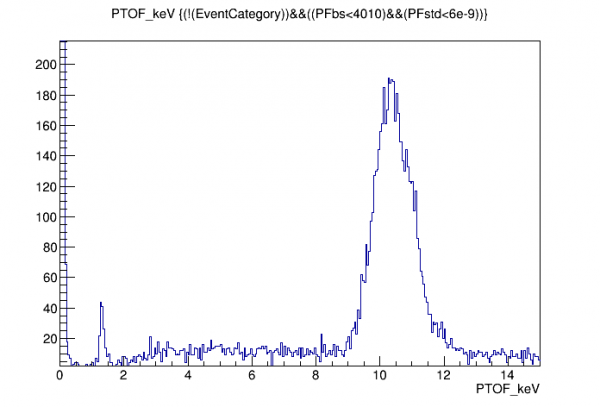 |
This PTOF calibration results in a 42.5 eVee noise sigma.
pF-only calibration and noise
| Figure 2 |
|---|
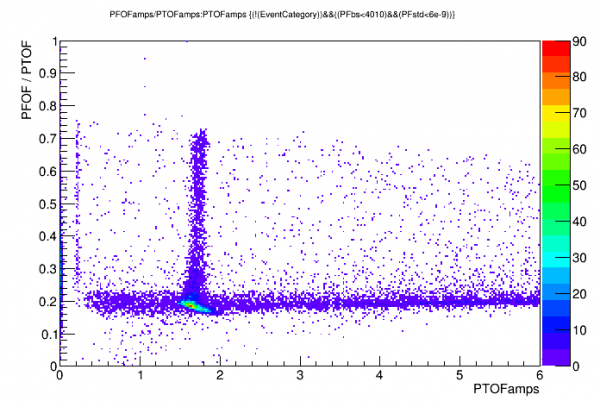 |
The pF-fraction versus PTOF plot above allows us to make a high-pF selection, with threshold PFOF/PTOF>0.6. We can calibrate pF-only with this fiducial selection:
| Figure 3 |
|---|
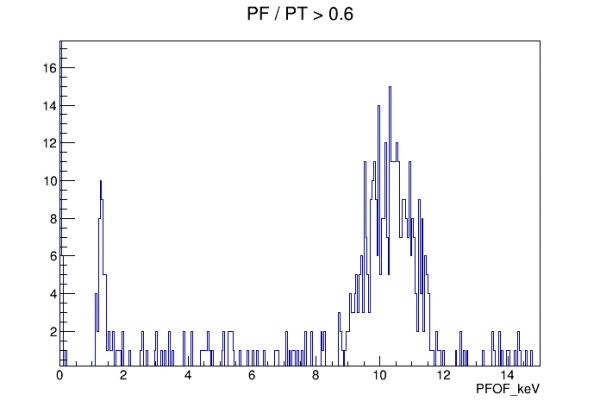 |
This pF-only OF calibration with fiducial selection results in a 18.3 eVee noise sigma.
This is of course a significant improvement.
Balanced pSum calibration and noise
After balancing the channels and calibrating we can produce improved line widths:
| Figure 4 |
|---|
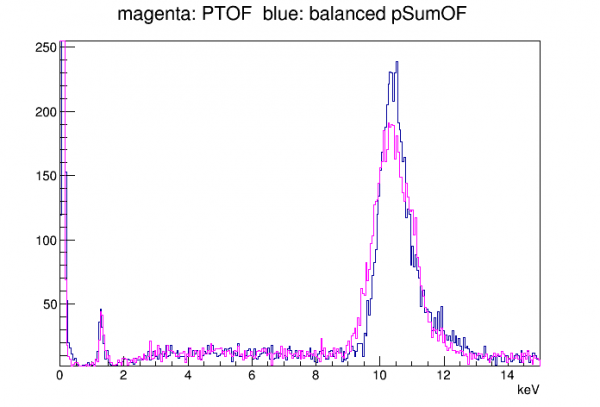 |
This balanced pSum OF calibration results in a 43.3 eVee noise sigma.
This is about the same as PTOF.
Noise contribution per channel
With the balanced phonon amplitudes we can break down the noise contribution per channel. To do this I applied the same calibration function used for balanced pSum to each individual channel's balanced OF amplitude, then fit the corresponding OF0 to randoms as usual.
| Figure 5 |
|---|
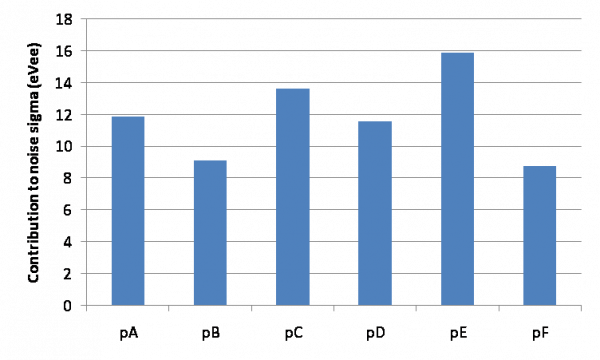 |
As has been stated before, the inner-ring channels (pC/D/E) have higher noise than the inner channel (pF). But the difference is not dramatic.
| Table 1 | |
|---|---|
| Channel | Noise sigma [eVee] |
| pA | 11.90 |
| pB | 9.14 |
| pC | 13.66 |
| pD | 11.58 |
| pE | 15.88 |
| pF | 8.79 |
| Quadrature sum | 29.6 |
| Direct sum | 70.9 |
| Balanced pSum | 43.3 |
The table above shows that the noise width from the balanced pSum is somewhere between a quadrature sum and a direct sum of the individual channels. This suggests that the noise between channels is partially correlated.
I had been assuming that the improved noise width with the inner-ring channels de-weighted (or removed) was caused by the higher noise in those channels. But upon further reflection it seems moreso the case that the noise width from any single-channel calibration is better than from a calibration using the total energy in all the channels. The reason is that, for any event there is generally one channel with a large fraction of the energy, with others contributing only a little. By including the non-primary channels, you add only a little to signal but you add a full share to the noise. (And if noise is correlated the problem is compounded.)
I tested this by repeating the single-channel calibration with pD and checking the noise width:
pD-only OF calibration with fiducial selection results in a 26.4 eVee noise sigma.
This is also a significant improvement over PT or pSum. It's a bit worse than pF-only, by about the same ratio as the noise contributions calculated above.