Table of Contents
Balancing the Phonon Channels for Run 68
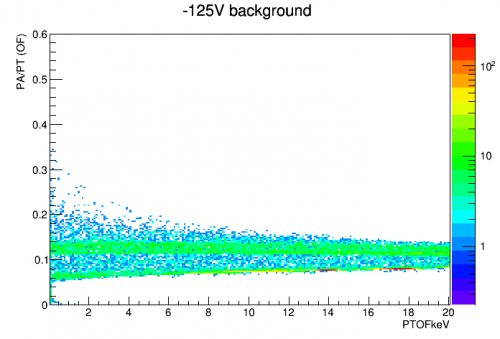
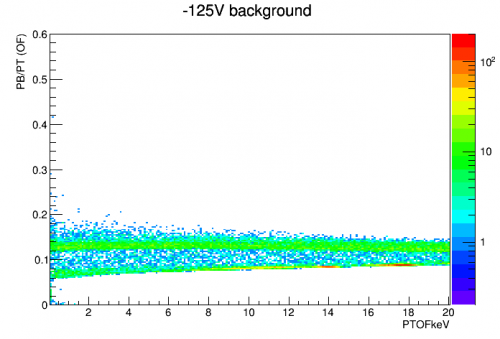
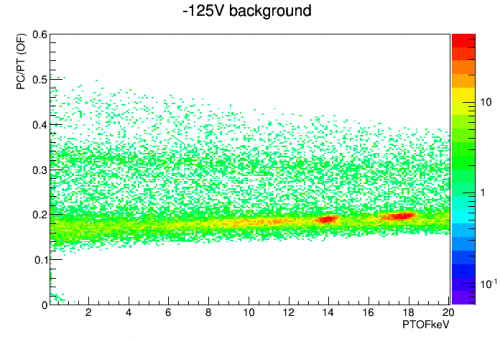
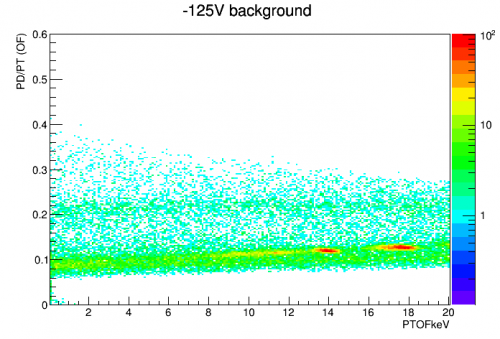
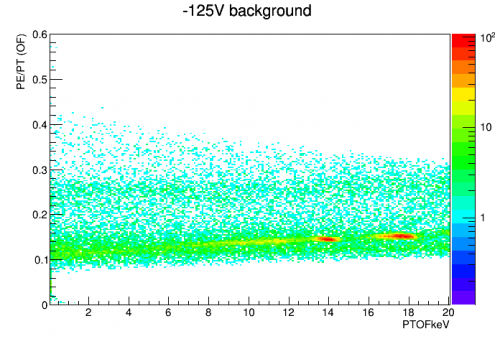
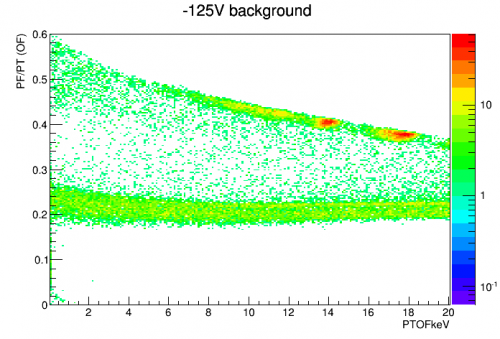
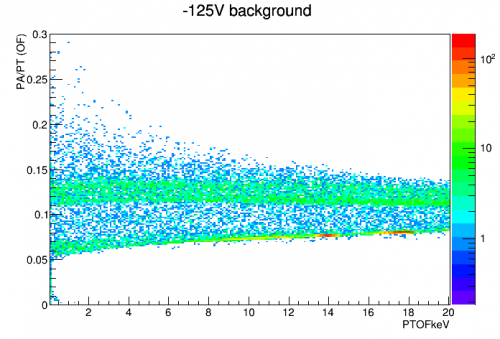
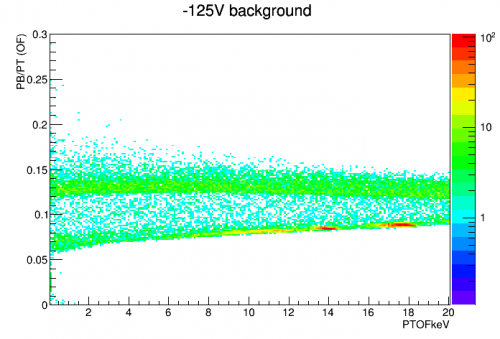
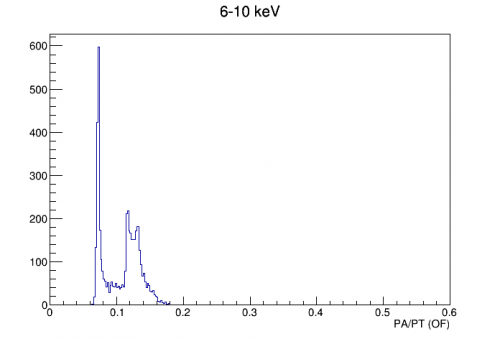
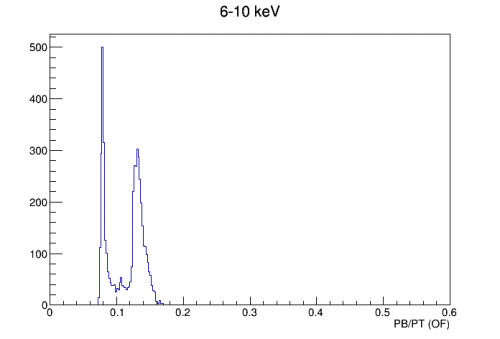
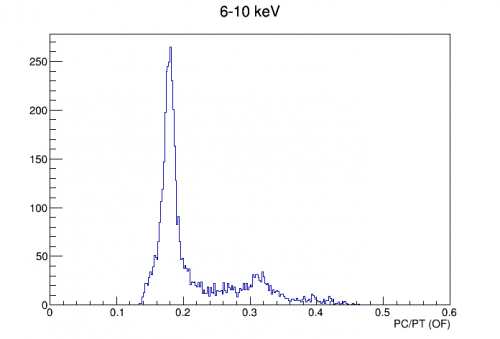
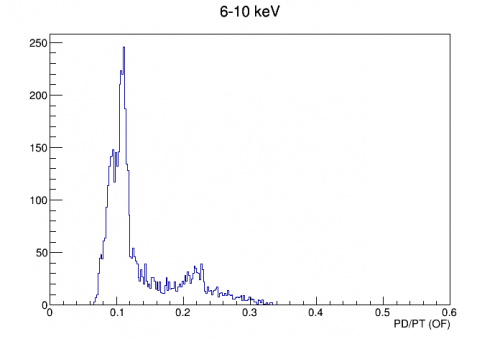
The six phonon channels of the SiHV detector in Run 68 have clearly different gains. The purpose of this study is to calculate the balancing factors (aka relative calibration factors) to construct a balanced PT in reprocessing. The strategy is to plot distributions of the fraction of energy in a each channel and compare. For the inner channels the distributions are bimodal with a lower peak corresponding to events that occur in another channel and a higher peak for events in that channel. The factors are calculated to make the lower peak equal across channels. As a check we can see whether the gains as derived from IbIs data are consistent with those inferred from fractions, but prior experience suggests that there will only be rough agreement.
I'll check different data types and biases to see if there is a consistent set of factors that works for all of them. I'll also check across energies and if to the extent that the factors vary we'll decide what optimal range upon which to base the balancing.
Note: throughout this note I use a convention of normalizing balancing factors to the mean. Thus any set of balancing factors shown will have an average of 1.
-125 V background data
There are 31 hours of -125 V background data. In much of the analysis shown below I use a sparsified dataset, choosing every 5th series, in order to speed up generating plots.
General cuts include !crand (no randoms), cofint (rough agreement between PTOF and PTINT which removes pileup and OF saturation and other pathologies), !ctail (remove tail events where post-pulse is significantly lower than pre-pulse), and cbs (remove events where the baseline is higher than normal). Calibration is done in the standard way as a quadratic fit between 0 and the 14keV and 18keV Am lines.
| Figure 1 | ||
|---|---|---|
 |  | |
 |  |  |
 | ||
| Figure 2 | ||
|---|---|---|
 |  | |
 |  |  |
 | ||
| Figure 3 | ||
|---|---|---|
 |  | |
 |  |  |
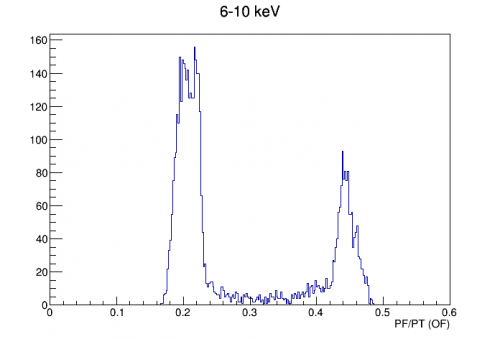 | ||
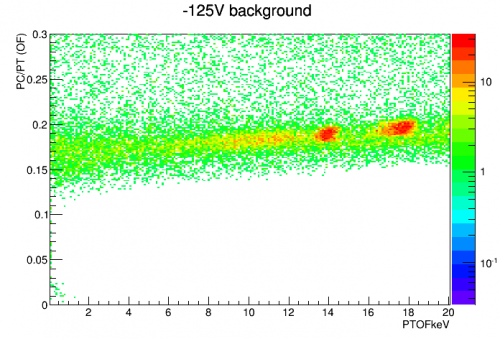
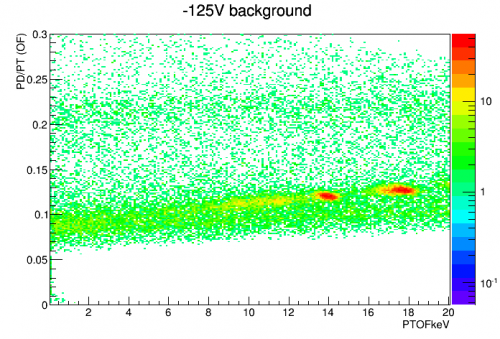
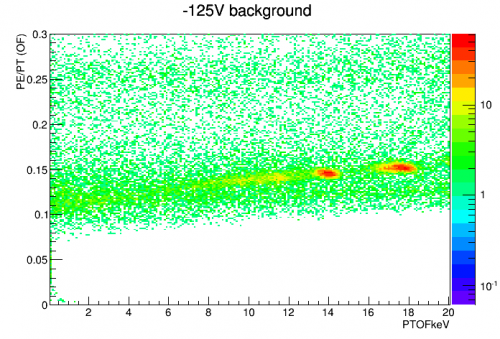
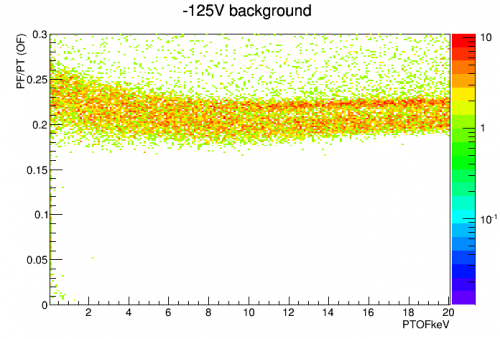
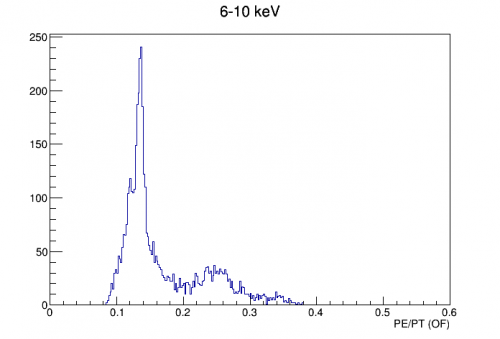
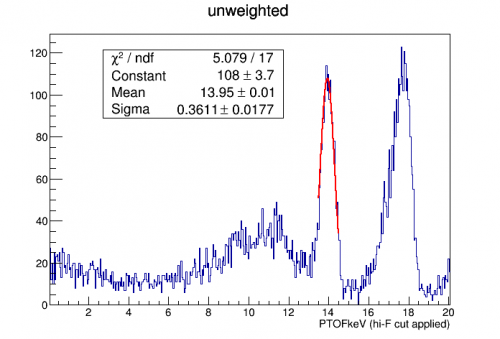
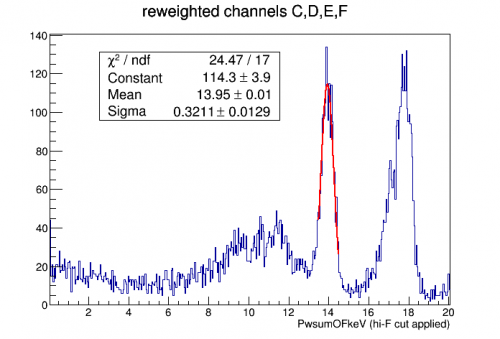
The lowest characteristic channel fractions are seen in the outer rings pA and pB, which seems an unlikely coincidence - it's possible that this is physical. Also pF is the highest, which may also be physical. I separately attempted three cases: 1) balancing only the 3 inner ring channels 2) balancing the 4 inner channels 3) balancing all 6 channels. In each case I constructed weighted OF sum quantities and calibrated to the Am peaks. It appears that case 2), the 4-channel balancing, produces the best resolution in the Am spectrum. (The spectra were generated with an additional cut requiring high pF fraction.)
z->SetAlias("PwsumOFamps","PAOFamps+PBOFamps+PCOFamps*0.83+PDOFamps*1.37+PEOFamps*1.09+PFOFamps*0.71")
| Figure 4 | |
|---|---|
 |  |
Iterative approach
Unbalanced channels can cause the energy-fraction peaks of other channels to appear split, making it hard to identify the position. Because of this I tried an iterative technique to balance the channels.
| Figure 5 | ||
|---|---|---|
| Iteration 0 | Iteration 1 | Iteration 2 |
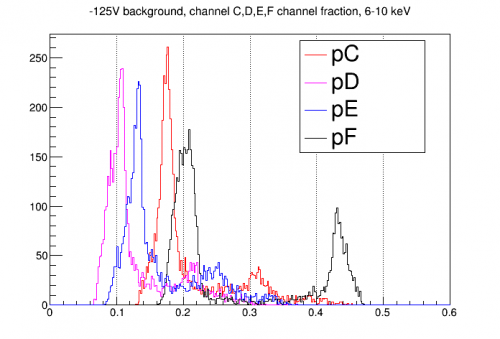 | 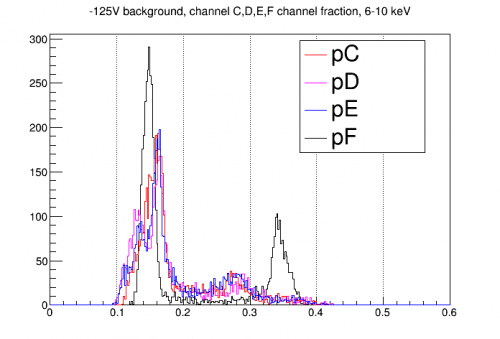 | 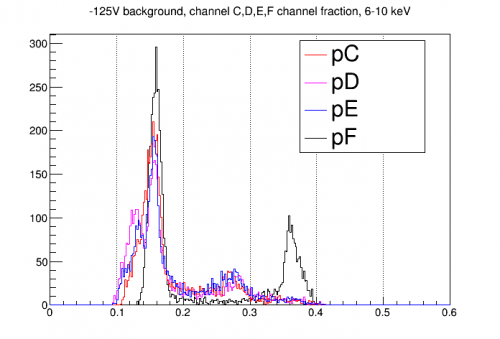 |
In the first plot above the low energy fraction peak in pF is rather wide, because imbalance among pC,D,E distorts it. It becomes sharper as we iterate to improve the balancing.
But note that the pC,D,E low energy fraction peaks tend to split up more. Maybe this is physically reasonable - or maybe it means that pF is unbalanced. As before we can try only balancing pC,D,E (inner ring) and leave pF at unit balance:
| Figure 6 |
|---|
| 3-channel Balancing (C,D,E but not F) |
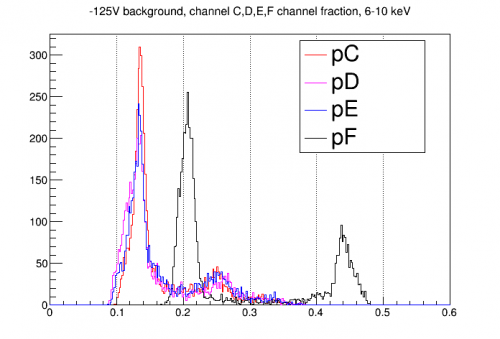 |
As seen above the 3-channel balance makes all the low energy-fraction peaks appear unsplit. But is this better? We can check the 14keV peak resolution for Psum quantities constructed with the two different weightings:
| Figure 7 | |
|---|---|
| 14keV fit, 4-channel balancing | 14keV fit, 3-channel balancing |
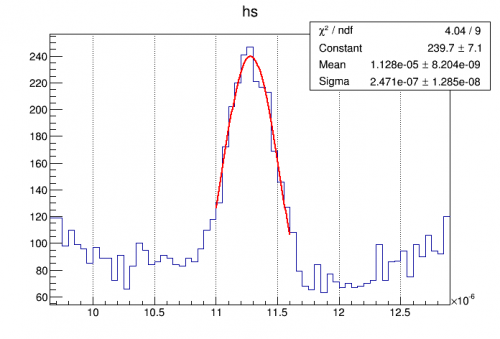 | 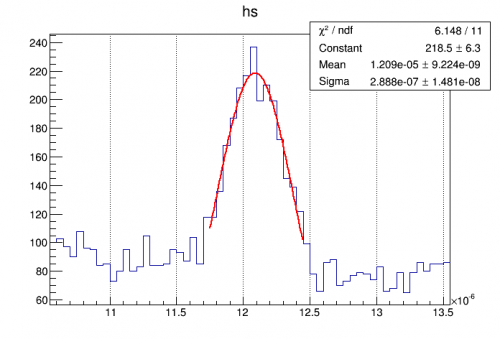 |
| Sigma = 2.190% (306 eV) | Sigma = 2.388% (333 eV) |
As seen before, if peak resolution is our figure of merit, the 4-channel balancing is better than the 3-channel balancing. (These can be compared to the unweighted case, which is only a little worse than the 3-channel balanced case: 2.392% (334 eV)).
float bf[6] = {1, 1, 0.817, 1.320, 1.075, 0.758} // 4-channel balanced
float bf[6] = {1, 1, 0.763, 1.233, 1.004, 1}     // 3-channel balanced
Optimizing peak width
Another approach to channel balancing is to optimize the width of a calibration line. Our Am peaks are not great for this task since the events have very little position variation and thus may be insensitive to channel balancing. But it's worth exploring.
I tried varying the balancing between pF and the inner-ring channels pC,D,E (keeping the balancing between these three channels fixed to the energy-fraction result). I created pSum spectra and measured the resulting width of the 14keV peak. Gaussian fits of the peak showed a lot of random variation and it was hard to regularize this so I used a different approach: I made a cut to select the peak events, then made a list of pSum values between the four channels with different weightings on pF, and for each weighting compared the standard deviation to the mean. This produces a clean optimization, with the following results:
- pF balancing factor = 0.764 from matching energy fractions with pC,pD,pE
- pF balancing factor = 0.680 from minimizing stdev/mean for weighted sum of pC,D,E,F for 14keV events
It's difficult to say which of the above is more correct. As mentioned, the Am events should be somewhat insensitive to balancing because there's no position variation. So maybe the improvement in width has more to do with the relative amount of noise in pF versus the others. But it's also true that we have no a priori knowledge that the energy fractions should match between pF and the inner-ring channels. The width-optimized version would shift the low-peak in the pF energy fraction below that of the inner-ring channels, but the high-peak would still be above the others.
| Figure 8 |
|---|
| -125 V background using 3-channel balancing plus 14keV-optimized pF balancing |
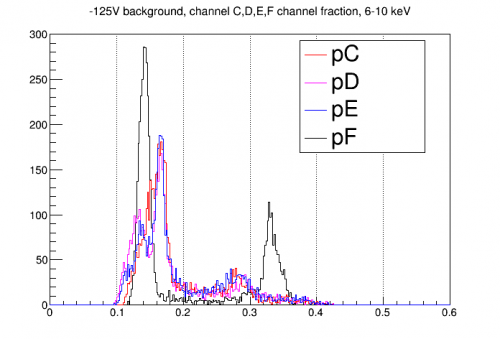 |
The figure above shows the energy-fraction plots for the case where pF is weighted to optimize the 14keV width. Although the low-peak of pF no longer lines up with the main low-peak of pC,D,E, it roughly lines up with the lower side-peaks of those distributions. So maybe there is a physically meaningful reason for this.
-125 V Na22 data
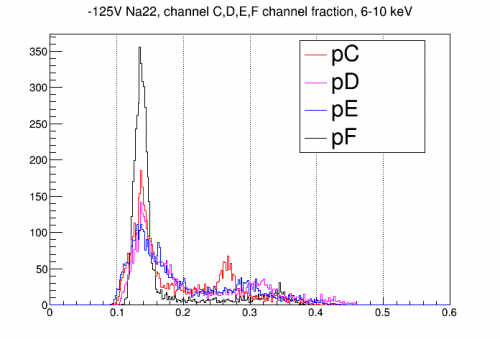
For the -125 V Na22 data I tried using the balancing factors that were calculated for background data and made energy-fraction plots for channels pC,D,E,F as before:
| Figure 9 |
|---|
| -125 V Na22 data using the background balancing factors |
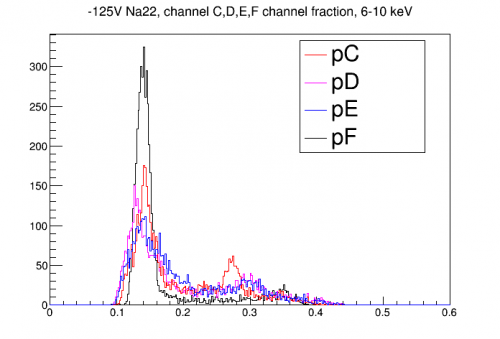 |
The balancing factors seem to work for this data equally well for all four channels except pD, which seems to be underweighted by about 10%.
If we choose to readjust the balancing factors specifically for this Na22 data, we find the following:
| Figure 10 |
|---|
| -125 V Na22 data using Na22-specific balancing factors |
 |
float bf[6] = {1, 1, 0.789, 1.415, 1.053, 0.743} // 4-channel balance for Na22 case
-125 V PuBe data
For the -125 V PuBe data, as with the Na22 data, I tried using the balancing factors that were calculated for background data and made energy-fraction plots for channels pC,D,E,F as before:
| Figure 11 |
|---|
| -125 V PuBe data using the background balancing factors |
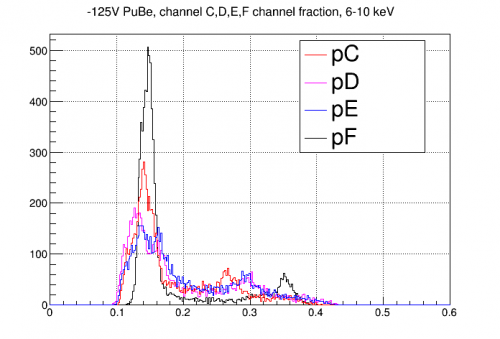 |
This looks similar to the Na22 case. These are both high-event-rate situations, which may be changing the TES responses.
If we choose to readjust the balancing factors for this data we get the following:
| Figure 12 |
|---|
| -125 V PuBe data using PuBe-specific balancing factors |
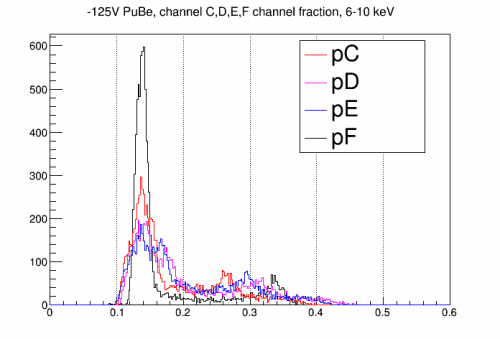 |
float bf[6] = {1, 1, 0.801, 1.404, 1.077, 0.718} // 4-channel balanced for PuBe case
-125 V IbIs data
A different approach to balancing the phonon channels is to try to measure the TES gains using IbIs curves. The most recent IbIs data was taken at -125 V with the PuBe source present. Analysis of the IbIs curves can produce estimates of the power-to-current gain using a method described in this dP/dI calculation note. The final calculation is a product of QET bias, shunt resistance, and a “prefactor” calculated from the shape of the IbIs curve. So apart from the IbIs data we need knowledge of the shunt resistance, although if the shunt resistances are the same for each channel it doesn't matter in terms of balancing. We've seen though that in this run pA seems to have a higher shunt resistance, suggesting that the shunt resistor reduction failed for that SQUET (perhaps a wirebond broke). So in the dP/dI calculation I assume pA has a shunt resistance 3 times higher than the other channels.
From past experience I didn't expect the dP/dI values to match the empirical balancing factors very well, but I was pleasantly surprised - this time they are a pretty close match.
| Table 1: dP/dI balancing factors from IbIs data | ||||
|---|---|---|---|---|
| channel | dP/dI [μV] | 6-channel balancing | 4-channel balancing | 3-channel balancing |
| pA | 0.888 | 1.128 | 1 | 1 |
| pB | 1.042 | 1.323 | 1 | 1 |
| pC | 0.594 | 0.754 | 0.850 | 0.782 |
| pD | 0.972 | 1.235 | 1.392 | 1.281 |
| pE | 0.711 | 0.903 | 1.018 | 0.937 |
| pF | 0.517 | 0.657 | 0.741 | 1 |
Below is an energy-fraction plot using PuBe data and the above balancing factors, this time showing all 6 channels
| Figure 13 | |
|---|---|
| -125 V PuBe data using IbIs-based balancing factors | |
| CORRECTED | OLD |
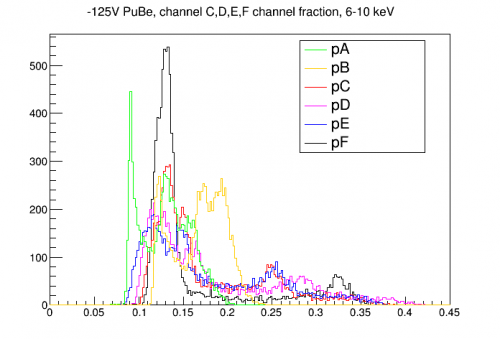 | 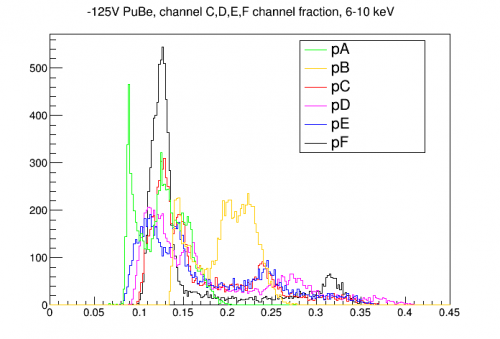 |
UPDATE: My first IbIs analysis of this data gave a pB dP/dI of 1.25484 μV, which gave it a higher balance factor. This channel has an unusual IbIs curve due to something strange with its SQUET, so that the normal part of the curve is difficult to see, so originally I used a superconducting portion to estimate the offset. But on a second look I found that there is enough of the normal part visible to calculate the offset based on that part of the curve, as is done with all the other channels. This resulted in a 17% smaller result for dP/dI.
With the corrected pB dP/dI, the curves in Figure 13 look more reasonable - pB's low peak in energy fraction is about the same as the other channels. Now pA is the main outlier, which appears underweighted. But it could be that this outer-ring actually receives less phonon flux for some reason. It's also possible that the dP/dI result is skewed because this channel has a different Rshunt - it is assumed to be 3 times greater than the others, but if it were even larger it would imply a dP/dI which would make its energy fraction more consistent with other channels. At any rate if pA's balancing factor is incorrect, it's better that it is underweighted than overweighted.
All considered it seems reasonable to rely on the dP/dI values for pA and pB.
Comparing different techniques
| Figure 14 |
|---|
| -125 V balancing factors from various datasets |
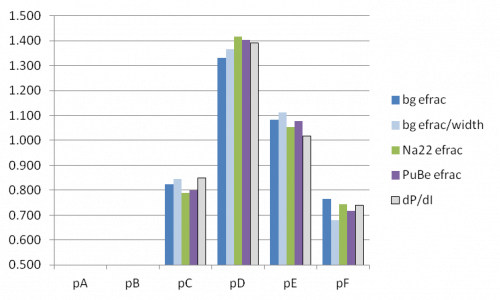 |
The figure above compares 4-channel balancing factors calculated using the energy-fraction-matching method for the three datasets, as well as the modified method for background data that sets the pF balance by optimizing the width, as well as the IbIs-derived balancing factors.
The two high-rate datasets agree with one another better than either with the background datasets (the chisquare differences are around 6 times smaller). The dP/dI balancing factors (from IbIs data taken with the PuBe source present) agree more closely with the high-rate datasets than with the background (about 2 times smaller chisquare).
Recommendation for balancing factors for -125 V data
The IbIs-based and PuBe-based balancing factors for the center and inner-ring channels C,D,E,F are independent results from data taken under the same conditions and they are in pretty good agreement. I recommend averaging these values. These should be correct for PuBe data, the most important dataset, and will be very close to empirical results for Na22 data as well. They vary a little from the empirical results for background data, but the difference is small so I suggest using the same factors for background as well, for simplicity and consistency. For the outer rings A and B I recommend using the dP/dI values (specifically I recommend assigning these the same ratio to the sum of the inner channels as they have in the dP/dI values).
It would be interesting to see whether resolution can be improved by varying the pA & pB factors, but it is very unlikely that Am peaks will be useful for this - we would have to rely on the Compton step, or on possible fluorescence lines unrelated to the Am source, or on details in the (n,gamma) signal spectrum. These are more involved, higher stats studies that can be pursued later.
float bf[6] = {1.128, 1.323, 0.732, 1.24, 0.929, 0.647} // recommended balancing factors for -125 V data