Table of Contents
R68 OF Settings
OFdelay window
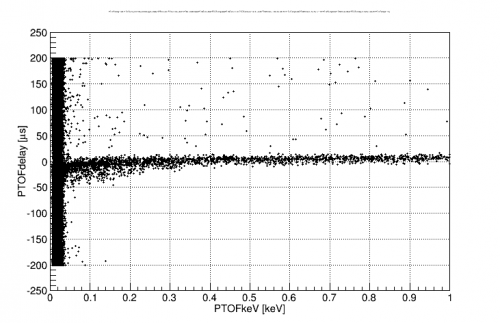
The OF algorithm requires a time window within which to search for a peak. Reducing this window can speed up processing (how much?) and lower the noise wall. The idea is that, with a larger window, there are more opportunities to find a large noise deviation, so the OF amplitude distribution becomes biased away from 0. One extreme version of this is the OF0 amplitude, which doesn't allow a time shift and achieves a lower noise wall that the OF with floating delay. The default window in our processing is +/- 200 μs. As can be seen in the figure below, this is likely larger than we need. For large events, the delay is near 0. But for small events, the hardware trigger will come later on the pulse, so the optimal delay is a bit before the trigger time. For good events, the optimal delay found by the OF algorithm stays well between -75 μs and +25 μs.
 |
I thus recommend using these values as the new OF window limits:
PARAMETER_DOUBLE	P_PEAK_WINDOW_MIN	DETECTOR 1-15	=	75e-6    #200e-6	# Ge
PARAMETER_DOUBLE	P_PEAK_WINDOW_MAX	DETECTOR 1-15	=	25e-6    #200e-6	# Ge
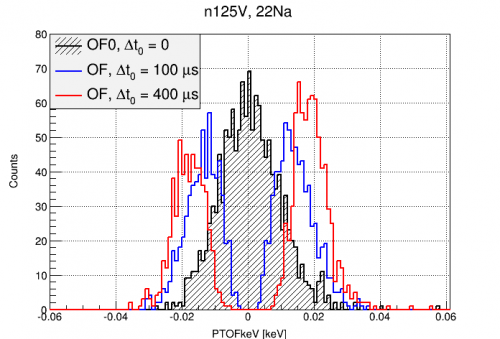
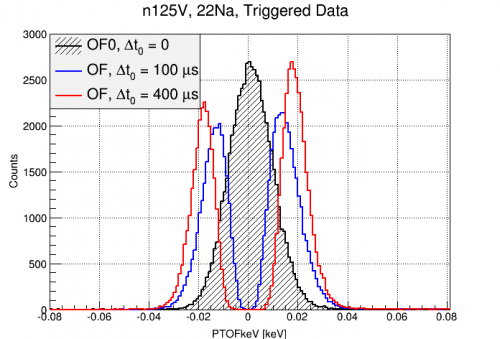
The results of a test processing using these windows are shown below. The plot on the left compares the noise wall distribution for randoms when using an OF window of 0μs (OF0), 100μs (suggested above), and 400μs (default). The plot on the right shows the same thing for triggered data. Standard quality cuts have been applied. The distributions are split around 0 because the symmetric OF algorithm was used (see below). As expected, the smaller OF window reduces the noise wall amplitudes.
 |  |
OF delay selection
The current (Nov 2018) cdmsbats version of OF looks for the highest amplitude (not largest, but highest) while the 1X2OF finds the min chisq. Now for positive-deviations, this is the same thing, but for negative-going ones, the amplitude with the largest magnitude will have the lowest chisq. This can also be seen if you write the expression for OF chisq in terms of the OF amplitude:

where v is the measured signal, s is the template, J is the psd, and A(t0) is the amplitude at delay t0. It turns out that chisq depends only on the square of the amplitude. So for min chisq, the right thing to do is select the max(abs(A)).
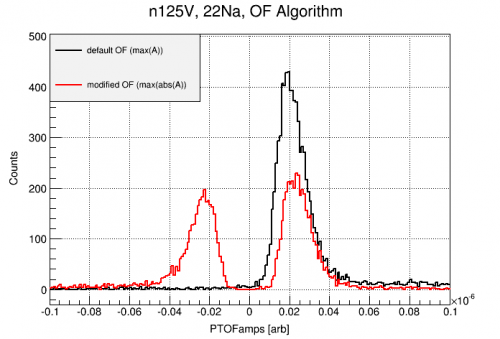
To test this, I processed some data with a modified OF algorithm which selects based on the abs of magnitude. The figures below show the result of this. The first shows the resulting noise wall spectrum. As expected, it splits the noise wall into 2 symmetric peaks. The second figure plots the ratio of chisq of the events using the two different OF algorithms. The differences are small but, as expected, for positive amplitudes, the chisq are identical while for negative amplitudes, the modified algorithm was able to find a lower chisq.
 |
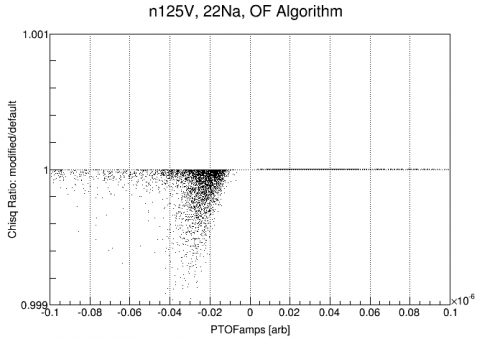 |
So, I think the cdmsbats OF algorithm is a little incorrect in that it doesn't find the min chisq. Incidentally, in newer versions of the OF such as in scdmsPyTools, they just search for the min chisq as well. I suggest we modify the OF algorithm as described above to select the max(abs(A)) and thus minimum chisq.