4K heatsinking options
Normally we install the 4K stage with the tower, which serves as a heat sink of the tower to the IVC and a shield to lower temperature stages. But we realized that with a detector with no FETs this may not be necessary and may be counterproductive. It's been seen that a major contributor to phonon channel noise for this detector is the temperature of the pins plugging the SQUET into the 4K stage of the tower. If this temperature could be reduced it would probably improve our threshold.
It's possible however that even without the FETs on, the 4K heatsinking may help pull away incoming heat from the stripline traces. Then removing the heatsinking could make the SQUET warmer (and may even compromise the fridge, putting a greater heat load on the still and/or coldplate). The question is whether the heatsinking is pulling heat away from the tower to the bath or pushing heat into the tower from the bath.
If the heat from the striplines to the tower is small, so that the heat flow through the 4K stage heatsinking is toward the tower, then leaving off the heatsinks would allow the 4K tower stage to fall below 4K. This would occur via conduction to the lower temperature stages, through the carbon tubes. It would be sensible to aid this by thermally tying the 4K stage to the 600 mK stage. This could be done with thick copper wire connecting the central 600mK ring (where the SQUID cards plug in) to the bottom of the 4K stage via screws.
Thermal estimates
The real question is whether in the absence of warm FETs the heat from the 4K stage heat sinks flows to the tower or away from it. This would depend mostly on 1) the heat from the striplines to the tower and 2) the thermal conductance between the 4K stage and the 600mK stage. The latter is hard to guess but we can try to estimate the former.
| Figure 1 | |
|---|---|
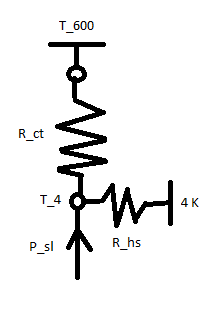 | The question of whether heat flows through the heatsink to/from the tower is determined by whether the product of the power from the stripline and the carbon tube resistance (P_sl×R_ct) is less/greater than the temperature difference between the bath and 600mK stage (4K - T_600). |
As a matter of scale we can use the fact that the heat from an operating FET is about 5 mW. If we for example run a detector with 4 FETs that's 20 mW. If the power from the striplines to the tower is comparable to this, then it's pretty certain that we don't want to remove the heat sinking. If the power from the striplines is much smaller than this, than it may be the case that removing the heatsinks would lower the SQUET temperature, and it would probably be true that removing the heatsinks would not harm the fridge performance.
The striplines convey heat from 300K down to 4K. They deposit this heat to the two stripline heatsinks to the 4K bath (at the top and bottom of the IVC) and to the tower's 4K stage. The problem of how much heat can be estimated by calculating the total power from 300K to 4K and by comparing the conductance of the heatsinks to the conductance of the stripline from the heatsink to the tower.
| Table 1 | ||
|---|---|---|
| Power conducted through striplines from 300K to 4K | ||
| Integrated thermal conductivity | 162000 | W/m |
| traces/stripline | 50 | |
| number of striplines | 3 | |
| trace width | 0.000127 | m |
| trace thickness | 0.0000175 | m |
| area/trace | 2.2225e-9 | m2 |
| shields/stripline | 2 | |
| shield width | 0.0254 | m |
| shield thickness | 1e-6 | m |
| area/shield | 25.4e-9 | m2 |
| total area (A) | 0.4858e-6 | m2 |
| length (L) | 0.9906 | m |
| Ptotal | 79.44 | mW |
Details from the above table are taken from the CDMS cold hardware documentation. The thermal conductivity of copper depends strongly on the purity of the copper. The value above is taken from a BNL reference for common ETP copper, the same values used by Rich Schmitt in a calculation for CDMS.
The total power transmitted to 4K by the stripline copper is pretty large compared to the power dissipated by the FETs.
| Table 2 | ||
|---|---|---|
| Thermal conductance of stripline between heatsink and tower at 4K | ||
| Thermal conductivity | 320 | W/m/K |
| total area (A) | 0.4858e-6 | m2 |
| length (L) | 0.381 | m |
| Conductance | 0.000408 | W/K |
The thermal conductance of copper at 4 K is taken from the same reference that was used for the previous table.
The stripline heatsinks consist of a copper plate anchored to 4K and copper sheets sandwiched between this plate and the three striplines, all layers screwed tightly together. The stripline consists of layers of kapton alternating with the two ground shields and the trace layer, with adhesive between all layers. I found a reference for the conductivity of kapton and used an approximate approach based on the geometry of the striplines to get an effective length and area. In the table below I neglect any extra thermal resistance due to contacts between the copper and kapton and from the adhesive layers.
| Table 3 | ||
|---|---|---|
| Number of stripline heatsinks | 2 | |
| Temperature | 4 | K |
| Kapton thermal conductivity | 0.02155 | W/m/K |
| Thickness to 1st stripline | 0.000125 | m |
| Thickness to 2nd stripline | 0.000375 | m |
| Thickness to 3rd stripline | 0.000625 | m |
| Effective thickness (L) | 0.0002446 | m |
| Heatsink height | 0.0508 | m |
| Wire width | 0.000127 | m |
| Number of wires | 50 | |
| Mean width factor | 2 | |
| Total area (A) | 0.0006452 | m2 |
| Conductance (contact resistance neglected) | 0.114 | W/K |
As one would hope the thermal conductance of the heatsinks is large compared to the thermal conductance of the stripline from heatsink to tower. We assume that the power from the striplines to the tower is equal to the total power (Table 1) times the ratio of the stripline conductivity (Table 2) to the sum of the stripline conductivity and the heatsink conductivity (Table 3).
The result of the above calculation is 0.28 mW transmitted by the striplines to the 4K tower stage.
If we assume the stripline heatsink conductivity is reduced by a factor of 10 due to contact resistances, we get 2.8 mW.
Suppose this higher value is true, and suppose that normally it is mostly routed to the bath when we have the normal heatsinking. Removing the 4K heatsinking and anchoring the 4K and 600mK stages together would mean this heat would be diverted to the still. Heating the still by 2.8 mW would probably not hurt the performance; indeed in the last run we saw that this amount of still heating actually improved the base temperature.
This however assumes the 600mK rod is a good heat sink. If it isn't, then part of that heat would go to the coldplate, which is more likely to hinder fridge performance.
All in all it seems probable that leaving the 4K stage off would not hinder fridge performance. But it's an open question whether it would help reduce the SQUET temperature.