To improve energy and spatial resolution in HV detectors, it is desirable to read out phonon signals from both faces. However, the current HV biasing scheme only allows 1-sided, cdms-lite-like readout. To test the possibility of 2-sided HV phonon readout, the additional noise due to floating phonon channels was investigated. This was accomplished by inserting Dsub switchboards on the 3 dib cables on the outside of the ebox. Then, noise data was take with the boards in two configurations.
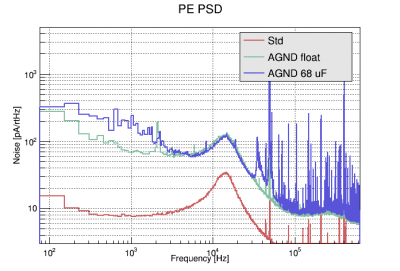
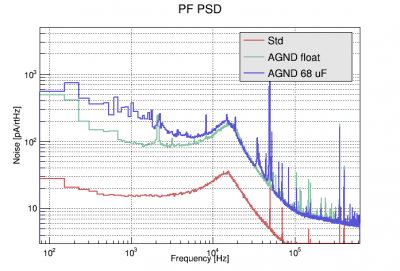
1) With the connection between DCRC analog grounds and the ebox (star-ground) interrupted by disconnecting copper sheets on the switchboards which connect the dsub connector shell to the switchboard ground planes. This should leave the 2 dcrc analog grounds, HVboard ground, and detector cable ground shields connected to each-other, but isolated from the fridge chassis (and building ground).
2) The above broken ground plane connections were bridged on each board with identical 68 uF capacitors. The hope was that the capacitor and ~hundred Ohm stripline resistances would each form a high pass filter with knee frequency at 1/(2*pi*R*C) ~ 20 Hz. The idea being that frequencies in the signal range would be passed through as usual, but ~DC components would be blocked.
The plots below show that the tests were not promising. As expected, breaking the ground plane increased the noise substantially, but including the coupling capacitor did not improve things. In fact, the capacitors worsened the signal-region noise and introduced a number of additional large noise sources at discrete frequencies.
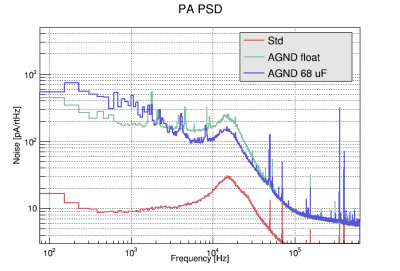 | 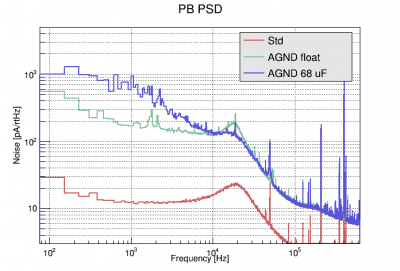 |
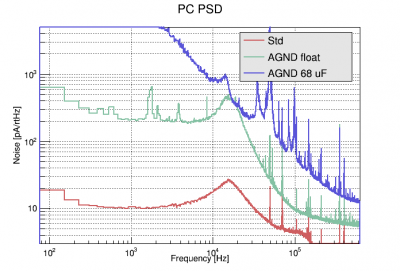 | 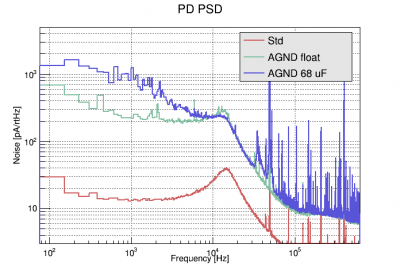 |
 |  |
Finally, introducing the capacitor may have inadvertently damaged one of the SQUIDs. As can be seen above, and documented here, PC displayed atrocious noise with the capacitor in place. This was irregular, jagged noise at the SQUID level which was only present once the SQUID was biased. Despite repeated zapping and re-tuning on different DCRCs, it was too noisy to operate. At the time of writing, the SQUID card as not yet been thoroughly checked electrically.