Crosstalk
Crosstalk between adjacent channels was observed in the data. Cross talk can come from 2 mechanisms: 2 channels measuring the same drifting charges due to overlapping Ramo potentials, or capacitive coupling between channel electrodes.
| Figure 1 | |
|---|---|
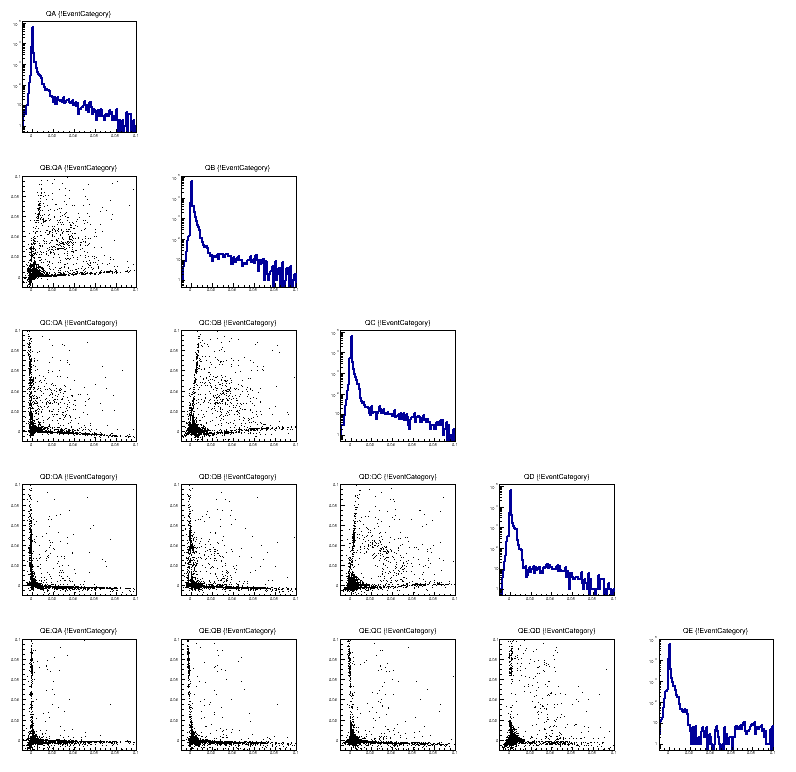 | 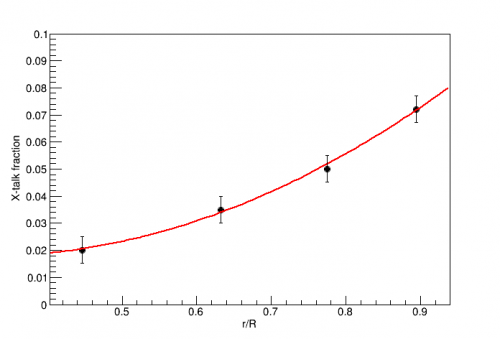 |
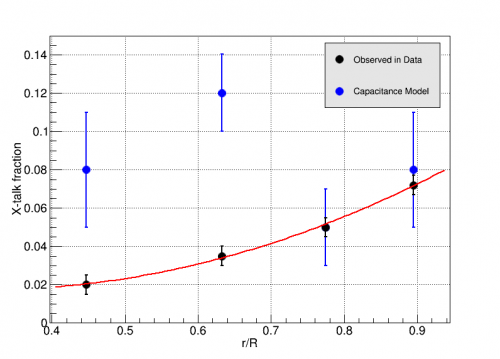
| The above matrix of plots compares the amplitudes of each pair of charge channels using the dataset 07171019_1703. The channels are largely independent (no shorts) Neighboring channels have more cross-talk while separated channels have little to no cross talk. Furthermore, the amount of cross-talk between neighboring channels increases as inter-channel radius squared. This indicates the cross-talk is likely due to Ramo potential overlap as opposed to capacitance between electrodes which would grow linearly with radius. |
|
Capacitance Measurements
One way to determine the expected size of electronic crosstalk is to measure the capacitance between channels. Unfortunately, this is not a straightforward task as there is a network of relevant capacitances between the channels, the bias electrode, and ground. This is shown in figure 2 below. All measurements were performed on the detector in its housing without side coaxes, thus the absence of coupling capacitors in this diagram.
| Figure 2 |
|---|
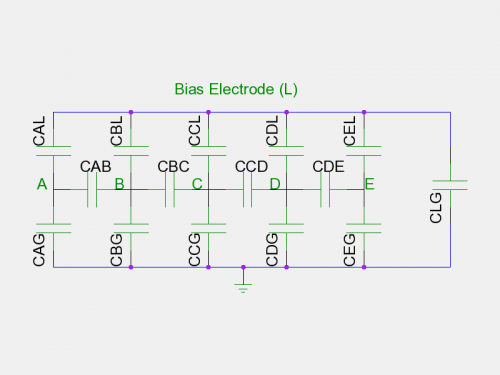 |
| S1502 capacitance network. The capacitance between e.g. channels A and B is labelled CAB, that between A and the bias electrode is CAL, and that between A and ground is CAG. |
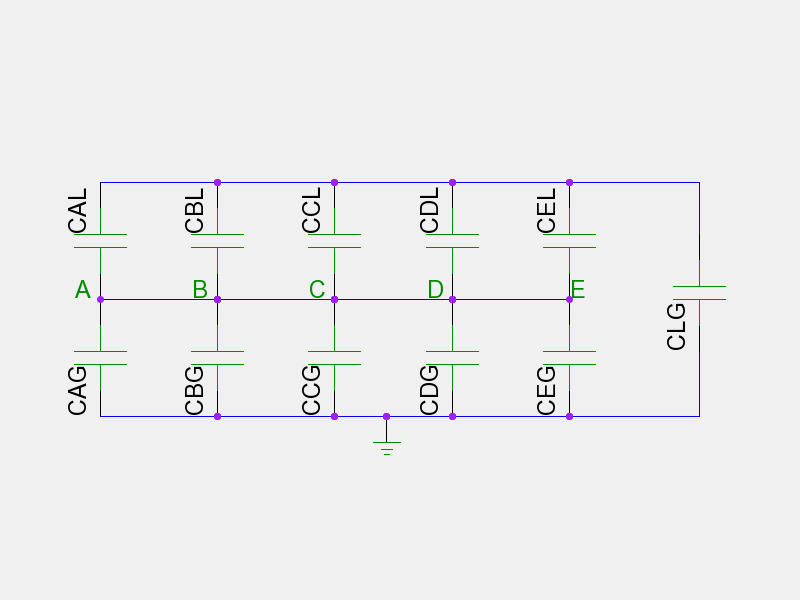
To measure the inter-channel capacitances, we first measure the total channel capacitance to ground and the electrode by shorting all the channels together as shown in figure 3. This is effectively 3 capacitors in series, the total channel capacitance to ground, CTG = CAG + CBG + CCG + CDG + CEG, the total capacitance to the electrode, CTL = CAL + CBL + CCL + CDL + CEL, and the electrode to ground capacitance, CLG. However, a measurement across any of these capacitors also includes the other two. All measurements below were performed with an HP4275A LRC meter. In particular the measurement from the total channels to ground, MTG, is
MTG = CTG + CLG*CTL/(CLG+CTL) = 171.29 pF
Similarly, the measurement from channels to electrode, MTL, and from electrode to ground, MLG, are
MTL = CTL + CLG*CTG/(CLG+CTG) = 157.90 pF
MLG = CLG + CTG*CTL/(CTG+CTL) = 131.50 pF
| Figure 3 |
|---|
 |
It turns out that this is a hard problem to invert. The most straightforward method to extract the true capacitances from the measurements was to use chisquared minimization to fit the measured values using the true capacitances as parameters. This returned the following values:
CTL = 111.6 pF
CTG = 127.4 pF
CLG = 72.2 pF
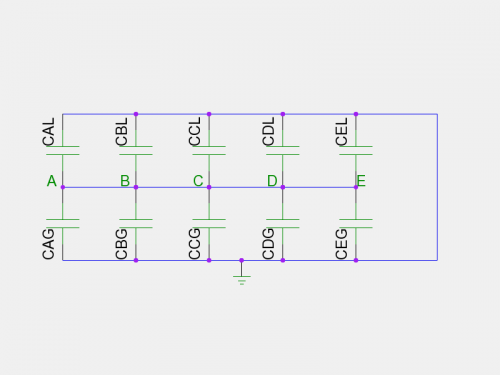
As a consistency check, we also measured the capacitance of the circuit shown in figure 4, which now has the electrode shorted to ground. This yields the total channel capacitance to ground and the electrode, CTG + CTL = 244.04 pF. This agrees within 2% of the sum of the fit values above (CTG + CLG = 239.0 pF.)
| Figure 4 |
|---|
 |
This means that the average channel capacitances to electrode and ground are measured to be
C{chan→L} = 22.3 pF
C{chan→G} = 25.5 pF
Note, however, that this is in conflict with the naive calculation of parallel plate channel→electrode capacitance which yields ~8 pF.
To measure the inter-channel capacitance, we then made a series of other measurements with everything shorted together except a single channel. Examples of these circuits are shown in figure 5. This measurement should give the total capacitance of a single channel to everything else (other channels, electrode, and ground.)
| Figure 5 | |
|---|---|
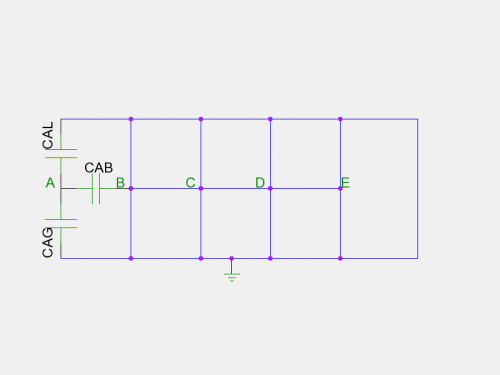 | 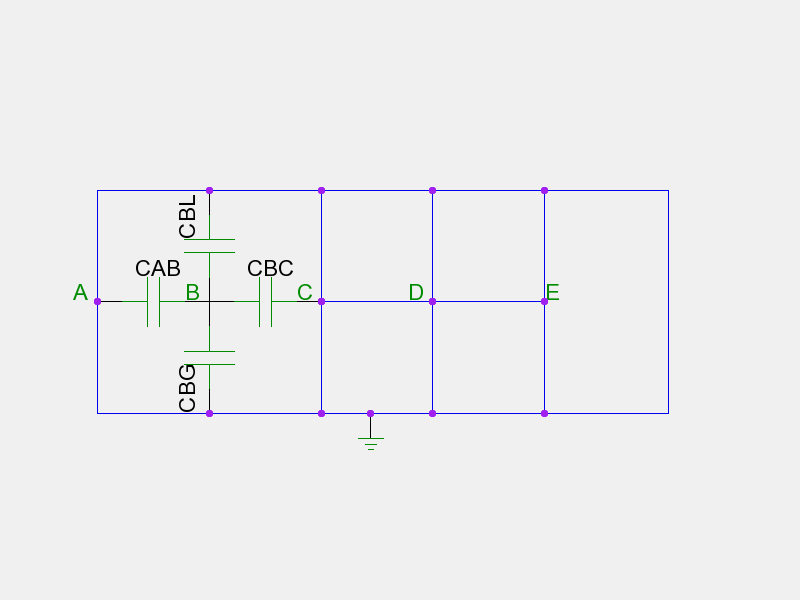 |
The measurements yielded the following:
| Measurement | Value (pF) | Theoretical Value |
|---|---|---|
| A → others | 80.57 | CAG + CAL + CAB |
| B → others | 93.91* | CBG + CBL + CAB + CBC |
| C → others | 116.44 | CCG + CCL + CBC + CCD |
| D → others | 123.32 | CDG + CDL + CCD + CDE |
| E → others | 80.70 | CEG + CEL + CDE |
*This connection was somewhat dodgy
Using these values and assuming the average channel capacitance to ground + electrode is 47.8 pF, the following inter-channel capacitances are obtained
| CAB | 26.4 ± 9.0 pF |
|---|---|
| CBC | 19.7 ± 9.0 pF |
| CCD | 50.0 ± 9.0 pF |
| CDE | 26.6 ± 9.0 pF |
Crosstalk Model
To figure out how much crosstalk this capacitance should produce, we must consider the measurement circuits of two channels, coupled by their interchannel capacitance. This is shown for channels A and B in figure 6 below.
| Figure 6 |
|---|
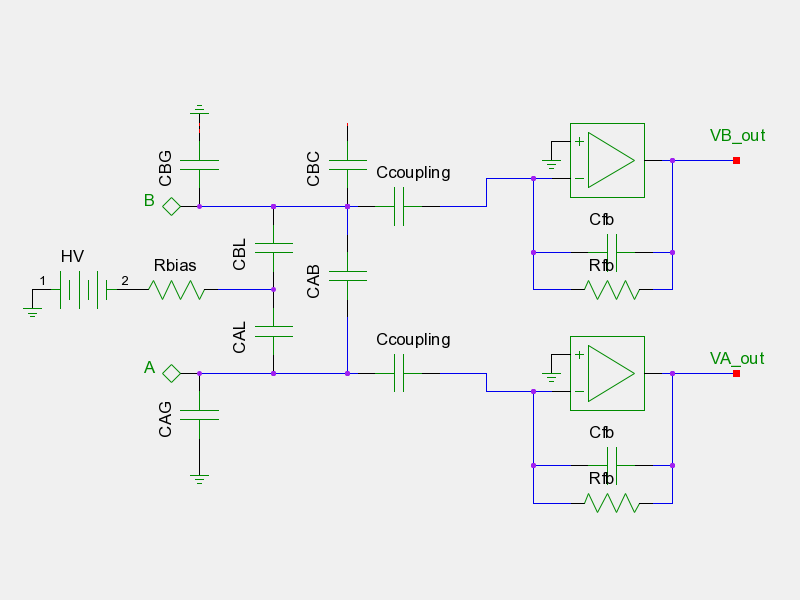 |
When an event occurs under channel A, the amount of image charge equal to that liberated by the event in the crystal must accumulate on channel A's electrode. In principle, this is supplied entirely by channel A's coupling capacitor and is all seen by A's amplifier. In practice, the channel to ground and interchannel capacitances present provide some fraction of this charge. Note that the electrode cannot provide any charge on the the time scale of the event because the 10MΩ bias resistor and channel→electrode capacitance give that branch a time constant of ~200 μs. This leaves channel A's coupling capacitor with the fraction Ccoupling/(Ccoupling+CAG+CAB) ~ 0.9 of the total event charge. Likewise, the fraction CAB/(Ccoupling+CAG+CAB) is induced on the channel B electrode, of which the fraction Ccoupling/(Ccoupling+CBG+CAB+CBC) is seen by its amplifier. The ratio of signal measured on channel B to that on A for an event under A (i.e. the fraction of crosstalk) will then be CAB/(Ccoupling+CBG+CAB+CBC). Note that really, the inter-channel capacitance should be in series with the other capacitance to ground and other coupling capacitance, but it is a small correction. A similar calculation can be done for the cross talk between the other pairs of channels. Using the values measured above, these formulae give the following values for cross-talk fraction as expected from measured capacitances:
| Channels | Expected crosstalk fraction |
|---|---|
| AB | 0.08 ± 0.03 |
| BC | 0.05 ± 0.02 |
| CD | 0.12 ± 0.02 |
| DE | 0.08 ± 0.03 |
Finally, these are compared to the observed level of crosstalk in the detector. The crosstalk fraction in data was determined by the slope of the e.g. QA vs QB graphs as shown in Figure 1 above. The crosstalk level calculated here is in agreement with those observed between the outer channels A and B as well as channels B and C. At lower radius, the measured capacitances predict higher crosstalk than is observed. These discrepancies may be the result of the assumption that all channels have the same capacitances to ground and to the electrode. There is also currently no effort made to include the error associated with the best-fit values calculated for the total channel to ground and total channel to electrode capacitances.
| Figure 7 |
|---|
 |