2021/08/19 (Thursday)
- Lab in-personnel: Giulia and Matt
| Status | Run 74 in progress. First cooldown after IVC rebuild. |
|---|---|
| Tower thermometer is reading high, probably this is a thermometer problem and the actual temperature is much lower. High noise in some of the charge channels. | |
| Setup: DIB1/2+acc → SL 41/43 → 3.2 MHz filters → cables 2/3 → nothing/Source_mover_board+HV_diverter_board → DCRC50(3)/55(1). Kepco 40V supplye → HV BNC. Lead shield erected, 4 walls. Currently both DCRCs are on. | |
| Position of Am source: y = 0.0 mm | |
| 0734 | Use Sequencer script r74_takeandflash_dcrcbias.msl |
| This data did not write. Why not? The sequencer should have turned the Logger on before taking data, then should have turned it off again. hmm, I also screwed up by not setting the initial randoms. I don't think that should have caused it not to write though. |
|
| 0820 | Tower = 137 mK |
| 0847 | Start test data series using Sequencer script r74_takeandflash_dcrcbias.msl for 2 minutes at 0V. This time it looks like it's writing data. So what happened? lame |
| 0913 | Start 45 min series of 10V/0V (bias applied after 60 sec), with 1000 beginning randoms, trigger threshold 150/50/50/250 on DCRC3qI/qO/DCRC1qI/qO, 5Hz in-run randoms, with 1.6384 ms pulses (8192 length) and 400 us prepulse (500 length). Use Sequencer script r74_takeandflash_dcrcbias.msl. This flashes for 30 seconds at end of series. |
| 0920 | Tower = 174 mK, cooling slowly after last flash at 08:49. |
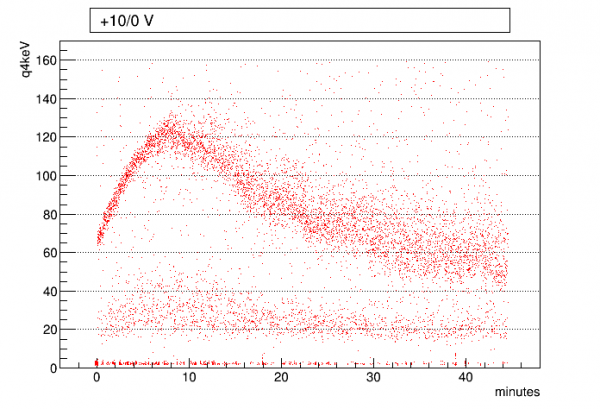 |
| 07210819_0913 |
| 1020 | Tower/MC/Coldplate = 160.7/38.25/183 mK, Still = 1.28 K / 0.095 mbar / 0 mW, G1/G2= 290.8/264.7 mbar, 1K Pot = 1.59 K / 20±1 mbar. MB = 72.0%. |
|---|---|
| The values above were recorded 20 minutes after the flash was applied. | |
| 1035 | Fill LN2 cold bath. |
| 1040 | At 10kHz noise in DCRC3qI/qO/DCRC1qI/qO = 24/3.2/3.1/73 8e-6. This is q3/q1/q4/q2 At 3kHz (peak) noise in DCRC3qI/qO/DCRC1qI/qO = 258/40/82/840 e-6. |
| Noise is considerably higher than yesterday. | |
| We'll try data at high-temperature again. | |
| 1100 | Turn MC heater on to 600 μW |
| 1150 | Tower/MC have settled at 863/953 mK |
| 1150 | Start 45 min series of 10V/0V (bias applied after 60 sec), at elevated temperature, with 1000 beginning randoms, trigger threshold 120/40/45/250 on DCRC3qI/qO/DCRC1qI/qO, 5Hz in-run randoms, with 1.6384 ms pulses (8192 length) and 400 us prepulse (500 length). Use Sequencer script r74_takeandflash_dcrcbias.msl. This flashes for 30 seconds at end of series. |
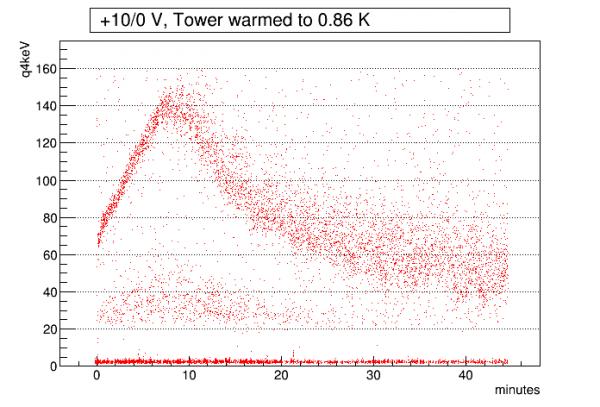 |
| 07210819_1150. Looks like impact ionization gets stronger at this elevated temperature. But - we should check again at base temperature, it could be that the detctor changed “state” again |
| 1315 | Turn off MC heater |
|---|---|
| 1420 | Tower has cooled back to base, ~ 187 mK |
| 1430 | Start 45 min series of 10V/0V (bias applied after 60 sec), with 1000 beginning randoms, trigger threshold 120/40/50/300 on DCRC3qI/qO/DCRC1qI/qO, 5Hz in-run randoms, with 1.6384 ms pulses (8192 length) and 400 us prepulse (500 length). Use Sequencer script r74_takeandflash_dcrcbias.msl. This flashes for 30 seconds at end of series. |
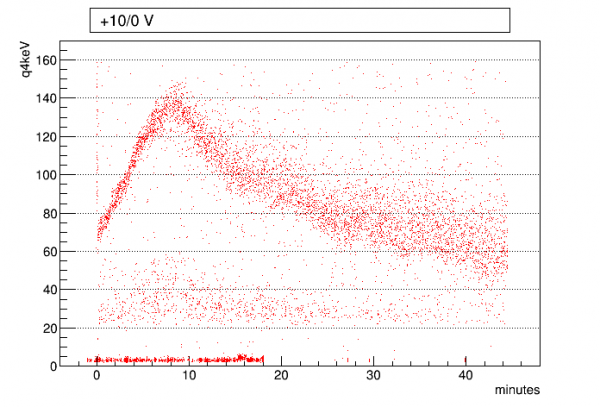 |
| 07210819_1430. Back at base temperature it still looks like the stronger impact ionization we saw at 0.86 K. looks like the detector changed “state” again. So, twice when taking data at elevated temperature we have induced a change of state. |
| Let's try a series where we start at +10/0V, then 15 minutes in we'll try applying -8 V to Side2 with the kepco voltage supply. The hypothesis is that the falloff in 60keV amplitude that we always see from ~ 10 minutes onward is caused by space charge buildup producing a counter bias that mostly cancels the applied bias. Will applying extra bias to Side2 restore the amplitude? | |
| 1640 | Start 45 min series of +10V/0V, then +10V/-8V (first bias applied after 60 sec, then wait 15 min, then second bias), with 1000 beginning randoms, trigger threshold 80/50/50/120 on DCRC3qI/qO/DCRC1qI/qO, 5Hz in-run randoms, with 1.6384 ms pulses (8192 length) and 400 us prepulse (500 length). Use Sequencer script r74_takeandflash_dcrcbias.msl. This flashes for 30 seconds at end of series. |
| 1645 | Note: noise and temperature are both lower now. Tower = 112 mK |
| 1700 | Looking at pulse viewer after applying Side2 bias, we saw breakdown noise. This has continued for a few minutes. We'll bring the Side2 bias back down. |
| 1702 | Close to 6.0 minutes after applying Side2 bias, reduce Side2 bias to -4V. Now the breakdown noise is gone and pulses are back. |
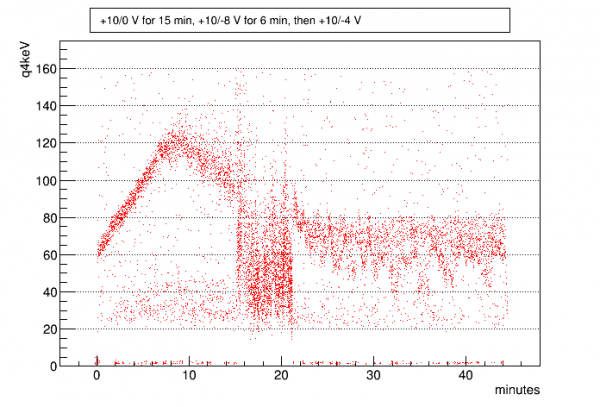 |
| 07210819_1640 |