2021/06/24 (Thursday)
- Lab in-personnel: Scott, Matt, Derek
| Status | Run 74 in progress. First cooldown after IVC rebuild. |
|---|---|
| Tower thermometer is reading high, probably this is a thermometer problem and the actual temperature is much lower. High noise in some of the charge channels. | |
| Setup: DIB1/2+acc → SL 41/43 → 3.2 MHz filters → cables 2/3 → nothing/Source_mover_board+HV_diverter_board → DCRC50(3)/55(1). Kepco 40V supplye → HV BNC. No lead/poly shield. | |
| 1120 | Attempted to fill LN2 cold trap bath. Started flowing and had normal condensation/freezing around copper pipe then noticed copper pipe thawing. Observed no flow. Close valve. Will troubleshoot after meeting. (The Dewar was just empty - mf). |
| 1130 | Tower/MC/Coldplate = 85.6/30.6 (H35)/194.7 mK, Still = 1.39 K / 0.080 mbar / 0 mW, G1/G2= 204.0/197.3 mbar, 1K Pot = 1.64 K / 24±2 mbar. MB= 66.7% |
| We have been moving the source mover, it seems to be working but we don't have any evidence yet that it's moving. Assuming that it is working correctly, we've moved it far enough that it should have already hit the near endstop but it doesn't seem to have done so, so we may be heading in the opposite direction toward the far endstop. We need to move it another 11.91 mm to reach the far endstop. | |
| Let's try another move but increase the driver bias from the 7.2 V we've been doing the last few days to 8.0 V, which is what we used in Run 73, and presumably what was used when viewing waveforms on 2020 Oct 28. Back then the voltage across the trim pot was significantly higher than we are seeing now. | |
| 1443 | Increase source mover driver bias from 7.2 to 8.0 V on the GwINSTEK power supply |
| 1444 | Do mv +128 with dwell = 40. MC rises quickly above 200 mK, then keeps rising. Waveforms start out with V_trimpot = 1V peak-to-peak, which is what it was at the previous bias. But later in the move they increase to 1.8 V pp. Then at the end they rose to 4.0 Vpp. strange - why would the current increase like this? Kinda makes me wonder whether we've hit an endstop and jammed… but checking with the multimeter this seems not to be the case. Note: on 2020 Oct 28, Vtrimpot was more like 6 Vpp. But were we hooked up in the same way? Dunno. 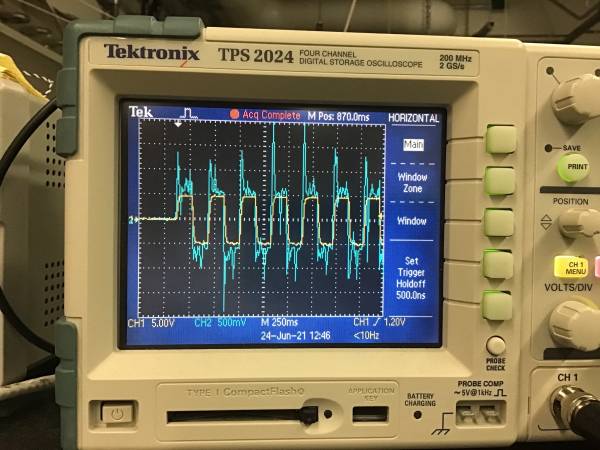 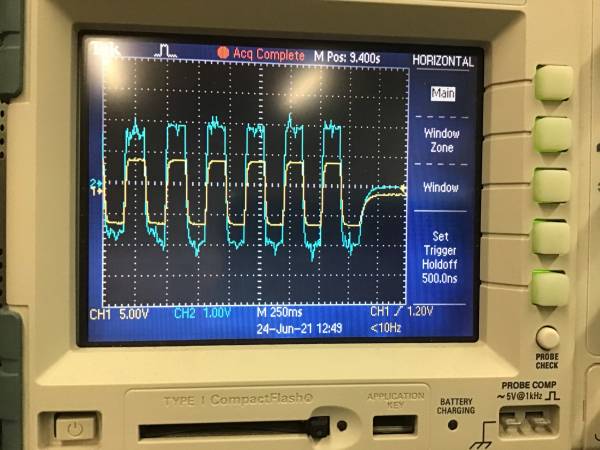 |
| 1446 | MC peaks at 495 mK. Tower = 2.73 K and falling. |
| These are higher than before, maybe due to the higher bias. | |
| Check endstop-to-chassis, still reading <0.2 nS for both near- and far-endstops. | |
| 1521 | MC = 40 mK and cooling slowly. Tower = 0.30 K and cooling. |
| let's try a short move and see what the waveforms look like. | |
| 1524 | Do mv +8 with dwell = 40. MC rises quickly to 86 mK, then falls. V_trimpot = 1.2 Vpp, similar to the beginning of the last pulse train. So maybe the increasing current has to do with rising temperature? |
| 1524 | MC peaks at 86 mK. Tower = 0.91 K and falling. |
| 1600 | Power down DCRC55 and disconnect source mover diverter board to study it, to further interpret what we see on the scope. Found out that I'm actually measuring voltage across the coil, not across the trim pot. But, should be essentially the same result. I measured the resistances of the coils and the trim pots: |
| Coil | Trim pot | ||
|---|---|---|---|
| Motor A | 55 Ω | 95 Ω | |
| Motor B | 17 Ω | 113 Ω | this seems to be the one I've been measuring |
| so as we can see above we can expect the Vpp across the coil (what I've been reading) to be only 0.15 times the Vpp across the trim pot (what we read before). This agrees with the Vpp difference we're seeing: 6 Vpp before, 1 Vpp now. OK good, that makes sense. | |
| 1620 | Reconnect Cable 3 to source mover board, but leave it disconnected from the HV board and DCRC. Reconnect wires to motor driver board. Reconnect scope leads but this time Channel 2 is reading Vtrimpot. |
| 1625 | MC = 30.8 mK. Tower = 0.14 K and cooling. |
| 1630 | Do mv +8 with dwell = 40. MC rises quickly to 83 mK, then falls. V_trimpot = 7.8 Vpp. Now we are actually reading across the trimpot rather than the coil. And indeed, before we saw 0.15 times this, consistent with the difference in resistance measurements. 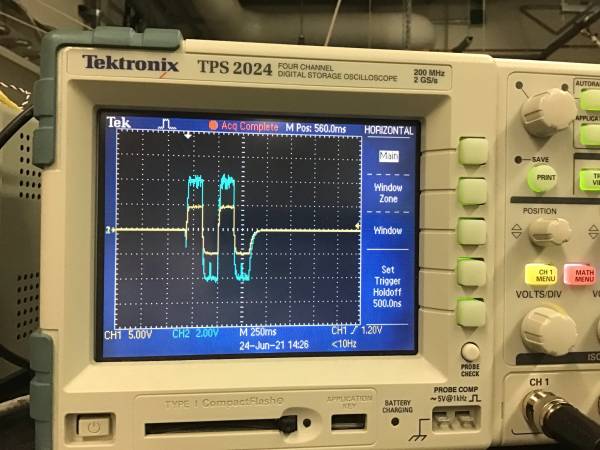 |
| Vdriver = 10V pp. Vtrimpot = 7.8 Vpp. Rtrimpot = 113 Ω. So current = 69 mApp. | |
| 1630 | MC peaks at 83 mK. Tower = 0.90 K and falling. |
| 1643 | MC = 39.1 mK. Tower = 0.31 K and cooling. |
| 1645 | Do mv +128 with dwell = 40. MC rises quickly above 200 mK, then keeps rising. Waveforms start out with V_trimpot = 7.8 V peak-to-peak, but end up at 6.0 Vpp. It occurs to me that I saw before a pattern in the temperatures that repeated every 1 full rotation, suggesting that at one angular position of the shaft there's greater resistance than at others - so maybe we're seeing that pattern now in the currents. |
| 1646 | MC peaks at 495 mK. Tower = 2.70 K and falling. |
| Looking at the differences between the 7.2 V driver bias and the 8.0 V, the Vdriver increases from 8.5V to 10V. And we see that we get more heating with the higher bias… so probably the ideal setting is the lowest bias possible so that we still have 100% step efficiency. Don't know what that is really, if we get to an endstop we can try to experiment. | |
| 1734 | MC = 33.4 mK. Tower = 0.22 K and cooling. |
| 1735 | Do mv +128 with dwell = 40. MC rises quickly above 200 mK, then keeps rising. Waveforms start out with V_trimpot = 8.0 V peak-to-peak, but end up at 6.0 Vpp again. Pretty similar to last time so maybe it has more to do with temperature. (But pattern is opposite to the first 128-step move today.) |
| 1736 | MC peaks at 484 mK. Tower = 2.26 K and falling. |
| Now it's theoretically 5.31 mm more to reach the far endstop. 2 more +128-step moves, then some smaller moves should get us there. |