2020/09/21 (Monday)
- Lab in-person: Zach
- Virtual partner: Matt, Michael
| Setup | Run 73. DIB 1/3/4 → Stripline 43/48/41 → pi-filters 1/2/3 → Cable 3/1/2 → nothing/nothing/accessory_interposer → HV_Conn 1/3/2 → HV 1/2 → DCRCX(4)/DCRC55(1)-master; DCRC33(2) → HV control. DCRCs on. Lead/poly shield erected (4 lead walls, 2 poly walls). |
|---|---|
| 0830 | MB = 29.2%. Bath predicted to hit 20% at 14:33 |
Main bath boiloff rate is good. After a partial warmup and short pumpout of the cryostat vacuum jacket, the boiloff rate had increased, and further pumpouts while still cold improved it partially but not completely. Now, after an overnight near-room-temperature pumpout, it's back to normal.
| 80%-20% boiloff time [hours] | |
|---|---|
| early Run 73 | 40.3 |
| after partial warmup | 34.1 |
| after pumping CVJ 2 days | 37.1 |
| another 1 day | 37.25 |
| after full warmup | 40.6 |
| 0910 | Tower = 64.9 mK, slowly cooling |
|---|---|
| 0915 | Several channels are railed. Let's zap again. |
| 0915 | Zap DCRC1&4 SQUIDs. |
| 1120 | Perform IbIs at current Tower temperature = 64.6 mK. Choose optimal-ish QET biases, trying to make all dP/dI approximately equal across channels. |
| 1150 | Check Threshold=8 for DCRC1pD trigger - looks fine. Even Threshold=6 looks ok. Could be that there's less spiky noise / oscillations at this temperature. |
| 1205 | Start a 60 min series at HV = 0V, CDMS detector: Driver Gains = 1x, DCRC4/1 QET biases = (0,210,240,0)/(0,265,240,275)uA, Front-End Gains = (3/3/3)/(5/5/5) 1000 BOR & 5 Hz in-run randoms, trigger on DCRC1pD threshold = 8 Use sequence SimpleDataLoopNoFlash.msl |
| Note: I didn't bother to adjust the offsets, should do that next time. | |
| 1205 | Tower = 64.6 mK |
| 1205 | Tower = 64.4 mK. Temperature fell steadily during series. |
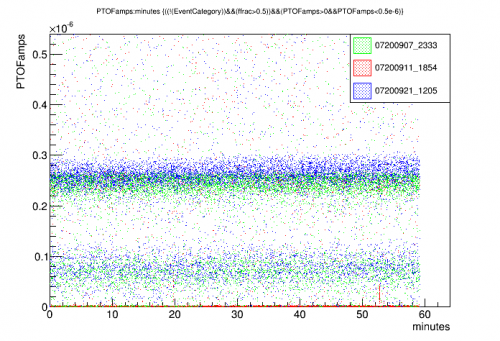 | 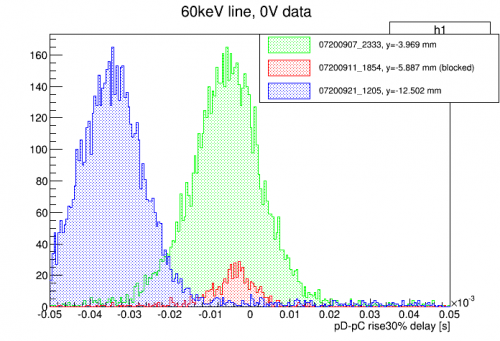 |
| Gain looks good c/w previous 0V data | This is the first data at this source position |
| Compared noise width to earlier data, when temperature was still around 50 mK. Very similar: 329 eV now, 324 eV then. | |
| 1230 | MB = 21.8% |
|---|---|
| 1240 | Zach body temp = 98.4 |
| 1300 | Zach arrives at lab. |
| 1305 | Tower/MC/Coldplate = 64.4/32.3/195 mK, Still = 1.49 K / 0.120 mbar / 0 mW, G1/G2= 146/158 mbar, 1K Pot = 1.68 K / 24±2 mbar. |
| 1323 | Begin LHe transfer @ MB = 20.8% |
| 1341 | Filled LN2 cold trap bath. |
| 1357 | Ended LHe transfer @ MB = 90.9% |
| 1416 | MB = 90.8% |
| 1435 | Tower = 66.3 mK and cooling. It rose to over 100 mK after the end of the transfer. |
| 1525 | Tower = 65.3 mK, rising at the moment. Didn't cool to quite as low as before the transfer. |
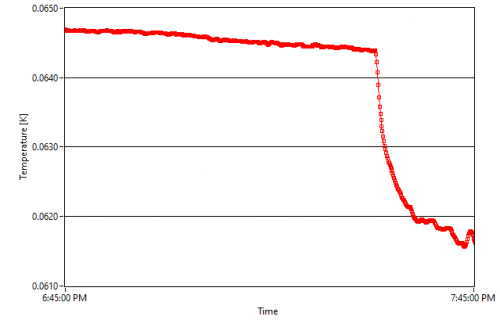
| 1535 | Tower temperature starts going on excursions for no discernible reason. Falls suddenly from by 2 mK, oscillates about 0.5 mK peak-to-peak for several minutes, then a sudden rise of about 4 mK, then after 10 minutes a 1 mK drop. |
| 1605 | Tower = 65.5 mK. Stable for a few minutes but now starting another excursion… |
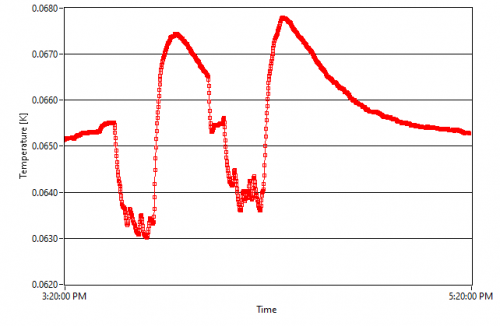 |
Note the quasi-periodic behavior. Went through two cycles, but maybe it's calming down now. Sadly this looks like a helium films phenomenon.
| 1740 | Another temperature excursion starts, bleah. |
|---|---|
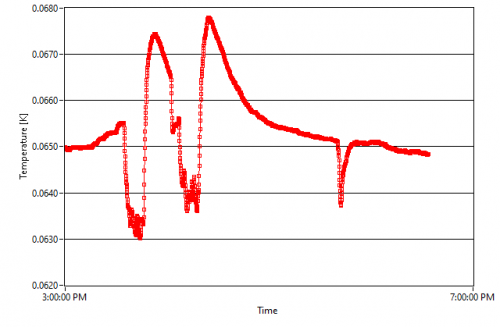
| 1835 | Maybe it's more stable now: |
| 1845 | Start a 60 min series at HV = +100V, drifting 0.0280 V/s, prebias 15% for 2min, CDMS detector: Driver Gains = 1x, DCRC4/1 QET biases = (0,210,240,0)/(0,265,240,275)uA, Front-End Gains = (3/3/3)/(5/5/5) 1000 BOR & 5 Hz in-run randoms, trigger on DCRC1pD threshold = 8 Use RootSequencer.c, function drift_sequence(100,0.0280) |
|---|---|
| oops - copied a drift rate for -100V data, that may be too fast for +100V | |
| 1845 | Tower = 64.7 mK |
| 1845 | Vtest = 3.0 mV shortly after drift begins. Drift appears to start at 106.2 V. 1.1% HV loss. |
| 1930 | Temperature excursion: sudden drop from 64.4 mK to below 63 mK. Well, the 1st 45 minutes of data is relatively stable. |
| 1945 | Drift ends, no apparent lag. Vtest = 4.8 mV. HV at end of drift looks like 206.3 V, indicating 0.93% HV loss |
 |
|
| later look at data shows Lag Ratio = 0.997 |
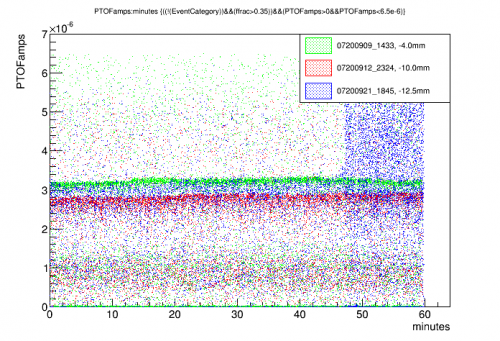 | 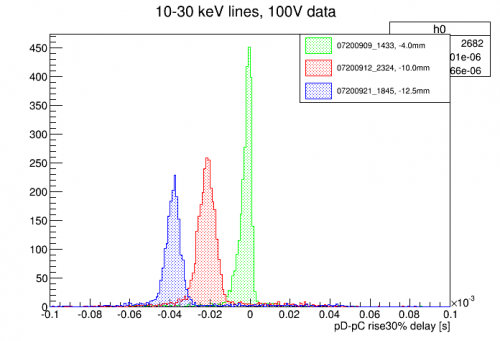 |
| Definitely see something change with the temperature excursion, otherwise looks OK | Nice position resolution in y-delay |