2020/08/03 (Monday)
- Lab in-person: Zach
- Virtual partner: Matt
| Setup | Run 73. DIB 1/3/4 → Stripline 43/48/41 → pi-filters 1/2/3 → Cable 3/1/2 → nothing/nothing/accessory_interposer → HV_Conn 1/3/2 → HV 1/2 → DCRCX(4)/DCRC55(1)-master; DCRC33(2) → HV control. DCRCs on overnight. Lead/poly shield erected (4 lead walls, 2 poly walls). |
|---|---|
| 1045 | Zach Williams body temperature = 98.6 |
| 1045 | MB = 70.0% |
| 1100 | Zach enters lab. |
| 1105 | Tower/MC/Coldplate = 51.6/34.4/192 mK, Still = 1.50 K / 0.18 mbar / 5 mW, G1/G2= 453/409 mbar, 1K Pot = 1.64 K / 26±2 mbar. |
| 1111 | Begin filling LN2 cold traps. |
| 1119 | Finished filling LN2 cold traps. |
| 1120 | Zach leaves lab. |
| 1550 | Take IbIs for all channels. |
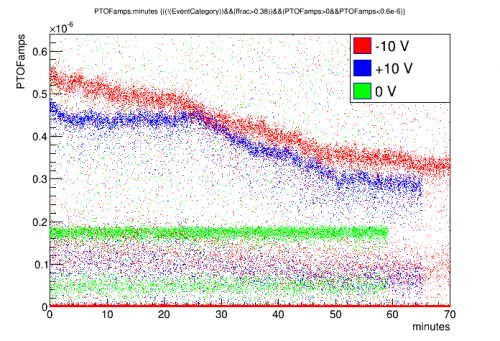
| 1610 | Write a new sequence for -10V drifted data. From yesterday's data it looks like we need a higher drift rate at negative bias. HVdrift_neg10V_23p9mVps_multiloop10_nopre_60min.msl |
| 1614 | Start a 60 min series at HV = -10V, drifting -0.0239 V/s, no prebias, CDMS detector: Driver Gains = 1x, DCRC4/1 QET biases = (0,320,370,0)/(0,360,420,420) uA, Front-End Gains = (3/3/3)/(5/5/5) 1000 BOR randoms, trigger on DCRC1pD threshold = 8 Use sequence HVdrift_neg10V_23p9mVps_multiloop10_nopre_60min.msl |
| 1615 | Tower = 51.7 mK |
| 1615 | Vtest = -0.5 mV, shortly after beginning of drift |
| 1630 | Zach Williams body temperature = 98.6 |
| 1725 | Vtest = -3.3 mV, HV = -95.0 V, drift ends. Lag ratio = 71/60 = 1.18, laggier than it should be. |
| Looking closely at the HV slope on the display, it seems that at around 17:00 it started drifting more slowly. Which unfortunately means that the change in gain in the second half of the series will be hard to interpret. | |
| More precisely: before around 16:48, actual drift rate was 21.5 mV/s, close to what is expected with the usual lag rate (21.7 mV/s). After 16:48, the average actual drift rate was close to 17.5 mV/s. |
| 1845 | MB = 59.6% |
|---|---|
| 1910 | Write new sequence to drift at -5V, using the faster drift rate that was used for -10V and seemed to work well. HVdrift_neg5V_23p9mVps_multiloop10_nopre_60min.msl |
| but will this be correct? Back on July 29 we did -5V drifting at 21.4 mV/s and that worked pretty well. Hmm… | |
| Let's try -10V again, see if we can get a constant lag rate this time | |
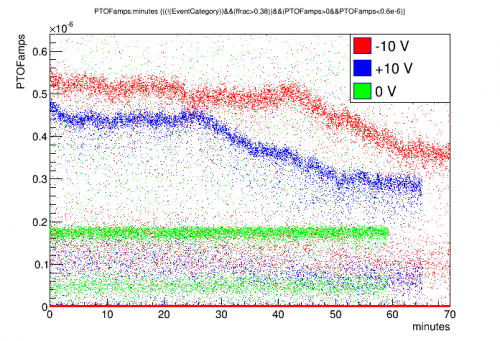
| 1947 | Start a 60 min series at HV = -10V, drifting -0.0239 V/s, no prebias, CDMS detector: Driver Gains = 1x, DCRC4/1 QET biases = (0,320,370,0)/(0,360,420,420) uA, Front-End Gains = (3/3/3)/(5/5/5) 1000 BOR randoms, trigger on DCRC1pD threshold = 8 Use sequence HVdrift_neg10V_23p9mVps_multiloop10_nopre_60min.msl |
| 1947 | Tower = 51.9 mK |
| 1949 | Vtest = -0.45 mV, shortly after beginning of drift |
| 2103 | Vtest = -3.0 mV, HV = -95.0 V, drift ends. Overall Lag ratio = 76/60 = 1.27, even laggier than last time! |
| This time it looks like it was slow till about 20:48, then got faster. | |
| More precisely: before around 20:41, actual drift rate was 17.6 mV/s. After 20:41, the average actual drift rate was 21.6 mV/s, close to what is expected with the usual lag rate (21.7 mV/s). So it looks like there are two characteristic lag rates, which I guess change back and forth at random times. The good “fast mode” has a lag ratio of 1.11; the bad “slow mode” has a lag ratio of 1.36. That's like a 1-second overhead versus a 3.6-second overhead per 10-second step. |
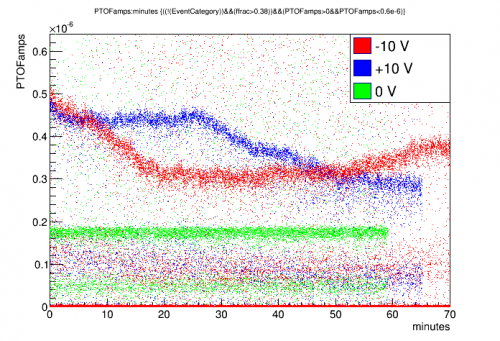
| 2324 | Start a 60 min series at HV = -10V, drifting -0.0239 V/s, no prebias, CDMS detector: Driver Gains = 1x, DCRC4/1 QET biases = (0,320,370,0)/(0,360,420,420) uA, Front-End Gains = (3/3/3)/(5/5/5) 1000 BOR randoms, trigger on DCRC1pD threshold = 8 Use sequence HVdrift_neg10V_23p9mVps_multiloop10_nopre_60min.msl |
|---|---|
| 2325 | Tower = 51.6 mK |
| 2325 | Vtest = -0.5 mV, shortly after beginning of drift |
| cripes, this is another one that started fast then the lag got worse later. | |
| 0039 | Vtest = -3.1 mV, HV = -95.2 V, drift ends. Overall Lag ratio = 75/60 = 1.25, too high. |
| Actually analysis of the rate of HV increase looks different this time. Drift rate starts around 22.0 mV/s (lag ratio 1.09), then gets steadily worse, ending at around 16.0 mV/s (lag ratio 1.49). |