2019/12/12 (Thursday)
| Status | Tower from Run 71 has been removed. |
|---|---|
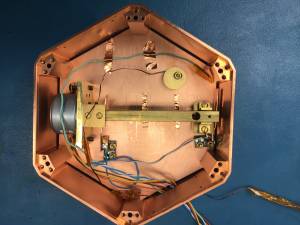
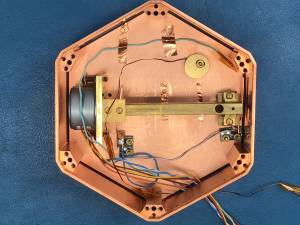
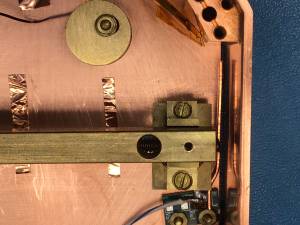
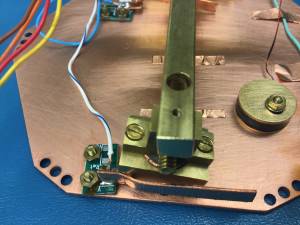
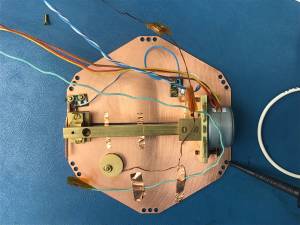
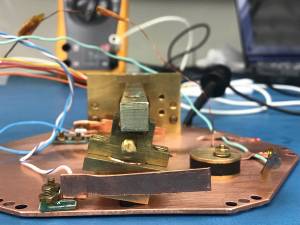
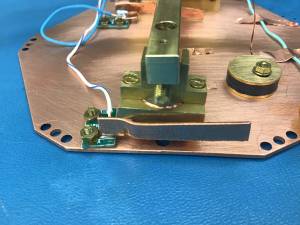
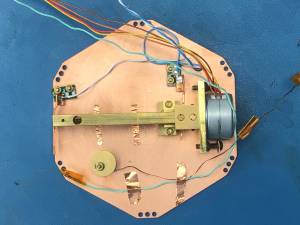
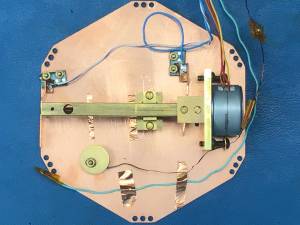
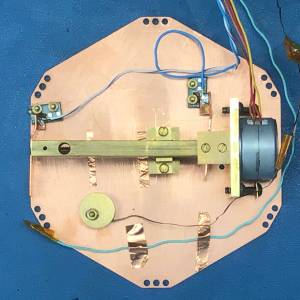
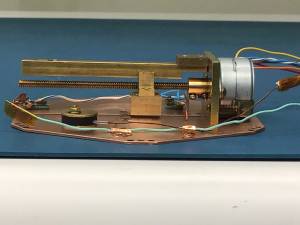
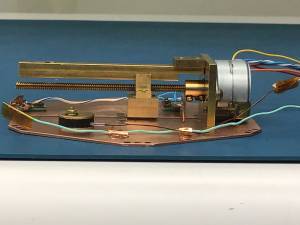
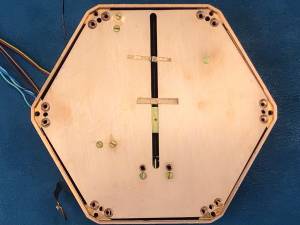
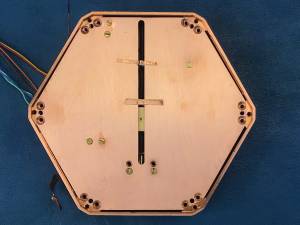
| 1430 | Examine source mover. Actually it doesn’t seem to be jammed on the end stop, even though the one side of the carriage is pushed up over the end stop, making it at an angle. |
| It's at an angle because the guide rail is not aligned with the rod - it's bent to one side a bit. You can move it back and forth a bit with your finger, not much resistance. I think when the source mover warmed up the pressure of the carriage against the endstop pushed the guide rail to the side and pushed the carriage edge up over the endstop. | |
| 1450 | Try to measure the end position of the carriage with respect to the center position with a caliper. But it isn't easy to align. Measure three independent times, get 42.10, 42.26, 42.22 mm. 42.19±0.08 mm. |
| 1500 | Start moving the source by turning the motor shaft at the coupling. The motor shaft turns in clicks - but 1 click does not seem to be equal to 1 step. It is apparently 24 clicks for a full rotation - so 1 click is 2 steps. |
| Moving the source from its final position toward the center, it takes 4 clicks to break contact with the endstop. | |
| 1520 | Count how many clicks it takes between far endstop and center position: 52 full turns + 6 clicks = 52.25±0.04 turns. |
| Note: at the center position the screws on the motor shaft coupling are 1 click away from straight down. When looking down the rod at the motor, it's one click to the right (counterclockwise). | |
| So final position to center, according to turns, is 52.375±0.04 turns = 41.57±0.03 mm. This is not consistent with the caliper measurement - the caliper measurement was 0.62 mm longer, which is like 7 error bars difference. Later: I made a mark on the base plate 0.5 inches from the center line, then moved the source exactly 16 full turns from the center - it lined up exactly with the new line. So it seems that 32 turns/inch is reliable. I will assume the caliper measurement was inaccurate. |
|
| 1530 | Count how many clicks it takes between center position and near endstop: 16 full turns + 14 clicks = 16.583±0.04 turns. |
| 1535 | Try turning the motor the additional 56 steps past the first contact with the near endstop that we thought it went during the run. It's not too difficult to turn it another 2 full turns (96 steps). Nothing unusual happens in terms of parts getting wedged onto other parts, but there's significantly more torque needed to turn the carriage in either direction. Probably just because the carriage is being forced at a bit of an angle with the threaded rod. So it makes some sense that it got stuck simply for this reason, not because the screws wedged onto the endstop or something (they do get close, but it would take more turns for that to happen). |
| 1630 | Measure width of carriage (along the direction of motion): 0.5 inches. Measure distance from center point to where the motor holder plate is screwed to the base plate: close to 30 mm. |